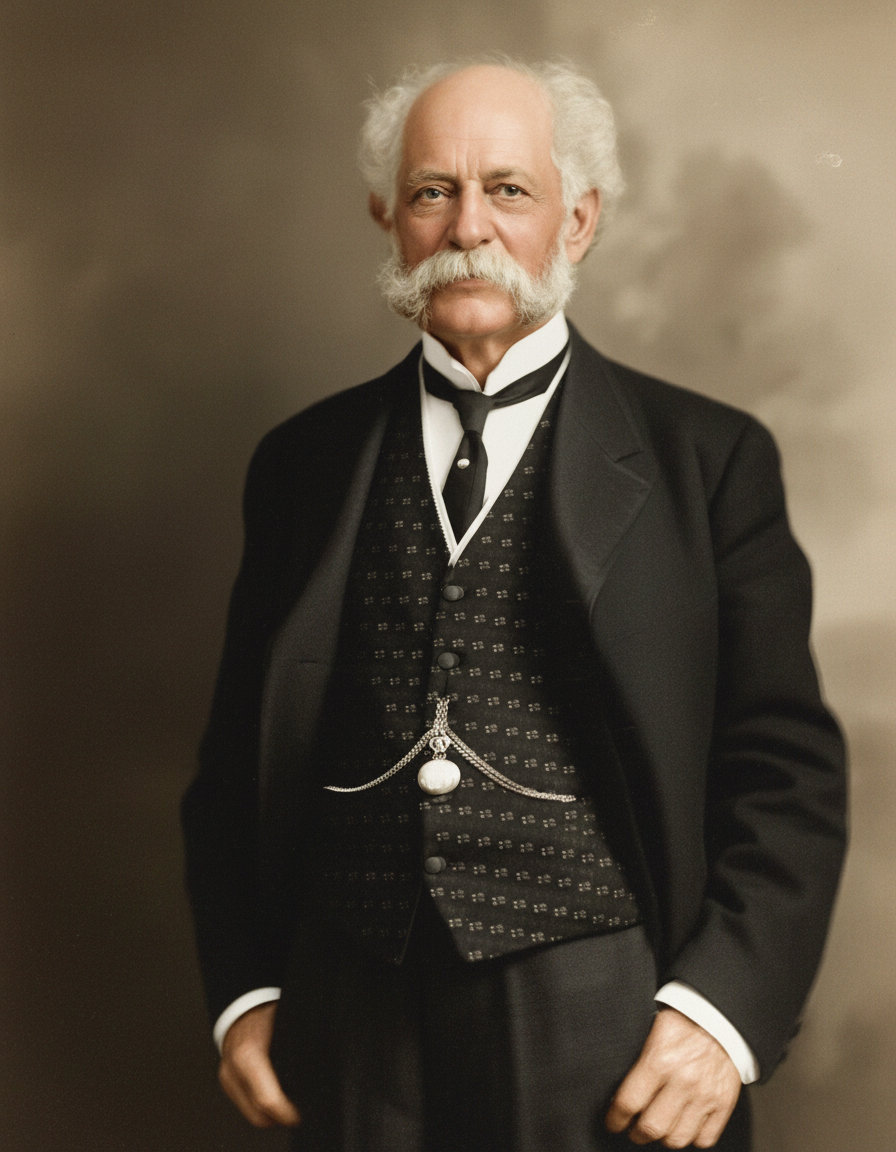
Eiichi Shibusawa
The institutional architect of modern Japanese capitalism who synthesized corporate enterprise with civic ethics.
Eiichi Shibusawa was the foundational architect of Japan's modern market economy during the Meiji and Taisho eras. Moving from Tokugawa samurai status to Vice Minister of Finance, and subsequently into private enterprise, he introduced the joint-stock corporate structure to Japan. Shibusawa founded or co-founded over 500 commercial enterprises—including Japan's first modern bank, stock exchange, and major industrial conglomerates—alongside 600 civic and educational institutions, anchored by his philosophy of harmonizing Confucian ethics with commercial profit.
Biography
Accomplishments
- 01Established Dai-Ichi Kokuritsu Ginko (First National Bank, now Mizuho Bank) in 1873, creating Japan's first commercial joint-stock banking institution.
- 02Drafted and implemented the National Bank Act of 1872 during his tenure in the Ministry of Finance, establishing a unified modern banking regime.
- 03Founded or catalyzed over 500 major commercial ventures, including the Tokyo Stock Exchange, Oji Paper, Tokyo Gas, Imperial Hotel, Sapporo Breweries, and Nippon Yusen.
- 04Formed Osaka Spinning Mill (Osaka Boseki, later Toyobo) in 1882, proving that modern steam-powered, continuous-operation textile factories could compete globally.
- 05Founded the Tokyo Chamber of Commerce and Industry in 1878, establishing structured private-sector dialogue with the government.
- 06Endowed and governed over 600 educational, philanthropic, and international diplomacy institutions, including Hitotsubashi University and Tokyo Imperial University's hospital facilities.
Lessons for Operators
Key Takeaways
Practical lessons distilled for operators, investors, C-levels, and capital allocators.
The Analects and the Abacus (Rongo to Soroban)
Sustainable enterprise requires integrating ethical responsibility (the Analects) with disciplined financial accounting and return generation (the abacus); neither can succeed in isolation.
Distributed Equity vs. Dynastic Conglomeration
Shibusawa avoided assembling a zaibatsu family monopoly, opting instead to seed companies as independent joint-stock firms, distributing ownership across multiple commercial participants.
Catalytic Capital Allocation
Rather than seeking permanent operational control, he served as a founder-catalyst: seeding capital, establishing governance, installing competent management, and deploying balance-sheet capacity to the next developmental bottleneck.
Systems-Level Market Design
He recognized that downstream industries require upstream foundations: modern textile mills required reliable domestic power, corporate paper supplies, sea shipping routes, and formal financial clearing.
Frameworks & Principles
Named frameworks and strategic principles they popularized or embodied.
The Moral-Commercial Equilibrium (Gapponshugi)
An economic doctrine that business should be organized around the pooling of capital and human talent from society to serve public welfare rather than dynastic enrichment, evaluating ventures simultaneously on return on capital and net benefit to national infrastructure.
When to useApply when formulating long-term corporate governance models, public-private partnerships, sovereign wealth strategies, or evaluating mission-driven enterprise defensibility.
Bottleneck-Driven Industrial Seeding
A strategic investment heuristic where capital is methodically deployed to identify and resolve systemic chokepoints in an emerging market (e.g., banking -> stock exchange -> paper manufacturing -> steam logistics -> power generation).
When to useUse when entering frontier markets, deploying venture ecosystems, or scaling foundational infrastructure where downstream demand cannot materialize without upstream operational platforms.
Sources & Further Reading
Profiles, interviews, podcasts, and articles used to compile and verify this entry. Each link opens at the original publisher.
Explore Related Titans
Other figures in the archive who share Eiichi Shibusawa's domain, geography, or era.
More in Finance & Investing










From Japan




Contemporaries — 19th century