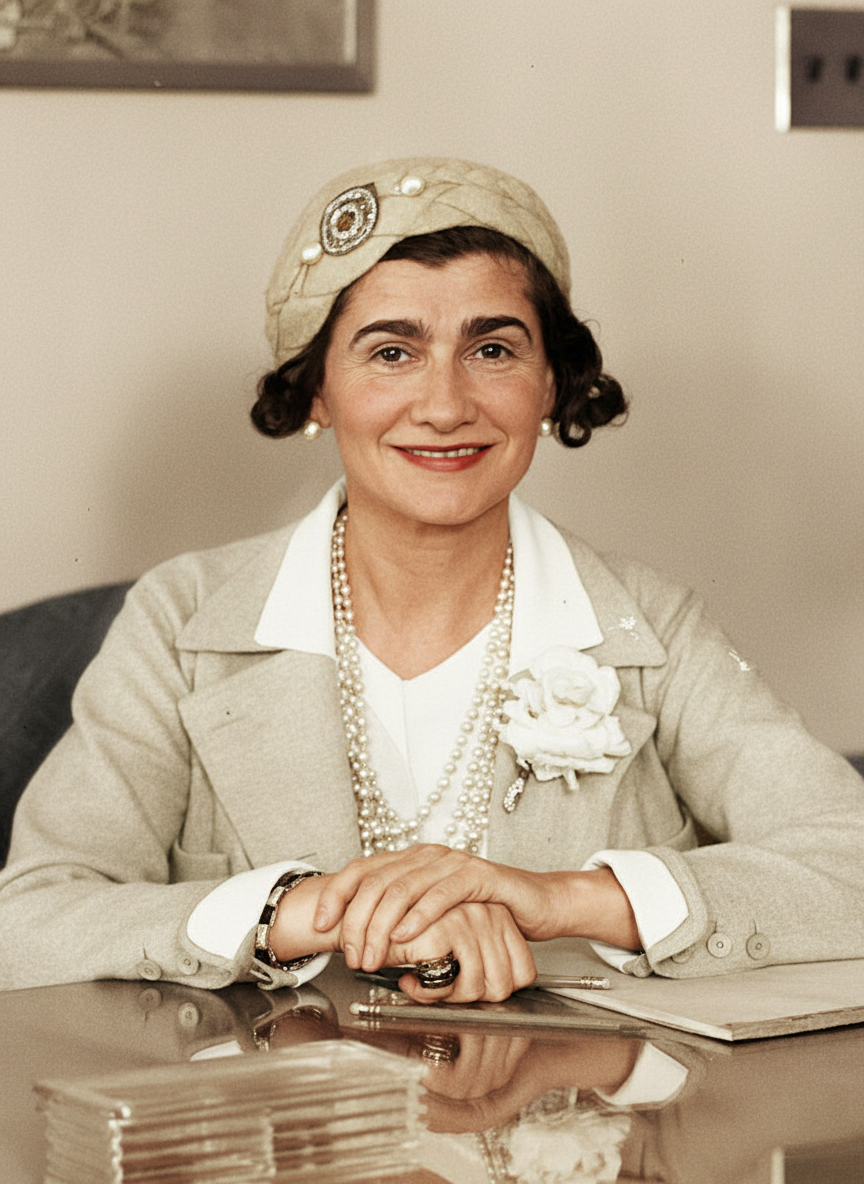
Coco Chanel
The architect of modern female fashion, transforming haute couture into an empire of timeless style and aspirational luxury.
Gabrielle Bonheur 'Coco' Chanel revolutionized women's fashion by liberating it from corsetry and elaborate ornamentation. Beginning with a millinery shop in 1910, she built a global luxury brand, known for its iconic 'little black dress,' Chanel No. 5 perfume, and tailored tweed suits, establishing enduring principles of elegance and practical luxury.
Biography
Accomplishments
- 01Founded her first millinery shop in 1910, quickly expanding to Deauville and Biarritz to introduce innovative sportswear.
- 02Launched Chanel No. 5 in 1921, creating the world's most iconic and enduring fragrance, revolutionizing the perfume industry by linking a designer's name to a scent.
- 03Pioneered the 'little black dress' in 1926 (featured in Vogue), making it a staple of modern female wardrobes.
- 04Introduced the modern tweed suit and quilted leather handbags (1955), establishing silhouettes and accessories that remain central to the brand's identity.
- 05Successfully reopened her fashion house in 1954 at age 70, reaffirming her design dominance and adapting to post-war aesthetics.
- 06Built a global luxury brand based on distinct codes of style, transforming the perception and accessibility of haute couture.
Lessons for Operators
Key Takeaways
Practical lessons distilled for operators, investors, C-levels, and capital allocators.
Visionary Product-Market Fit
Chanel identified a critical societal shift – women's increasing independence – and designed products (comfortable sportswear, practical dresses) that perfectly aligned with this evolving demand. Operators should meticulously analyze societal trends to inform product development and market entry strategies.
Strategic Capital Allocation & Partnership
Her decision to partner with the Wertheimers for her perfume line, exchanging equity for distribution and manufacturing prowess, illustrates a pragmatic approach to scaling. Investors should evaluate founders' ability to leverage external resources and form partnerships that enhance core competencies, even if it means diluting ownership for exponential growth.
Brand Archetype & Durability
Chanel created a timeless aesthetic and a strong brand narrative around liberation, simplicity, and understated luxury. This clarity of purpose allowed the brand to endure political shifts, economic downturns, and changes in fashion trends. Enterprise leaders must invest in defining and consistently communicating their brand's core values to foster long-term resilience.
Diversification for Longevity
Moving beyond couture into perfumes provided a high-margin, scalable product line that underpinned the financial stability of the entire enterprise. Fund managers should look for businesses with diversified revenue streams and product portfolios that can weather market fluctuations and provide multiple growth vectors.
Reinvention and Relevance
Chanel's successful comeback in her seventies, adapting her classic designs for a new generation while staying true to her core principles, exemplifies the importance of continuous innovation and market responsiveness. C-levels must foster a culture of perpetual learning and adaptation within their organizations to avoid obsolescence.
The Power of Scarcity and Aspiration
Despite her democratic approach to fashion, Chanel maintained an aura of exclusivity and aspiration around her brand. This ability to balance accessibility with desirability is crucial for luxury and premium segments. Capital allocators should assess a brand's capacity to command premium pricing through perceived value and unique positioning.
Frameworks & Principles
Named frameworks and strategic principles they popularized or embodied.
The 'Chanel Chic' Principle (Product-Market Fit)
Focus on creating products that are not just fashionable but deeply address an unmet need or evolving societal trend (e.g., comfort and practicality for women). Simplicity and elegance are functional assets.
When to useDuring product development, market entry analysis, or when evaluating opportunities to disrupt existing categories by offering a fundamentally better (simpler, more functional) solution.
The 'Wertheimer Play' (Strategic Partnership for Scale)
Identify critical gaps in your operational capabilities (e.g., manufacturing, distribution, capital) and seek strategic partnerships, even if it means ceding significant equity, to unlock exponential growth and market penetration that would otherwise be unattainable.
When to useWhen scaling a promising product, entering new markets, or facing resource constraints that limit growth potential. Applicable to fundraising, joint ventures, or licensing agreements.
The 'Little Black Dress' Strategy (Iconic Brand Element)
Develop one or more universally recognizable and enduring product/brand elements that become synonymous with your brand's core identity. These icons build lasting brand equity and simplify purchase decisions.
When to useDuring brand strategy development, product portfolio planning, and marketing campaign design to ensure consistency and reinforce core brand messages. Focus on creating 'signature' offerings.
The 'Reinvention Arc' (Post-Crisis Resurgence)
After a period of dormancy, decline, or significant market shift, analyze core brand DNA and adapt it slightly to resonate with contemporary tastes while retaining foundational principles. A successful comeback leverages heritage with renewed relevance.
When to useWhen considering a brand refresh, re-entry into a saturated market, or leading a turnaround strategy for an established but struggling enterprise.
Sources & Further Reading
Profiles, interviews, podcasts, and articles used to compile and verify this entry. Each link opens at the original publisher.
Explore Related Titans
Other figures in the archive who share Coco Chanel's domain, geography, or era.
More in Consumer & Retail




From France







Contemporaries — 19th century