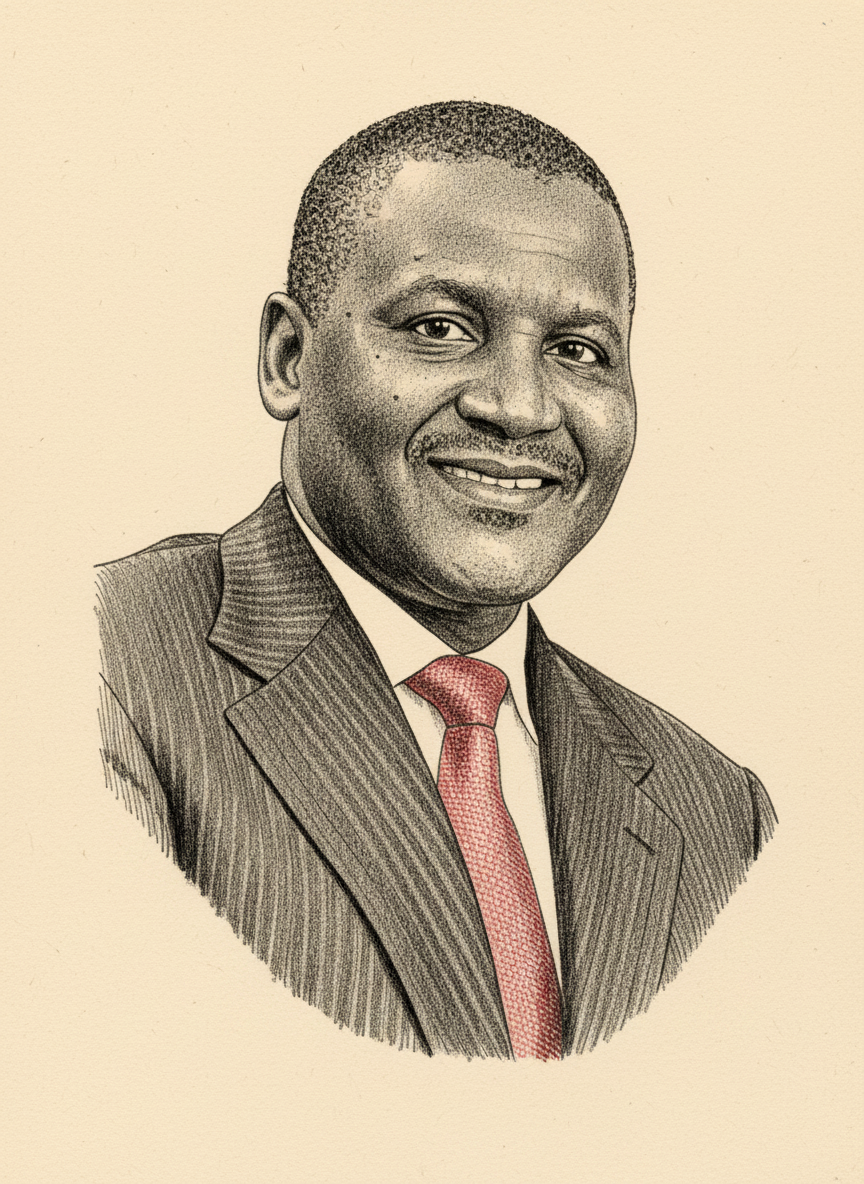
Aliko Dangote
Aliko Dangote: The architect of Africa's largest industrial conglomerate, transforming local resources into global-scale enterprises across cement, sugar, refining, and petrochemicals.
Aliko Dangote is a Nigerian businessman and philanthropist who founded the Dangote Group, West Africa's largest industrial conglomerate. As of August 2023, he is the wealthiest individual in Africa and the wealthiest black individual globally, with a net worth exceeding US$35.1 billion. His strategic vision has been instrumental in driving import substitution and industrialization across Nigeria and the African continent, notably through cement production, sugar refining, and the recently commissioned Dangote Refinery.
Biography
Accomplishments
- 01Established and scaled Dangote Cement Plc into Africa's largest cement producer, significantly reducing Nigeria's reliance on cement imports and driving infrastructure development.
- 02Founded the Dangote Group, transforming it from a commodities trading firm into a diversified industrial conglomerate with operations across cement, sugar, flour, salt, beverages, and petrochemicals.
- 03Developed and commissioned the Dangote Refinery and Petrochemical Complex, Africa's largest single-train refinery, designed to meet Nigeria's entire fuel needs and export surpluses, representing a $20 billion investment.
- 04Achieved status as the wealthiest individual in Africa, the wealthiest black individual globally, and the 66th wealthiest person worldwide, with a net worth over US$35.1 billion (as of August 2023).
- 05Implemented backward integration strategies across core businesses, such as sugarcane cultivation for sugar refineries and limestone quarrying for cement production, ensuring local value addition and supply chain resilience.
- 06Appointed as a member of Nigeria's economic management team by President Goodluck Jonathan in 2011, reflecting his influence on national economic policy.
- 07Spearheaded job creation and economic empowerment through the Dangote Group, which is one of the largest employers in Nigeria and across several African nations.
- 08Leveraged local raw materials to build industrial capacity, demonstrating a scalable model for industrialization in emerging markets.
Lessons for Operators
Key Takeaways
Practical lessons distilled for operators, investors, C-levels, and capital allocators.
Industrialization through Import Substitution
Dangote's core strategy has been to replace imported essential goods with locally produced alternatives. This not only creates domestic industries and jobs but also saves foreign exchange, fosters national self-reliance, and builds intrinsic economic value. Operators should assess major import categories in their target markets for opportunities.
Scale as a Competitive Advantage
By investing in large-scale production facilities, Dangote achieves significant economies of scale. This allows for lower per-unit costs, higher profitability, and the ability to outcompete smaller players. Investors should evaluate a company's capacity to achieve and sustain scale in its chosen market.
Resilience in Emerging Markets
Operating in markets with fluctuating currencies, political instability, and infrastructure deficits requires significant resilience and strategic foresight. Dangote's ability to complete multi-billion dollar projects in such environments demonstrates the importance of robust project management, risk mitigation, and long-term commitment. Enterprise leaders must factor in these complexities and develop adaptable strategies.
Strategic Vertical Integration
Owning significant parts of the supply chain, from raw material extraction to distribution, provides control over costs, quality, and supply. This strategy makes businesses less vulnerable to external shocks and supplier dependencies, offering a powerful playbook for capital allocators evaluating business models.
Impact Investing for Economic Development
Dangote's ventures often align with national development goals, such as energy independence (refinery) or infrastructure (cement). This creates a symbiotic relationship with governments and fosters a conducive operating environment. Fund managers looking for sustainable, impactful investments should consider ventures that address critical national needs.
Leveraging Local Resources for Global Ambition
Dangote consistently leverages Africa's abundant natural resources to build globally competitive industries. This approach turns local advantages into economic powerhouses. Operators should audit local resource availability and consider how they can be processed and scaled domestically.
Diversification Around Core Competencies
While diverse, Dangote's businesses often share logistical networks, customer bases, or raw material synergies. This controlled diversification spreads risk while building upon established strengths. C-levels should evaluate how new ventures can leverage existing assets and expertise.
Long-Term Bet on Africa's Growth
Despite challenges, Dangote has consistently made substantial, long-term investments across Africa, signaling strong confidence in the continent's demographic and economic potential. This perspective is critical for investors and enterprise leaders considering market entry or expansion in African markets.
Frameworks & Principles
Named frameworks and strategic principles they popularized or embodied.
Backward Integration Model
A strategy where a company gains control over its raw materials or intermediate inputs by acquiring or developing its suppliers. Dangote's cement business, for instance, owns limestone quarries, and the sugar refineries include sugarcane plantations.
When to useApplicable when supply chain reliability is critical, raw material costs are volatile, quality control is paramount, or there is an opportunity to capture additional value within the production process. Ideal for industries relying on specific natural resources or bulk commodities.
Import Substitution Industrialization (ISI)
An economic theory employed by developing countries to reduce foreign dependency through local production of industrialized products. Dangote's entire empire is built on replacing imported cement, sugar, flour, and now refined petroleum products.
When to useRelevant for businesses operating in economies with significant import bills for essential goods, abundant local raw materials, and government support for domestic manufacturing. It aims to foster national self-sufficiency and economic growth.
Economies of Scale
The cost advantages that enterprises obtain due to their scale of operation, with cost per unit of output generally decreasing with increasing scale. Dangote's massive cement plants and refinery exemplify this, allowing him to produce at lower per-unit costs.
When to useCritical for industries with high fixed costs (e.g., manufacturing, infrastructure) where increased production volume spreads these costs over more units, leading to higher margins and competitive pricing. It's a key consideration for investment in capital-intensive sectors.
Conglomerate Diversification
A business strategy where a company acquires or establishes businesses in unrelated industries. While Dangote's businesses often share some synergies (e.g., logistics), they span different sectors like cement, food, and energy, forming a diversified conglomerate.
When to useUseful for spreading risk across multiple industries, leveraging strong cash flows from mature businesses to fund growth in new ventures, or capturing opportunities in emerging markets with broad development needs. Requires strong central management and capital allocation.
Infrastructure-Led Growth
A development strategy focusing on large-scale investments in essential infrastructure (e.g., cement for roads and buildings, refined fuels for transportation and power) to stimulate broader economic activity and national development.
When to useApplicable for long-term investments in developing economies where fundamental infrastructure gaps exist, and there is a clear demand for basic commodities that facilitate industrial and societal progress. Often involves significant capital and a long return horizon.
Recent Appearances
Latest interviews, keynotes, and press from the past half year.
 youtube.com
 youtube.com
 youtube.com
 youtube.com
 youtube.com
 youtube.com
 youtube.com
 youtube.com
 youtube.com
 youtube.com
 youtube.com
 youtube.com
 youtube.com
 youtube.com
 youtube.com
 youtube.com
 youtube.com
 youtube.com
 youtube.com
 youtube.com
 youtube.com
 youtube.com
 youtube.com
 youtube.com
 youtube.com
 youtube.com
 youtube.com
 youtube.com
 youtube.com
 youtube.com
 youtube.com
 youtube.com
 youtube.com
 youtube.com
 youtube.com
 youtube.com
 youtube.com
 youtube.com
 youtube.com
 youtube.com
 youtube.com
 youtube.com
 youtube.com
 youtube.com
 youtube.com
 youtube.com
 youtube.com
 youtube.com
 youtube.com
 youtube.com
 youtube.com
 youtube.com
 youtube.com
 youtube.com
 youtube.com
 youtube.com
 youtube.com
 youtube.com
 youtube.com
 youtube.com
 youtube.com
 youtube.com
 youtube.com
 youtube.com
 youtube.com
 youtube.com
 youtube.com
 youtube.com
 youtube.com
 youtube.com
 youtube.com
 youtube.com
 m.youtube.com
 youtube.com
 youtube.com
 youtube.com
 youtube.com
 youtube.com
 youtube.com
 youtube.com
![Scaling. A masterclass. [8/10] - YouTube](https://i.ytimg.com/vi/8HNuiDsJpDY/hqdefault.jpg) youtube.com
youtube.com youtube.com
 youtube.com
 youtube.com
 youtube.com
 youtube.com
 youtube.com
 youtube.com
 youtube.com
 youtube.com
 youtube.com
 youtube.com
 youtube.com
 youtube.com
 youtube.com
 youtube.com
 youtube.com
 youtube.com
 youtube.com
 youtube.com
 youtube.com
 youtube.com
 youtube.com
 youtube.com
 youtube.com
 youtube.com
 youtube.com
 youtube.com
 youtube.com
 youtube.com
 youtube.com
 youtube.com
 youtube.com
 youtube.com
 youtube.com
 youtube.com
 youtube.com
 youtube.com
 youtube.com
 youtube.com
 youtube.com
 youtube.com
 youtube.com
 youtube.com
 youtube.com
 youtube.com
 youtube.com
 youtube.com
 youtube.com
 youtube.com
 youtube.com
 youtube.com
 youtube.com
 youtube.com
 youtube.com
 youtube.com
 youtube.com
 youtube.com
 youtube.com
 youtube.com
 youtube.com
 youtube.com
 youtube.com
 youtube.com
 youtube.com
 youtube.com
 youtube.com
 youtube.com
 youtube.com
 youtube.com
 youtube.com
 youtube.com
 youtube.com
 youtube.com
 youtube.com
 youtube.com
 youtube.com
 youtube.com
 youtube.com
 youtube.com
 youtube.com
 youtube.com
 youtube.com
![[SESSION TWO] Africa Unlocked 2026](https://i.ytimg.com/vi/aAr8m5mTYGo/hqdefault.jpg) youtube.com
youtube.com youtube.com
 youtube.com
 youtube.com
 youtube.com
 youtube.com
 youtube.com
 youtube.com
 youtube.com
 youtube.com
 youtube.com
 youtube.com
 youtube.com
 youtube.com
 youtube.com
 youtube.com
 youtube.com
 youtube.com
 youtube.com
 youtube.com
 youtube.com
 youtube.com
 youtube.com
 youtube.com
 youtube.com
 youtube.com
 youtube.com
 youtube.com
 youtube.com
 youtube.com
 youtube.com
 youtube.com
 youtube.com
 youtube.com
 youtube.com
 youtube.com
 youtube.com
 youtube.com
 youtube.com
 youtube.com
 youtube.com
 youtube.com
 youtube.com
 youtube.com
 youtube.com
 youtube.com
 youtube.com
 youtube.com
 youtube.com
 youtube.com
 youtube.com
 youtube.com
 youtube.com
 youtube.com
 youtube.com
 youtube.com
 youtube.com
 youtube.com
 youtube.com
 youtube.com
 youtube.com
 youtube.com
 youtube.com
 youtube.com
 youtube.com
 youtube.com
 youtube.com
 youtube.com
 youtube.com
 youtube.com
 youtube.com
 youtube.com
 youtube.com
 youtube.com
 youtube.com
 youtube.com
 youtube.com
 youtube.com
 m.youtube.com
 youtube.com
 youtube.com
 youtube.com
 youtube.com
 youtube.com
 youtube.com
 youtube.com
 youtube.com
 youtube.com
 youtube.com
 youtube.com
 youtube.com
 youtube.com
 youtube.com
 youtube.com
 youtube.com
 youtube.com
 youtube.com
 youtube.com
 youtube.com
 youtube.com
 youtube.com
 youtube.com
 youtube.com
 youtube.com
 youtube.com
 m.youtube.com
 youtube.com
 m.youtube.com
 youtube.com
 youtube.com
 m.youtube.com
 youtube.com
 youtu.be
 youtube.com
 youtube.com
 m.youtube.com
 youtube.com
 youtube.com
 youtube.com
 youtube.com
 youtube.com
 youtube.com
 youtube.com
 youtube.com
 youtube.comyoutube.com
 youtube.com
 youtube.com
 youtube.com
 youtube.com
 youtube.com
![[Met Dhabi 2025] Debate: Star x Street - YouTube](https://i.ytimg.com/vi/YvAWKZdw0Ts/hqdefault.jpg) youtube.com
youtube.com youtube.com
 youtube.com
 youtube.com
 youtube.com
 youtube.com
 youtube.com
 youtube.com
 youtube.com
 youtube.com
 youtube.com
 youtube.com
 youtube.com
 youtube.com
 youtube.com
 youtube.com
 m.youtube.com
 youtube.com
 youtube.com
 youtube.com
 youtube.com
 youtube.com
 youtube.com
 youtube.com
 youtube.com
 youtu.be
 youtube.com
 m.youtube.com
 youtube.com
 youtube.com
 youtube.com
 youtube.com
 youtube.com
 youtube.com
 youtube.com
 youtube.com
 youtube.com
 youtube.com
Sources & Further Reading
Profiles, interviews, podcasts, and articles used to compile and verify this entry. Each link opens at the original publisher.
- interviewAfrica's richest man eyes Kenya for new refinery - Financial Timesft.com→
- interviewNigerian billionaire plans refinery expansion part financed by stake ...ft.com→
- interviewHow a vast refinery could mend Nigeria's relationship with oilft.com→
- interviewAfrica's richest man Aliko Dangote plans London listing of cement ...ft.com→
- interviewAfrica should not pick sides in minerals race, says Zambiaft.com→
- interviewNigeria - Latest News and Updates - WSJ.comwsj.com→
- interviewNigeria | Financial Timesft.com→
- interviewMarkets | Financial Timesft.com→
- interviewDangote founder aims to clone refinery to secure global leadspglobal.com→
- interviewAfrica's richest man has ambitious plans for the continenteconomist.com→
- interviewIn an interview with Tell magazine in 2002, Aliko Dangote, Africa's ...facebook.com→
- interviewIn this short interview, Aliko Dangote awakens Nigerian and African ...instagram.com→
- interviewDangote Files to Build Seaport in Next Phase of Empire Expansionbloomberg.com→
- interviewDangote to Sell About 10% of Refinery in IPO Across Africabloomberg.com→
- interviewDangote Adds Another East Africa Site to Build a Mega-Refinerybloomberg.com→
- interviewDangote Ships Fuel to Five Nations After Reaching Full Capacitybloomberg.com→
- interviewDangote Cement to Spend $1 Billion to Boost Capacity by 2030bloomberg.com→
- interviewBillionaire Dangote Pledges $688 Million for Nigerian Educationbloomberg.com→
- interviewNigeria Taps Ex-Dangote Exec to Head Oil Regulator After Tensionbloomberg.com→
- interviewThe World's Black Billionaires 2026 - Forbesforbes.com→
- interviewAfrican billionaire businessman Aliko Dangote has revealed that he ...instagram.com→
- interviewMy first trip to Nigeria.. I interviewed the RICHEST man in Africa ...instagram.com→
- interviewIn an interview with Riddhima Bhatnagar of Business Today, Aliko ...facebook.com→
- interviewHe's the RICHEST MAN in AFRICA I interviewed Aliko Dangote ...instagram.com→
- interviewDangote Plans Pan-African IPO for Continent's Biggest Refinerybloomberg.com→
- interviewNigeria to Meet Union on Dangote Dispute Threatening Oil Shut-inbloomberg.com→
- interviewDangote Said to Seek $50 Billion IPO Valuation for Refinery Armbloomberg.com→
- interviewNews Feed | Financial Timesft.com→
- interviewNews Feed | Financial Timesft.com→
- interviewHe's the RICHEST MAN in AFRICA I interviewed Aliko Dangote in ...facebook.com→
- interviewINTERVIEW: Dangote CEO eyes heavier crude options, new era of ...spglobal.com→
- interviewMy first trip to Nigeria.. I interviewed the RICHEST man in Africa ...instagram.com→
- interviewWe Will Open Africa — A Conversation with Aliko Dangoteifc.org→
- interview“There are more than 10 very good countries in Africa that you can ...facebook.com→
- interviewDangote's Bet: Billionaire Looks to Dominate Oil Refiningbloomberg.com→
- interviewDangote Seeks More Nigerian Crude to Cushion Fuel-Price Gainsbloomberg.com→
- interviewHow a $20bn bet paid off for Africa's richest man - Financial Timesft.com→
- interviewAfrica | Financial Timesft.com→
- interviewNews Feed | Financial Timesft.com→
- podcastAdesina | Podcast on Spotifyopen.spotify.com→
- podcastAliko Dangote: Building Africa's industrial future from the ground uppodcasts.apple.com→
- podcastAliko Dangote: Wie der reichste Mann Afrikas die Wirtschaft beflügeltpodcasts.apple.com→
- podcastThe Shady PHodcast | Podcast on Spotifyopen.spotify.com→
- podcastEike Batista: Golden grifter - Good Bad Billionaire | Podcast on Spotifyopen.spotify.com→
- podcastFatih Birol: Global Energy Under Pressure, Europe's Mistakes and ...open.spotify.com→
- podcast„NZZ“-Kanal - Apple Podcastspodcasts.apple.com→
- podcastLive podcast with Jamie Dimon, CEO JPMorgan Chase - Spotifyopen.spotify.com→
- podcastGrace Ofure explains why she said taking money advice from Aliko ...instagram.com→
- podcastHow I made my first Million dollars in Ghana @drdanielmckorleyinstagram.com→
- podcastAI MAKES the RICH RICHER: Jack Dorsey just fired 4400 hundred ...facebook.com→
- podcastA Billionaire Stay at Home Dads Two Treasures Full Video | TikToktiktok.com→
- podcastOracle dreams of AI, but even with more than $6 billion in profits, it's ...facebook.com→
- podcastOliver Curtis' $6 billion start-up has powerful backers convinced it's ...facebook.com→
- podcastAlok Jain, founder of WeekendInvesting and an IIT Delhi graduate ...facebook.com→
- podcastThe Haitian American - Facebookfacebook.com→
- podcastDavid Grain has officially joined the ranks of the world's billionaires ...facebook.com→
- podcastCELEBRITIES AND THEIR PRODUCTION COMPANIES Hollywood ...facebook.com→
- podcastCELEBRITY BUSINESSES THAT FAILED SPECTACULARLY Even ...facebook.com→
- podcastFRONTPAGE NEWS AND ANALYSIS FOR MARCH ... - Facebookfacebook.com→
- podcastfor folks who have never seen info on Summit's investors: - Facebookfacebook.com→
- podcastTheCityCeleb - Facebookfacebook.com→
- podcastWhy Most People Will Never Become Millionaires. 1 ... - Facebookfacebook.com→
- podcastTimes of Eswatini - Facebookfacebook.com→
- podcastAlumnus Jonathan Hall (TPR '10) has built a successful career in ...facebook.com→
- podcastMC Hammer, once mocked for going broke, has reinvented himself ...facebook.com→
- podcastTiens 7 star recognition celebration - Facebookfacebook.com→
- podcastWhat would you say to learning the business systems used by Alex ...facebook.com→
- podcastMeet Chief Godlove, a Tanzanian self-made millionaire influencer ...facebook.com→
- podcastFormer bottle shop employee Robert Hilmer is just 37 and now ...facebook.com→
- podcastKalau beneran IPO, kira-kira kalian pada ikut gak? #ipo #stock #bei ...tiktok.com→
- podcastNot many times you find highly successful people within our ...instagram.com→
- podcastI think you might like this book – "UNLIMITED OPPORTUNITIES: AN ...facebook.com→
- podcastStarting a whole publishing house just for your book ... - Instagraminstagram.com→
- podcastI'm thrilled, the wait is over, e-book to be available for grabs from the ...instagram.com→
- podcastAt some point, every entrepreneur asks a question they don't always ...facebook.com→
- podcastMeet Modupe Evans-Osi, Ivey PhD candidate | News & Eventsivey.uwo.ca→
- podcast1. Aesthetic business is not the surest path to becoming a billionaire ...instagram.com→
- podcastHow @femiotedola Femi Otedola Reset After ₦220B ... - Instagraminstagram.com→
- podcastReid Hoffman on Entrepreneurial Success: Key Lessons | Startup ...linkedin.com→
- podcastTo build a big business you can scale, you must lean on #Process ...facebook.com→
- podcast“When I was recruiting many of my early founders, the pitch I gave ...facebook.com→
- podcastMasheleng - Facebookfacebook.com→
- podcastScale or fail: Why Africa firms must embrace shared ownershipfacebook.com→
- podcastMINT by EGBANK - Facebookfacebook.com→
- podcastScale or fail: Why Africa firms must embrace shared ownershipfacebook.com→
- podcastLong dismissed as a hedge fund trader who lucked into bitcoin ...facebook.com→
- podcastIndia Leadership Council - Facebookfacebook.com→
- podcastPhoto by Alemtsehay Mebrahtu (@alembeauty141) · May 18, 2026instagram.com→
- podcastSecret Billionaire Marriage Advice in Hindi - TikToktiktok.com→
- podcastMUTARI JAAFARU BELLO - Global Edutech Services | LinkedInng.linkedin.com→
- podcastreal ways startups are using AI in 2025 are Adebowale Banjo, CEO ...facebook.com→
- podcastPeter Thiel a licencié Elon Musk. Mais ...facebook.com→
- podcastProfessor Saras Sarasvathy is retiring from Darden after more than ...facebook.com→
- podcast15 billionaire beliefs for success (practical, copyable) - Facebookfacebook.com→
- podcastWARREN BUFFETT'S 8 RULES THAT BUILT $150 BILLION (Most ...facebook.com→
- podcastUS President's entourage to China includes CEOs of Tesla, Apple ...facebook.com→
- podcastCEO, Illumina The following officials accompanied President Tinubu ...facebook.com→
- podcastSuccess is not accidental - Instagraminstagram.com→
- podcastThe 'Diary of a CEO' host said he invests 95 per cent or more of the ...facebook.com→
- podcastThe secret to elite performance isn't just working harder its removing ...instagram.com→
- podcast"Aliko Dangote wanted to tangibly confirm his immense wealth. He ...tiktok.com→
- podcastEverybody wants big results… but very few are willing to fill their ...instagram.com→
- podcastAliko Dangote wanted to tangibly confirm his immense wealth. He ...facebook.com→
- podcastHe raised $15 million from Goldman Sachs. But that's not the story ...instagram.com→
- podcastAliko Dangote: Building Africa's industrial future from the ground uppodcasts.apple.com→
- podcastHIGHLIGHTS: Aliko Dangote - In Good Company with Nicolai Tangenpodcasts.apple.com→
- podcastAliko Dangote: Building Africa's industrial future from the ground uppodcasts.apple.com→
- podcastBarrel vault: a Nigerian refining giant rises - Apple Podcastspodcasts.apple.com→
- podcastPlaybook with Paul Foh - Apple Podcastspodcasts.apple.com→
- podcastIFC Trendlines | Podcast on Spotifyopen.spotify.com→
- podcastFatih Birol - Executive Director of the International Energy Agencyopen.spotify.com→
- podcastMost people jump into business off vibes. Toby doesn't. Before he ...instagram.com→
- podcastThe Afropolitan Podcast on Instagram: "He said it plainlyinstagram.com→
- podcast“I made my first one million naira when I was in the hood ... - Instagraminstagram.com→
- podcast10 years ago he asked me for financial advice. I told him to believe ...facebook.com→
- podcastI Asked A Self-Made Millionaire How He Got Rich... His Answer Was ...facebook.com→
- podcastMeet Aliko Dangote, the billionaire founder of a $30B empire, and ...instagram.com→
- podcastA Nigerian startup might be building Africa's Anduril. Terra Industries ...instagram.com→
- podcastWe're constantly told Africa is the risky investment. But if one founder ...instagram.com→
- podcast“Hiphop legend, Nas investing in Carry1st showed how far the news ...facebook.com→
- podcastFormer Reagan budget director David Stockman just absolutely ...facebook.com→
- podcastHoward Huang of Orbbec on 2026 Forbes Billionaires list - Facebookfacebook.com→
- podcastGOOD MORNING DOWNTOWN MOBILE! Monday, April 6, 2026 ...facebook.com→
- podcastReal leaders don't beg for praise or medals. **THEY - Facebookfacebook.com→
- podcastGrede is a serial entrepreneur worth a reported $405 million.facebook.com→
- podcastYou Finally Have Money… So Why Do You Still Feel Empty? (Full ...instagram.com→
- podcastReborn From Poverty, He Awakens a Godlike Systemfacebook.com→
- podcastfblifestyle Charles Koch vs Jessica Simpson - Facebookfacebook.com→
- podcastAgomoni Utsav 2025 Celebration Tiens ...facebook.com→
- podcastFounder of microcredit company reaches $800m net worth - Facebookfacebook.com→
- podcastThe $11 BILLION MAN he rejected me 3 months ago but I finally inter...tiktok.com→
- podcastChamath Palihapitiya's Success Advice for Young Entrepreneurstiktok.com→
- podcastSinging Techniques for Intermediate Vocalists - TikToktiktok.com→
- podcastCombinaciones con AZUL PETRÓLEO #modarubentroya ... - TikToktiktok.com→
- podcastPhotos by Lords & Legends Limited (@lordslegendsltd) - Instagraminstagram.com→
- podcastSamuel Oyeniran | Q1 2026✔️ - Instagraminstagram.com→
- podcastThe Stories of 4 Great Businessmen Who Acquired Businesses for $1facebook.com→
- podcastAbout The Pre‑Yum Foundation and R2® The Pre‑Yum ... - Instagraminstagram.com→
- podcastFrom shaping pop culture to fueling tech innovation—Troy Carter is ...facebook.com→
- podcastAprès 6 mois d'absence sur les réseaux sociaux, je suis heureux de ...instagram.com→
- podcastUNLIMITED OPPORTUNITIES - Obeng Darko - Facebookfacebook.com→
- podcastBanking CEO Reveals How He Built a $500M Business ... - Facebookfacebook.com→
- podcastBusiness owners, are you building wealth or just building a job ...facebook.com→
- podcastOne entrepreneur. A continental vision. This ... - Facebookfacebook.com→
- podcastQ: How do you scale your business to go global? A: Start ... - Facebookfacebook.com→
- podcastAbdulsamad Rabiu built his reputation by concentrating ... - Facebookfacebook.com→
- podcastI recently graduated from the Venture Capital Program at ... - Facebookfacebook.com→
- podcastAt 61 years old, South African businessman and Discovery founder ...instagram.com→
- podcastAnduril IPO: A Major Investment Opportunity Ahead! | TikToktiktok.com→
- podcastWe just hit our first milestone! The support for Hylio has ... - Instagraminstagram.com→
- podcastAliko Dangote became Africa's richest person by building around ...instagram.com→
- podcastBillionaire Tech CEOs Discuss Future at Exclusive Round Tabletiktok.com→
- podcastThey Bought A Failing Company… Now It's Worth $14 Billion A ...instagram.com→
- podcastAliko Dangote became Africa's richest person by building around ...instagram.com→
- podcastChamath's Bold Advice for Entrepreneurs: Get the Money | TikToktiktok.com→
- podcastLooking for business inspiration? 'Shoe Dog' by Phil Knight is a must ...instagram.com→
- podcastI just found out that Stephen Bartlett is Nigerian And ... - Facebookfacebook.com→
- podcastPeople always ask what ACTUALLY happens before the cameras ...instagram.com→
- podcastAs we exit 2025, if there's one book I'd recommend, The Diary of a ...instagram.com→
- podcastStephen Blewett, CEO of @MTNGhana, shares two big life lessonsfacebook.com→
- podcastHIGHLIGHTS: Jens Stoltenberg | Podcast on - Spotifyopen.spotify.com→
- podcastAliko Dangote: Wie der reichste Mann Afrikas die Wirtschaft beflügeltpodcasts.apple.com→
- podcastElon Musk: Money, memes and Mars - Good Bad Billionaire - Spotifyopen.spotify.com→
- podcastHow I made my first million. #thatboyclean #millionaire ... - Instagraminstagram.com→
- podcastThe media like to make people h8te me and it's not nice, I'm not just ...instagram.com→
- podcastCatherine Mwangi - Facebookfacebook.com→
- podcastAfrica's richest person Aliko Dangote plans to offer shares in his oil...tiktok.com→
- podcastCapital NOT Talent is Africa's biggest challenge towards building ...instagram.com→
- podcastDon't take it from me ♀️ if you're interested in returning home t...tiktok.com→
- podcastMarnju Tiles - Facebookfacebook.com→
- podcastDans l'épisode #4 du podcast — **"Si tu entreprends, fais-toi payer ...instagram.com→
- podcastIt's all about people. It's about networking and being nice ... - Facebookfacebook.com→
- podcastAgomoni Utsav 2025 Celebration Tiens ...facebook.com→
- podcastYOUNGEST BILLIONAIRES: At 22, three Bay Area high school ...facebook.com→
- podcastBillionaire Ron Carson pulled himself out of poverty by building a ...facebook.com→
- podcastStanChart's Bill Winters sparked a backlash with comments on AI ...tiktok.com→
- podcastUS billionaire Bill Ackman has made a $64.7 billion bid for ... - TikToktiktok.com→
- podcastI was a loyal customer for 4 years. One employee. One bad ...instagram.com→
- podcastGrowing a business isn't just about holding your ground ... - Facebookfacebook.com→
- podcastAkara business is fast selling!!!! I made my first million ... - Instagraminstagram.com→
- podcastFEED YOUR BUSINESS UNTIL IT CAN FEED YOU. There's a ...instagram.com→
- podcastGreat business model to learn from. - Facebookfacebook.com→
- podcastAt the Let's Talk event, we had a chance to speak with a few of our ...facebook.com→
- podcastSalvation Alibor - Facebookfacebook.com→
- podcastAbdulsamad Rabiu's journey is a powerful reminder that focus can ...facebook.com→
Explore Related Titans
Other figures in the archive who share Aliko Dangote's domain, geography, or era.
More in Consumer & Retail



From Nigeria
Contemporaries — born 1950s