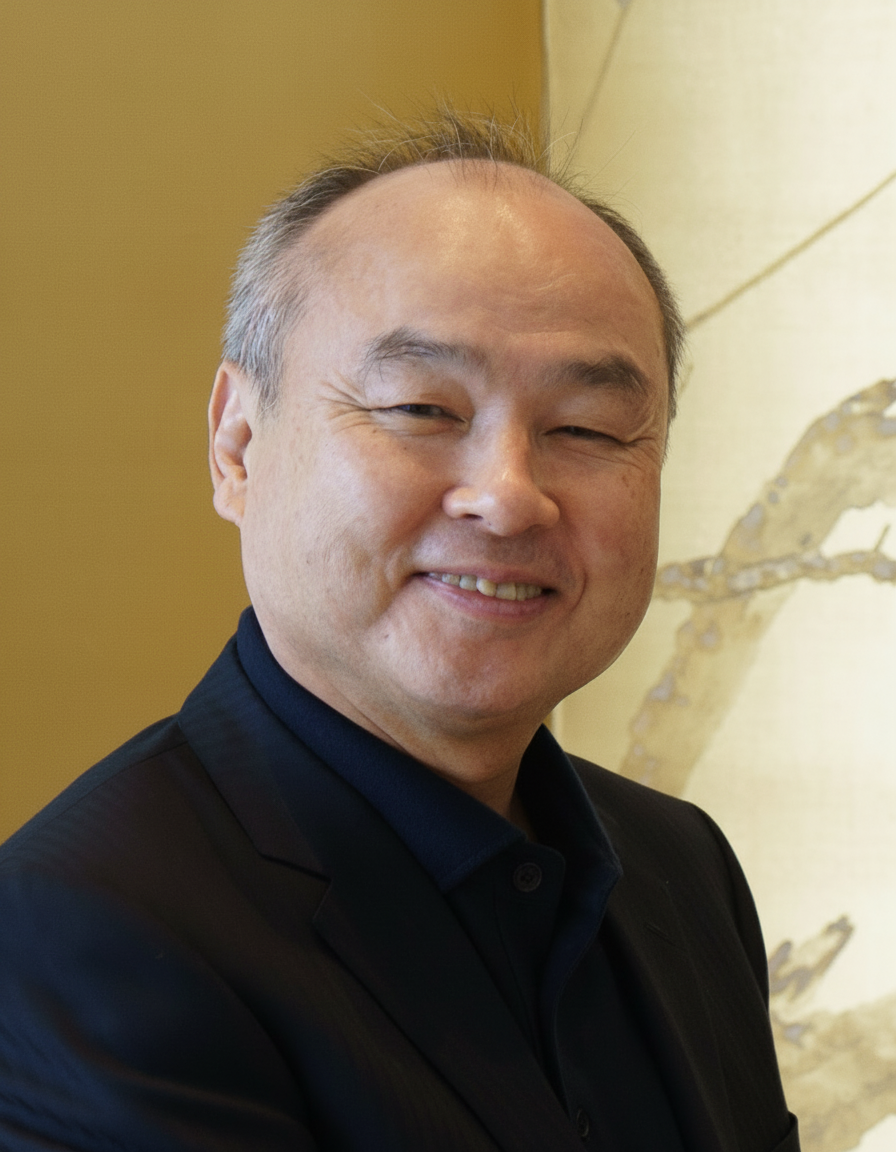
Masayoshi Son
Visionary founder of SoftBank, pioneering global technology investing with audacious long-term bets.
Masayoshi Son is the founder, Chairman, and CEO of SoftBank Group Corp., an investment holding company known for its transformative investments in technology and telecommunications. He built SoftBank from a software distributor into a global conglomerate, famously identifying and backing early-stage internet companies with significant long-term potential, most notably Alibaba.
Biography
Accomplishments
- 01Founded SoftBank in 1981, transforming it from a software distributor into a global telecommunications and technology investment conglomerate.
- 02Engineered the foundational $20 million investment in Alibaba in 2000, which grew to be worth over $100 billion, marking one of the most successful venture capital investments ever.
- 03Led SoftBank's acquisition of Vodafone Japan in 2006 for ¥1.75 trillion, significantly expanding SoftBank's footprint in the competitive Japanese mobile market.
- 04Orchestrated the $21.6 billion acquisition of Sprint in 2013, followed by its successful merger with T-Mobile U.S. in 2020, creating a formidable competitor in the U.S. telecommunications industry.
- 05Established the SoftBank Vision Fund in 2016, raising over $100 billion to become the largest technology-focused investment fund, fundamentally altering the landscape of late-stage venture capital.
- 06Pioneered the 'information revolution' investment thesis, consistently identifying and funding companies at critical junctures of technological shifts across multiple decades.
- 07Successfully navigated multiple economic cycles and technology bubbles, demonstrating resilience and adaptive strategy in building and sustaining SoftBank's growth.
Lessons for Operators
Key Takeaways
Practical lessons distilled for operators, investors, C-levels, and capital allocators.
Long-Term Vision as a Competitive Advantage
Son's '300-year plan' for SoftBank provides a framework for investing in disruptive technologies that may not yield immediate returns but can reshape industries over decades. This allows for patience and commitment to ventures others might dismiss.
Founder-Centric Investment Philosophy
A core tenet for SoftBank is identifying and empowering visionary founders. Son's belief in the individual's ability to execute a 'crazy' idea often outweighs short-term financials, particularly in early-stage or rapidly evolving markets.
Aggressive Capital Deployment for Market Dominance
SoftBank's strategy involves providing substantial capital to portfolio companies, allowing them to outspend competitors, achieve rapid scale, and consolidate market leadership. This 'blitzscaling' approach requires significant conviction and risk tolerance.
The Power of Ecosystem Building
Son envisions SoftBank's portfolio companies as an interconnected ecosystem, where synergies and data sharing can create network effects and mutual benefits. This strategy aims to create sustainable competitive advantages beyond individual company performance.
Risk Mitigation Through Ecosystem Diversification and Strategic Exits
Despite high-conviction bets, Son has demonstrated an ability to diversify risk across a vast portfolio and opportunistically exit investments (e.g., partial Alibaba sales) to generate liquidity and manage capital effectively, even when under pressure.
Adaptability in the Face of Adversity
Son has faced significant challenges, including the dot-com bust and Vision Fund setbacks. His ability to publicly acknowledge missteps, make strategic adjustments, and rally capital showcases resilience and a pragmatic approach to investment management.
Frameworks & Principles
Named frameworks and strategic principles they popularized or embodied.
The 'Information Revolution' Thesis
Son's overarching investment framework posits that information technology will continue to be the most significant force shaping human society for centuries. He seeks to identify and invest in companies that are at the forefront of this revolution, particularly those leveraging AI and data.
When to useWhen evaluating long-term investment opportunities, market trends, or strategic directions for a business. It encourages looking beyond current fads to fundamental technological paradigm shifts and their broad societal impact.
Cluster of No. 1 Strategy
This framework involves investing in a 'cluster' of companies that are either leading or have the strong potential to lead their respective market segments. The goal is to create a symbiotic network of category leaders that can collectively dominate the future digital economy, rather than investing in disparate entities.
When to useApplicable for venture capitalists, private equity firms, and corporate strategists looking to build a portfolio of complementary businesses. It guides M&A activities and investment decisions towards creating a synergistic ecosystem that leverages market dominance in multiple related areas.
Vision Capital Approach
This approach prioritizes a founder's long-term vision and potential over immediate profitability or conventional metrics. Son is willing to fund 'crazy' ideas with significant capital, betting on a future where those ideas become mainstream and dominant. This often means tolerating high burn rates in exchange for rapid growth and market capture.
When to useRelevant for investors assessing disruptive technologies or business models with high growth potential but uncertain near-term financial viability. Also valuable for founders seeking patient, strategic capital that understands and champions radical innovation, rather than focusing solely on quarterly returns.
Evergreen Talks & Interviews
Foundational talks, lectures, and interviews worth revisiting.

Sources & Further Reading
Profiles, interviews, podcasts, and articles used to compile and verify this entry. Each link opens at the original publisher.
Explore Related Titans
Other figures in the archive who share Masayoshi Son's domain, geography, or era.
More in Technology








From Japan



Contemporaries — born 1950s