
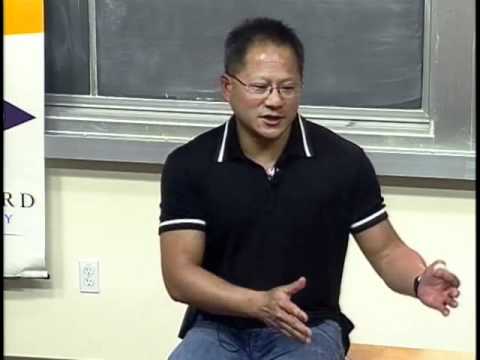
Jensen Huang
Co-founder, President, and CEO of NVIDIA, a pioneering force in graphics processing units (GPUs) and artificial intelligence.
Jensen Huang co-founded NVIDIA in 1993, steering it from a graphics chip startup into a dominant force in high-performance computing, artificial intelligence, and accelerated data centers. His strategic foresight in pivoting NVIDIA towards general-purpose GPU computing, particularly for AI workloads, has positioned the company at the forefront of the technological revolution.
Biography
Accomplishments
- 01Co-founded NVIDIA in 1993, pioneering the modern GPU, which shipped its billionth unit in 2011.
- 02Led the invention of the Graphics Processing Unit (GPU) in 1999, fundamentally transforming computer graphics and enabling photo-realistic imagery.
- 03Architected NVIDIA's strategic pivot into general-purpose GPU computing (GPGPU) with the introduction of CUDA in 2006, opening up new markets beyond gaming, particularly in scientific computing and AI.
- 04Positioned NVIDIA as the leading hardware provider for artificial intelligence and deep learning, facilitating breakthroughs across numerous industries from autonomous driving to healthcare.
- 05Expanded NVIDIA's market capitalization to exceed a trillion dollars, driven by its indispensable role in the AI revolution, notably by May 2023.
- 06Oversaw significant acquisitions, including Mellanox Technologies for $6.9 billion in 2020, to enhance NVIDIA's data center and networking capabilities.
Lessons for Operators
Key Takeaways
Practical lessons distilled for operators, investors, C-levels, and capital allocators.
Long-Term Strategic Vision
Huang's ability to foresee the transformative potential of GPUs beyond graphics and his sustained investment in CUDA for general-purpose computing exemplify long-term strategic vision. Operators should seek to identify and commit to foundational technological shifts well in advance of mainstream adoption.
Ecosystem and Platform Dominance
NVIDIA's strength isn't just hardware, but its CUDA software platform. Creating a robust developer ecosystem around core technology can establish a defensible moat and ensure technology becomes a standard. Invest in tools, libraries, and communities to foster adoption.
Aggressive R&D Prowess
NVIDIA continuously pushes the boundaries of semiconductor design and architecture (e.g., Hopper, Blackwell). Maintaining a substantial R&D budget relative to revenue, focused on disruptive rather than iterative innovation, is crucial for market leadership in high-tech sectors.
Operationalizing Adjacent Opportunities
The shift from gaming to professional visualization, then to data centers and AI, showcases effective identification and execution on adjacent market opportunities. Enterprises should systematically audit their core capabilities for unexpected applications in emerging markets.
The Full-Stack Advantage
Providing integrated hardware, software, and sometimes services offers a cohesive solution that often outperforms disparate components. This full-stack approach simplifies deployment for customers and provides greater control over the end-user experience and performance.
Adaptability in Leadership
Huang has successfully navigated NVIDIA through multiple technological cycles and market shifts for over three decades. Leaders must foster organizational agility and be prepared to make bold strategic pivots when fundamental market conditions change.
Frameworks & Principles
Named frameworks and strategic principles they popularized or embodied.
Ecosystem Lock-in Strategy (e.g., CUDA)
Develop a proprietary software platform or API that leverages unique hardware capabilities, creating a strong learning curve and investment for developers. This platform then becomes a foundation for subsequent innovation and a barrier for competitors.
When to useWhen you have a novel hardware or core technological advantage that can be exposed and enhanced through a software layer, creating network effects and a developer community.
Horizontal to Vertical Market Expansion
Start with a core technology that serves a broad horizontal market (e.g., GPUs for graphics), then identify and adapt that technology to serve specialized vertical markets (e.g., AI in healthcare, autonomous vehicles) where its unique capabilities provide significant advantages.
When to useWhen your core product or technology has latent potential for specialized applications in high-value, underserved markets. Requires deep market understanding and tailored product development.
The 'Platform Shift' Anticipation
Continuously monitor technological trends and anticipate fundamental shifts (e.g., the rise of AI, accelerated computing) before they become mainstream. Invest heavily in the foundational technologies required for the next platform shift, even at the expense of short-term profits.
When to useIn fast-evolving high-tech industries. Requires significant R&D investment, a culture of long-term thinking, and tolerance for initial market uncertainty.
Evergreen Talks & Interviews
Foundational talks, lectures, and interviews worth revisiting.

Sources & Further Reading
Profiles, interviews, podcasts, and articles used to compile and verify this entry. Each link opens at the original publisher.
Explore Related Titans
Other figures in the archive who share Jensen Huang's domain, geography, or era.
More in Technology










Contemporaries — born 1960s