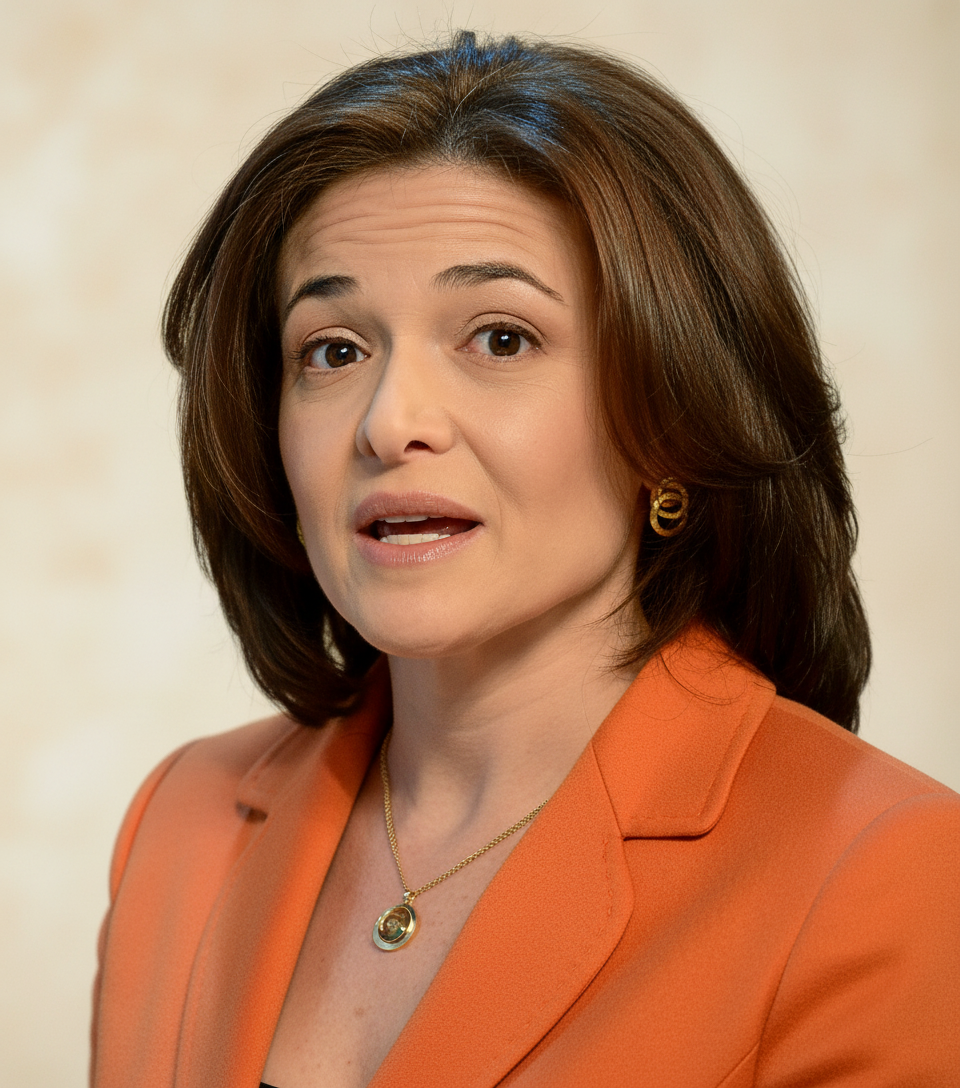
Sheryl Sandberg
Architect of Hyper-Growth and Global Scale for Digital Platforms.
Sheryl Sandberg is an American business executive, philanthropist, and author. She served as Chief Operating Officer (COO) of Facebook (now Meta Platforms) from 2008 to 2022, overseeing the company's business operations including sales, marketing, business development, human resources, public policy, and communications. Prior to Facebook, she was Vice President of Global Online Sales and Operations at Google and Chief of Staff for the U.S. Treasury Department under President Bill Clinton.
Biography
Accomplishments
- 01Scaled Google's advertising and publishing operations globally from 2001-2008, significantly contributing to its rapid revenue growth and international expansion. She built the global online sales and operations team from approximately 4 to 4,000 employees.
- 02Led Facebook's monetization strategy as COO from 2008-2022, transforming it into a multibillion-dollar advertising giant. Under her leadership, annual revenue grew from $153 million in 2008 to over $117 billion in 2021.
- 03Guided Facebook through its 2012 IPO, at the time the largest technology IPO in history, and managed the subsequent transition to a public company with robust financial reporting and investor relations.
- 04Authored 'Lean In: Women, Work, and the Will to Lead' (2013), and founded LeanIn.org, a nonprofit organization dedicated to empowering women to achieve their ambitions, which has fostered over 50,000 'Lean In Circles' globally.
- 05Navigated Facebook's business operations through periods of intense public scrutiny, including data privacy controversies (e.g., Cambridge Analytica in 2018), regulatory challenges, and content moderation debates, maintaining advertiser confidence and revenue stability.
- 06Successfully diversified Facebook's (Meta's) revenue streams and expanded its global advertiser base across its family of apps, including Instagram and WhatsApp.
Lessons for Operators
Key Takeaways
Practical lessons distilled for operators, investors, C-levels, and capital allocators.
Operationalizing Hyper-Growth
Sandberg's tenure at Google and Facebook demonstrates a repeatable blueprint for scaling business operations at an explosive rate. This involves building out sales, marketing, and HR infrastructure ahead of or concurrent with product-led expansion, focusing on data-driven optimization, and cultivating a high-performance culture.
Monetization Strategy in Digital Platforms
Her success at Facebook provides a case study in building a dominant digital advertising revenue model. Key elements include understanding user intent and behavior for ad targeting, developing self-serve platforms for advertisers, and continuous iteration on ad formats and placement based on performance data.
Leadership in Periods of Intense Scrutiny
Sandberg navigated Facebook through significant public and regulatory challenges. Her experience highlights the importance of clear communication with stakeholders (investors, employees, public), proactive PR strategies (e.g., 'earning trust back'), and demonstrating a commitment to addressing systemic issues while maintaining business momentum.
Advocacy for Workforce Diversity and Inclusion
Beyond her operational roles, Sandberg is a powerful voice for women in leadership. Her 'Lean In' philosophy, while debated, sparked global conversations and created practical networks (Lean In Circles) for women striving for career advancement, demonstrating the power of thought leadership in shaping business culture.
The COO as Strategic Partner
Her partnership with Mark Zuckerberg exemplifies the criticality of the COO role in high-tech. The COO can complement the visionary CEO by bringing operational rigor, financial discipline, business development prowess, and public-facing leadership, allowing the CEO to focus on product and vision.
Frameworks & Principles
Named frameworks and strategic principles they popularized or embodied.
The 'Lean In' Philosophy
Encourages women to 'lean in' to their careers by actively pursuing leadership opportunities, speaking up, negotiating for themselves, and taking risks. It emphasizes individual ambition and navigating workplace dynamics.
When to useApplicable for women in professional settings looking to advance their careers, negotiate for better positions, or contribute more significantly. Also relevant for organizations seeking to foster a culture of female leadership.
Build, Measure, Learn (Applied to Business Operations)
While often associated with product development, Sandberg applied this agile methodology to business functions. It involves launching new business initiatives (build), tracking their performance with rigorous metrics (measure), and then using those insights to refine strategies (learn) and iterate rapidly.
When to useIdeal for scaling sales teams, optimizing marketing campaigns, or developing new business models where rapid experimentation and data-backed adjustments are critical for efficient resource allocation and maximizing ROI.
The 'Two-Way Door' vs. 'One-Way Door' Decisions
A concept often echoed by Amazon's Jeff Bezos, but evident in Sandberg's operational approach. Two-way door decisions are reversible and can be made quickly, while one-way door decisions are high-stakes, irreversible, and require more deliberation. This framework helps teams assess risk and expedite decision-making.
When to useUseful for leaders and teams when clarifying which decisions need extensive analysis and consensus versus those that can be made autonomously and adjusted if needed, fostering agility and accountability.
Sources & Further Reading
Profiles, interviews, podcasts, and articles used to compile and verify this entry. Each link opens at the original publisher.
Explore Related Titans
Other figures in the archive who share Sheryl Sandberg's domain, geography, or era.
More in Technology







From United States


Contemporaries — born 1960s