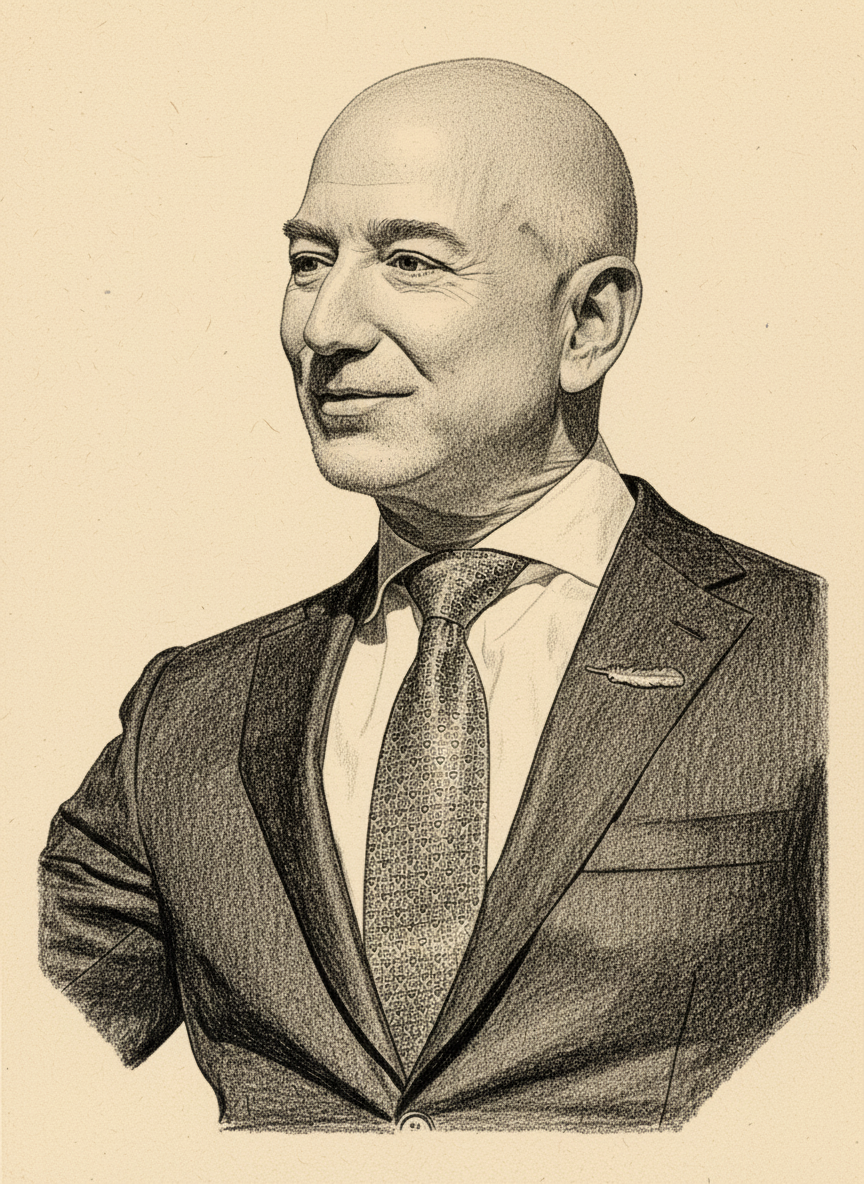
Jeff Bezos
Architect of Amazon, pioneer of e-commerce, and visionary across cloud computing, logistics, and space exploration.
Jeffrey Preston Bezos founded Amazon.com in 1994, transforming it from an online bookseller into a global e-commerce and cloud computing behemoth. His relentless focus on customer experience, long-term vision, and willingness to invest heavily in new ventures redefined multiple industries. He stepped down as Amazon CEO in 2021, transitioning to Executive Chairman, to dedicate more time to other ventures like Blue Origin and philanthropic efforts.
Biography
Accomplishments
- 01Founded Amazon.com in 1994, transforming it into the world's largest online retailer and a leading technology company, achieving a market capitalization exceeding $1.5 trillion under his leadership.
- 02Pioneered Amazon Web Services (AWS) in 2006, creating the dominant cloud computing platform that underpins a significant portion of the internet's infrastructure and drives substantial revenue and profit for Amazon.
- 03Revolutionized logistics and customer expectations with Amazon Prime (2005), offering fast shipping, streaming services, and significantly impacting consumer behavior and retail competition.
- 04Acquired The Washington Post in 2013 for $250 million, leading its digital transformation and return to profitability through subscription-based models and technology-driven efficiency.
- 05Founded Blue Origin in 2000, a private aerospace company, demonstrating long-term investment in space exploration and developing reusable rocket technology, achieving human spaceflight with New Shepard in 2021.
- 06Introduced innovative products like the Amazon Kindle (2007), establishing the e-reader market, and Amazon Echo with Alexa (2014), popularizing voice-controlled smart home devices.
- 07Cultivated a culture of innovation, experimentation, and customer obsession at Amazon, leading to numerous successful ventures and market disruptions across diverse industries.
Lessons for Operators
Key Takeaways
Practical lessons distilled for operators, investors, C-levels, and capital allocators.
Unwavering Customer Focus
Bezos ingrained 'customer obsession' as Amazon's core principle, driving innovation and service improvements. Operators should audit all initiatives against customer benefit, not just internal efficiency, to build enduring loyalty and market share.
Long-Term Investment Horizon
Amazon's success with AWS and Prime exemplifies patient capital deployment. Investors and capital allocators should evaluate opportunities not solely on immediate ROI, but on their potential to generate disproportionate value over multiple years, even if it means short-term volatility.
Embrace Strategic Risk-Taking
Bezos's willingness to invest in ventures like Blue Origin or The Washington Post, and to build AWS as an internal utility first, showcases calculated risk. Enterprise leaders should empower teams to pursue transformative, albeit risky, initiatives rather than incremental improvements, provided they align with a clear strategic vision.
Scalable Infrastructure as a Service
AWS's genesis from internal infrastructure demonstrates that internal capabilities, when modularized and optimized, can become highly profitable external services. Operators should assess their internal competencies for potential externalization, creating new revenue streams and competitive advantages.
High-Velocity Decision Making
Bezos's 'disagree and commit' philosophy speeds up execution. C-levels and fund managers should cultivate environments where robust debate is encouraged, but once a decision is made, teams pivot quickly to unified execution, preventing stagnation.
Iterative Development and Day 1 Mentality
Maintaining a 'Day 1' startup mindset, even in a large corporation, fosters continuous innovation. Enterprise leaders must resist complacency, regularly challenge assumptions, and prioritize rapid experimentation to stay agile and competitive in evolving markets.
Purpose-Driven Wealth Application
Bezos's commitment to giving away his wealth and focusing on significant global challenges like climate change (Bezos Earth Fund) demonstrates a shift towards impact investing and philanthropy. Capital allocators and fund managers can learn to integrate social and environmental impact with financial goals, aligning capital with broader societal benefit.
AI as a Strategic Frontier
His recent engagement with AI startups signals that emerging technologies remain critical for future value creation. Investors and operators should actively monitor and invest in foundational AI capabilities and applications that can redefine industries, similar to how cloud computing did a decade ago.
Frameworks & Principles
Named frameworks and strategic principles they popularized or embodied.
Customer Working Backwards
Start every product or service development process by envisioning the ideal customer experience and drafting a press release for its launch. This forces clarity on customer benefits, problem solved, and core functionality before development begins.
When to useWhen launching new products/services, refining existing ones, or defining strategic priorities. Excellent for ensuring market fit and customer value from the outset.
Day 1 Philosophy
Maintain an entrepreneurial, agile mindset focused on experimentation, customer obsession, and long-term thinking, regardless of company size. It means avoiding complacency, staying nimble, and continually innovating.
When to useApplicable for any organization seeking to combat organizational inertia, foster innovation, or maintain market leadership. Especially vital for mature companies facing disruption.
Two-Pizza Teams
Organize work into small, autonomous teams (small enough to be fed by two pizzas) with clear ownership and accountability. This promotes agility, efficient communication, and rapid iteration, though Bezos himself admits it may need updates for modern complexities.
When to useIdeal for projects requiring rapid development, clear ownership, and minimal inter-team dependencies. Effective for both product development and operational initiatives within larger organizations.
Free Cash Flow per Share Focus
Prioritize maximizing free cash flow per share over traditional accounting profits, especially in growth phases. This emphasizes liquidity, sustainable reinvestment, and long-term shareholder value.
When to useCrucial for businesses with high capital expenditure needs or long investment cycles. Investors use this to evaluate a company's ability to self-fund growth and return capital.
Disagree and Commit
Encourage vigorous debate and diverse opinions in decision-making, but once a decision is made by the leader, all team members are expected to fully commit and execute, regardless of their initial stance.
When to useWhen making critical strategic decisions where consensus is difficult but unified execution is essential. Prevents analysis paralysis and fosters accountability.
Quotations
"It is always Day 1."
"Your margin is my opportunity."
Evergreen Talks & Interviews
Foundational talks, lectures, and interviews worth revisiting.

Recent Appearances
Latest interviews, keynotes, and press from the past half year.
 youtube.com
 youtube.com
 youtube.com
 youtube.com
 youtube.com
 youtube.com
 youtube.com
 youtube.com
 youtube.com
 youtube.com
 youtube.com
 youtube.com
 youtube.com
 youtube.com
 youtube.com
 youtube.com
 youtube.com
 youtube.com
 youtube.com
 youtube.com
 youtube.com
 youtube.com
 youtube.com
 youtube.com
 youtube.com
 youtube.com
 youtube.com
 youtube.com
 youtube.com
 youtube.com
 youtube.com
 youtube.com
 youtube.com
 youtube.com
 youtube.com
 youtube.com
 youtube.com
 youtube.com
 youtube.com
 youtube.com
 youtube.com
 youtube.com
Sources & Further Reading
Profiles, interviews, podcasts, and articles used to compile and verify this entry. Each link opens at the original publisher.
- interviewJeff Bezos: I'm going to give away most of my wealth in my lifetimecnbc.com→
- interviewJeff Bezos: Pres. Trump is a more mature, more disciplined ... - CNBCcnbc.com→
- interviewJeff Bezos: My time at Amazon, Blue Origin and Prometheus is spent ...cnbc.com→
- interviewJeff Bezos Speaks with CNBC's Andrew Ross Sorkin on “Squawk ...cnbc.com→
- interviewJeff Bezos: The bottom half works pay 3% of all taxes - CNBCcnbc.com→
- interviewJeff Bezos Didn't Just Build Amazon. He Scripted It - Forbesforbes.com→
- interviewJeff Bezos Says New York City Second-Home Tax Is 'Fine' Ideabloomberg.com→
- interviewJeff Bezos Says the 1-Hour Rule Makes Him Smarter. New ...inc.com→
- interviewJeff Bezos Brings Signature Management Style to $6 Billion AI Startupbloomberg.com→
- interviewJeff Bezos' Road To Riches: Behind The Billions - Forbesforbes.com→
- interviewBezos Enters The AI Arena Amid Shifting Rules And Heavy Startup ...forbes.com→
- interviewJeff Bezos' Two Pizza Rule for Team Meetings May Need an Updatebloomberg.com→
- interviewJeff Bezos says raising taxes on the rich wouldn't help average ...nbcnews.com→
- interviewJeff Bezos hails AI boom as 'good' kind of bubble - Financial Timesft.com→
- interviewJeff Bezos in Talks to Raise $100 Billion for AI Manufacturing Fundwsj.com→
- interviewBezos, Billionaires and the Age of AI Abundance - WSJwsj.com→
- interviewJeff Bezos - Latest News and Updates - WSJ.comwsj.com→
- interviewJeff Bezos Says Space Data Centers Will Happen—Eventually - WSJwsj.com→
- interview“Speed Is a Leadership Decision”hbr.org→
- interviewJeff Bezos and Lauren Sánchez Bezos Donate $34 Million in ... - WSJwsj.com→
- podcastJeff Bezos & Andrew Ross Sorkin at Blue Origin 5/20/26podcasts.apple.com→
- podcast5-21-26 Hour 1 - Jeff Bezos Defends Billionaires - Apple Podcastspodcasts.apple.com→
- podcastJeff Bezos - The Complete Guide to Everything | Podcast on Spotifyopen.spotify.com→
- podcastBezos Guts The Washington Post - The Daily - Apple Podcastspodcasts.apple.com→
- podcast5-21-26 Hour 1 - Jeff Bezos Defends Billionaires - Apple Podcastspodcasts.apple.com→
- podcastThe Jeff Bezos & Lauren Sánchez Wedding - Apple Podcastspodcasts.apple.com→
- podcastJeff Bezos - Leaders | Podcast on Spotifyopen.spotify.com→
- podcast5-21-26 Hour 1 - Jeff Bezos Defends Billionaires - Apple Podcastspodcasts.apple.com→
Explore Related Titans
Other figures in the archive who share Jeff Bezos's domain, geography, or era.
More in Technology


From United States

Contemporaries — born 1960s