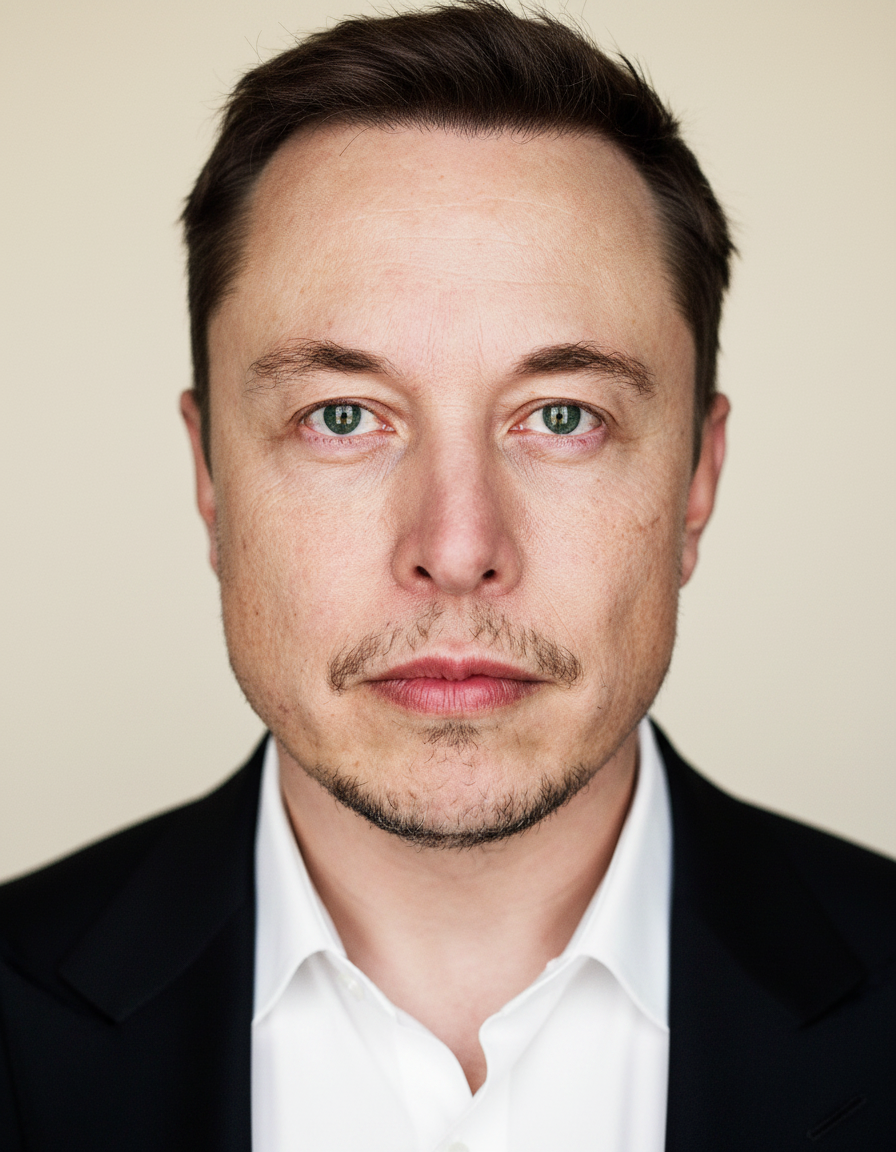
Elon Musk
Elon Reeve Musk: Visionary entrepreneur leading advancements in aerospace, automotive, and artificial intelligence.
Elon Musk is a businessman known for founding and leading several transformative technology companies, including SpaceX, Tesla, Neuralink, and The Boring Company. He gained early success with Zip2 and X.com (which became PayPal). As of May 2026, he is the wealthiest person in the world, with an estimated net worth of US$828 billion.
Biography
Accomplishments
- 01Co-founded Zip2 (1995), a successful internet startup sold to Compaq for $307 million in 1999.
- 02Co-founded X.com (1999), which became PayPal, acquired by eBay for $1.5 billion in 2002.
- 03Founded SpaceX (2002), a private aerospace manufacturer and space transportation services company. Achieved first private company to launch, orbit, and recover a spacecraft (Falcon 9, 2010) and first to dock with the ISS (Dragon, 2012).
- 04Became CEO of Tesla (2008), leading its transformation into the world's most valuable automaker and accelerating global electric vehicle adoption.
- 05Founded Neuralink (2016) and The Boring Company (2016), pushing frontiers in brain-computer interfaces and urban transport infrastructure.
- 06Led the development and deployment of Starlink, a satellite internet constellation providing global broadband internet access.
Lessons for Operators
Key Takeaways
Practical lessons distilled for operators, investors, C-levels, and capital allocators.
Disruptive Ambition
Musk consistently targets industries ripe for disruption (space, automotive, energy) with goals that often appear unachievable, demonstrating that audacious visions can attract significant capital and talent.
Technological Self-Reliance
By investing heavily in research, development, and manufacturing capacity, Musk's companies minimize reliance on external suppliers for critical components, allowing for greater control and faster innovation cycles.
Brand as a Force Multiplier
Musk's personal brand and willingness to communicate directly (often controversially) act as a powerful marketing and investor relations tool, generating immense attention and customer loyalty at low cost.
Iterative Development Culture
Companies under Musk's leadership adopt a philosophy of rapid prototyping and testing, allowing for quick identification and correction of flaws, significantly accelerating product development compared to traditional models.
Capital Allocation for Growth
Musk demonstrates a persistent focus on reinvesting profits and raising capital to expand production capacity and develop new technologies, prioritizing growth over immediate dividends for shareholders.
Frameworks & Principles
Named frameworks and strategic principles they popularized or embodied.
First Principles Thinking
Breaking down problems to their fundamental truths and reasoning up from there, rather than reasoning by analogy. This involves asking 'why' repeatedly to identify core assumptions and potential new solutions.
When to useWhen developing truly novel products or solving entrenched, complex problems where existing solutions are inefficient or non-existent. Applicable for strategic planning, R&D, and cost reduction in manufacturing.
Vertical Integration Strategy
Bringing multiple stages of production or supply chain processes in-house rather than outsourcing. This provides greater control over quality, intellectual property, costs, and response times.
When to useWhen a company seeks to achieve significant competitive advantages through proprietary technology, cost efficiency, or supply chain resilience, especially in industries where external suppliers may lack specific capabilities or pose risks.
Iterative Product Development (Agile/Lean Principles)
Developing products through continuous cycles of building, testing, learning, and refining, rather than a single linear process. This allows for early error detection and adaptation to feedback.
When to useApplicable across R&D, software development, and hardware engineering, particularly for complex systems where rapid learning and adaptation are critical to success and market fit.
Quotations
"When something is important enough, you do it even if the odds are not in your favor."
Evergreen Talks & Interviews
Foundational talks, lectures, and interviews worth revisiting.

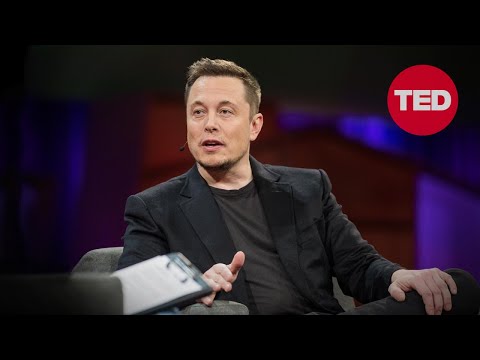
Sources & Further Reading
Profiles, interviews, podcasts, and articles used to compile and verify this entry. Each link opens at the original publisher.
Explore Related Titans
Other figures in the archive who share Elon Musk's domain, geography, or era.
More in Technology








From South Africa

Contemporaries — born 1970s