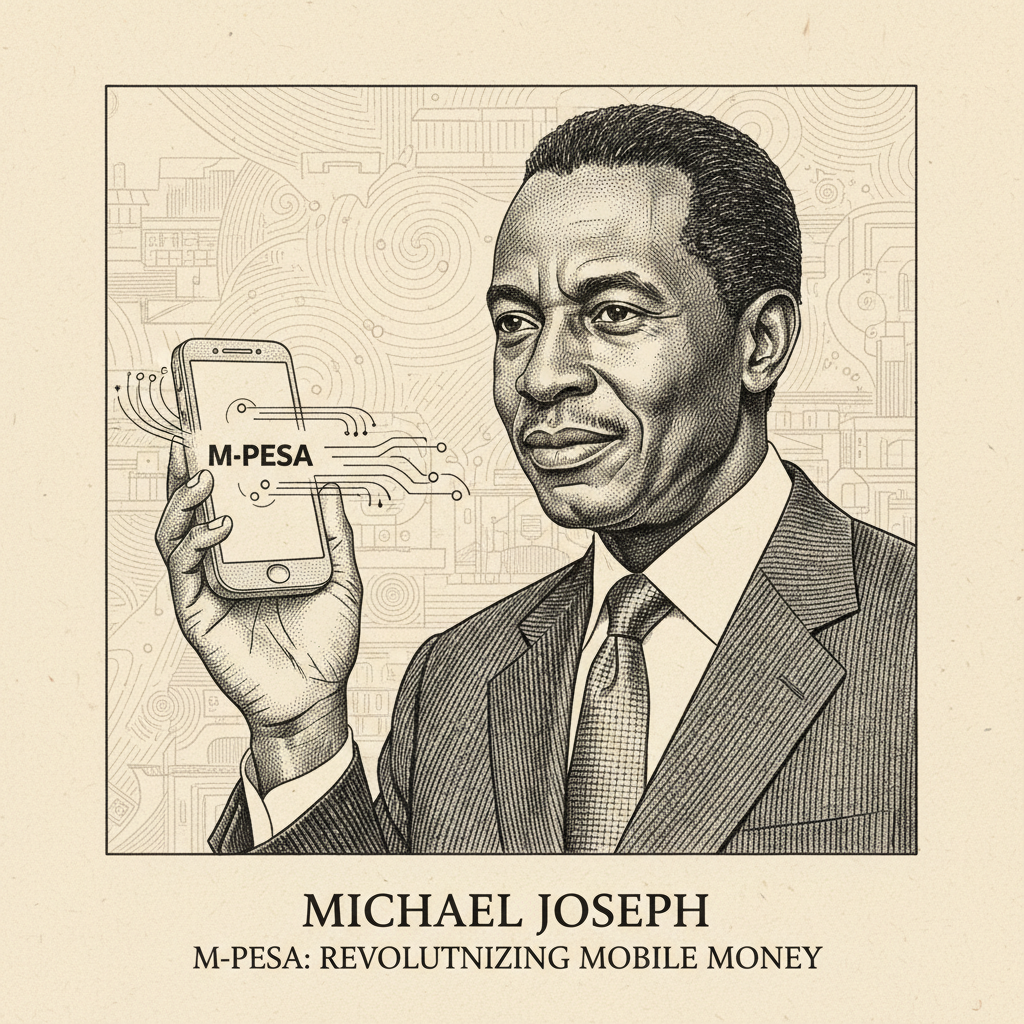
Michael Joseph
Architect of Mobile Money: Pioneering Financial Inclusion in Emerging Markets.
Michael Joseph is a pioneering telecommunications executive best known for launching and scaling Safaricom in Kenya, Africa's most profitable company, and for driving the creation and global expansion of M-Pesa, the world's most successful mobile money service, profoundly impacting financial inclusion.
Biography
Accomplishments
- 01Founded Safaricom in 2000, growing it into East Africa's most profitable company and a dominant telecommunications provider, achieving over 70% market share in Kenya by 2010.
- 02Led the development and commercial launch of M-Pesa in March 2007, globally recognized as the most successful mobile money service, serving over 50 million users across multiple countries by 2023.
- 03Catalyzed financial inclusion in Kenya, enabling millions of previously unbanked individuals to access basic financial services, leading to significant economic development and poverty reduction.
- 04Successfully navigated complex regulatory and competitive landscapes in emerging markets, establishing sustainable business models for telecommunications and mobile financial services.
- 05Served as CEO of Vodacom South Africa (2015-2016) and as Chairman of Safaricom (2020-2022), demonstrating continued influence and strategic leadership in the African telecom sector.
- 06Expanded M-Pesa beyond Kenya, overseeing its rollout and integration into various Vodafone operating companies worldwide, solidifying its position as a global leader in mobile payments.
Lessons for Operators
Key Takeaways
Practical lessons distilled for operators, investors, C-levels, and capital allocators.
Problem-Oriented Innovation
Focus on acute, unaddressed consumer pain points, particularly in underserved markets. M-Pesa's initial success stemmed from addressing the simple, pervasive need for secure money transfer, not complex banking services.
Ecosystem Building
A successful product, especially in financial services, requires a robust ecosystem. M-Pesa's agent network was as critical as the technology, illustrating the need for integrated physical and digital infrastructure.
Scaling Through Practicality
Prioritize practical, user-friendly solutions over technologically complex ones. M-Pesa's reliance on basic SMS technology made it accessible to feature phone users, enabling unprecedented scale in emerging economies.
Regulatory Engagement
Proactive and constructive engagement with regulators is paramount for disruptive innovations, particularly in highly regulated sectors like finance. Joseph navigated this by focusing on financial inclusion benefits.
Leadership by Vision and Execution
True leadership requires not only a bold vision (e.g., M-Pesa's potential) but also relentless execution, operational discipline, and the ability to build and empower high-performing local teams.
Frameworks & Principles
Named frameworks and strategic principles they popularized or embodied.
Bottom-of-the-Pyramid Market Strategy
Investing in and developing products/services for low-income populations. M-Pesa directly targeted the unbanked and underbanked in Kenya, transforming financial access and creating new market segments.
When to useWhen entering emerging markets or targeting underserved demographics; requires a deep understanding of local needs and cost-effective delivery models.
Ecosystem and Network Effects
Building a comprehensive network of partners, agents, and users where the value of the service increases with each additional participant. M-Pesa's agent network and user base exemplify strong network effects.
When to useWhen launching platform-based products, marketplaces, or services that rely heavily on adoption and interconnection (e.g., payment systems, social networks).
Intrapreneurship and Corporate Venturing
Fostering entrepreneurial initiatives within a large corporation, often leading to disruptive innovation. M-Pesa was developed as an internal venture within Safaricom (and Vodafone) with significant autonomy.
When to useWhen established companies seek to innovate rapidly, diversify their offerings, or respond to market disruption without spinning out an entirely separate entity.
Explore Related Titans
Other figures in the archive who share Michael Joseph's domain, geography, or era.
More in Technology










From South Africa





Contemporaries — born 1950s