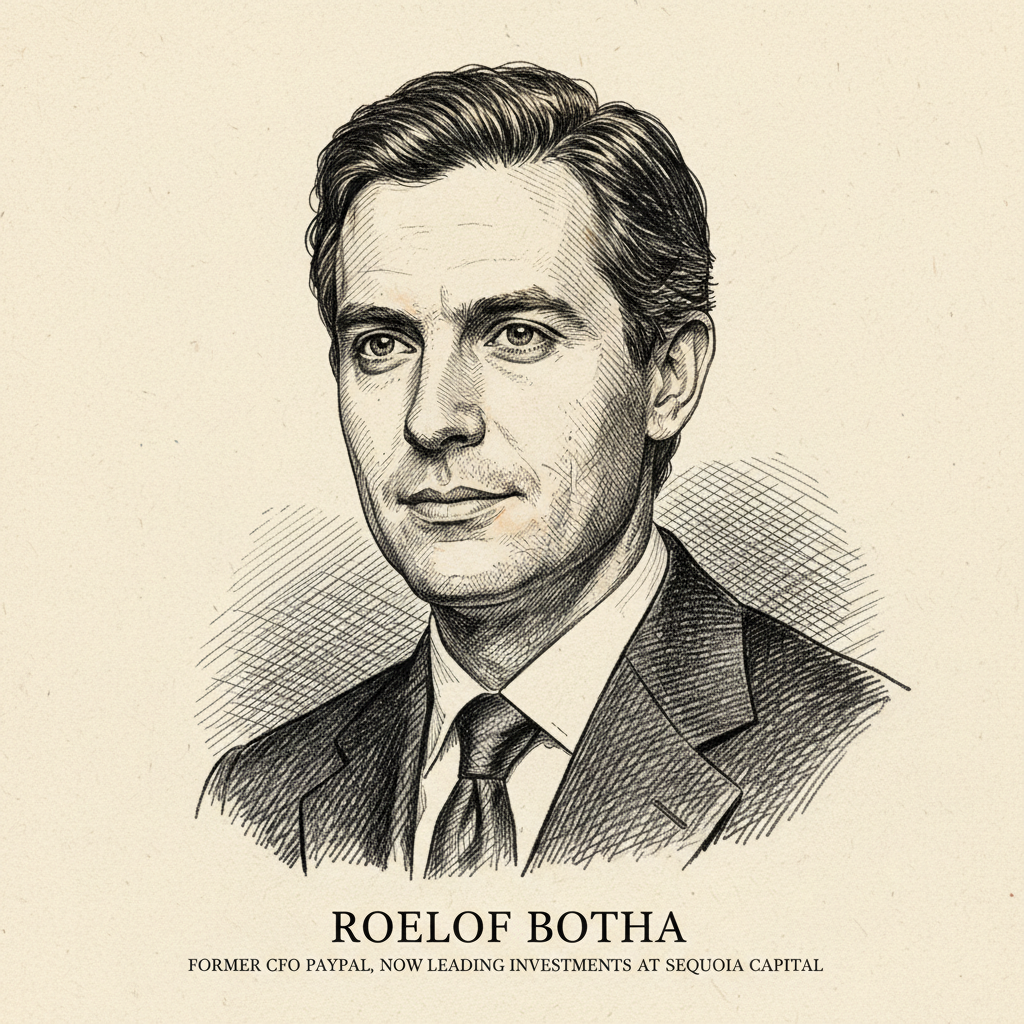
Roelof Botha
Architect of early-stage venture capital success and technology finance, leading transformative investments and operational strategies.
Roelof Botha is a South African-American venture capitalist known for his impactful career at Sequoia Capital and his critical role as CFO of PayPal. He steered PayPal through its IPO and subsequently joined Sequoia, where he ascended to lead its U.S. and European early-stage investment franchises before becoming the firm's overall leader.
Biography
Accomplishments
- 01Led PayPal as CFO from 2000-2003, culminating in its successful IPO in 2002, demonstrating expertise in financial strategy for high-growth tech companies.
- 02Served as a Partner at Sequoia Capital for 24 years (2003-2026), significantly contributing to the firm's investment portfolio and strategic direction.
- 03Oversaw Sequoia Capital's U.S. and European early-stage investment franchises from 2017, identifying and backing foundational technology companies.
- 04Held the leadership position at Sequoia Capital from 2022 to 2025, guiding a premier venture capital firm through a period of market shifts and technological advancements.
- 05Secured early investments in companies that became industry leaders, exemplifying a keen eye for disruptive technologies and scalable business models.
Lessons for Operators
Key Takeaways
Practical lessons distilled for operators, investors, C-levels, and capital allocators.
The Operator-Investor Advantage
Botha's background as PayPal's CFO before Sequoia demonstrates that direct operational experience at scale provides a distinct edge in venture capital. It informs due diligence, value-add to portfolio companies, and realistic growth projections.
Long-Term Value Creation Over Short-Term Gains
A 24-year tenure at a firm like Sequoia highlights a commitment to cultivating enduring value, a stark contrast to 'spray and pray' or quick-flip investment strategies. This attracts founders seeking patient capital and strategic partnership.
Global Perspective in Early-Stage Investing
Leading both U.S. and European early-stage franchises indicates the importance of understanding divergent market landscapes, regulatory environments, and talent pools for identifying global market leaders.
Leadership Through Market Cycles
His leadership of Sequoia from 2022 to 2025 encompassed periods of significant market recalibration. This demonstrates the necessity for strong, adaptable leadership to navigate venture capital through economic shifts and maintain competitive advantage.
Strategic Succession and Firm Stewardship
The progression from General Partner to leading early-stage investments, and finally to managing partner, illustrates a deliberate pathway for leadership development and seamless firm stewardship in institutional venture capital.
Frameworks & Principles
Named frameworks and strategic principles they popularized or embodied.
The Founder-First Thesis
An investment approach prioritizing exceptional founders with strong vision and execution capabilities, believing that the right team can pivot and succeed even with initial product challenges.
When to useWhen evaluating early-stage companies where product-market fit is still evolving, but the founder's resilience, intellect, and leadership potential are evident.
Market Timing and Category Creation
Focusing on identifying nascent market shifts and backing companies poised to define new categories or significantly disrupt existing ones, rather than merely optimizing incremental improvements.
When to useWhen assessing opportunities in rapidly evolving technological landscapes (e.g., AI, Web3, climate tech) where new paradigms are emerging and incumbents are vulnerable.
Operational Due Diligence
Leveraging deep operational experience (e.g., as a former CFO) to scrutinize a startup's financial models, burn rate, unit economics, and scalability, providing a more robust risk assessment than purely financial metrics.
When to useApplicable across all investment stages, but particularly critical for growth-stage companies seeking to scale operations and optimize capital efficiency.
Recent Appearances
Latest interviews, keynotes, and press from the past half year.
 youtube.com
 youtube.com
 youtube.com
 youtube.com
 youtube.com
 youtube.com
 youtube.com
 youtube.com
 youtube.com
 youtube.com
 youtube.com
 youtube.com
 youtube.com
 youtube.com
 youtube.com
 youtube.com
 youtube.com
 youtube.com
Sources & Further Reading
Profiles, interviews, podcasts, and articles used to compile and verify this entry. Each link opens at the original publisher.
Explore Related Titans
Other figures in the archive who share Roelof Botha's domain, geography, or era.
More in Technology