Thomas Edison
The Prolific Inventor and Industrialist Who Electrified the World and Standardized Innovation.
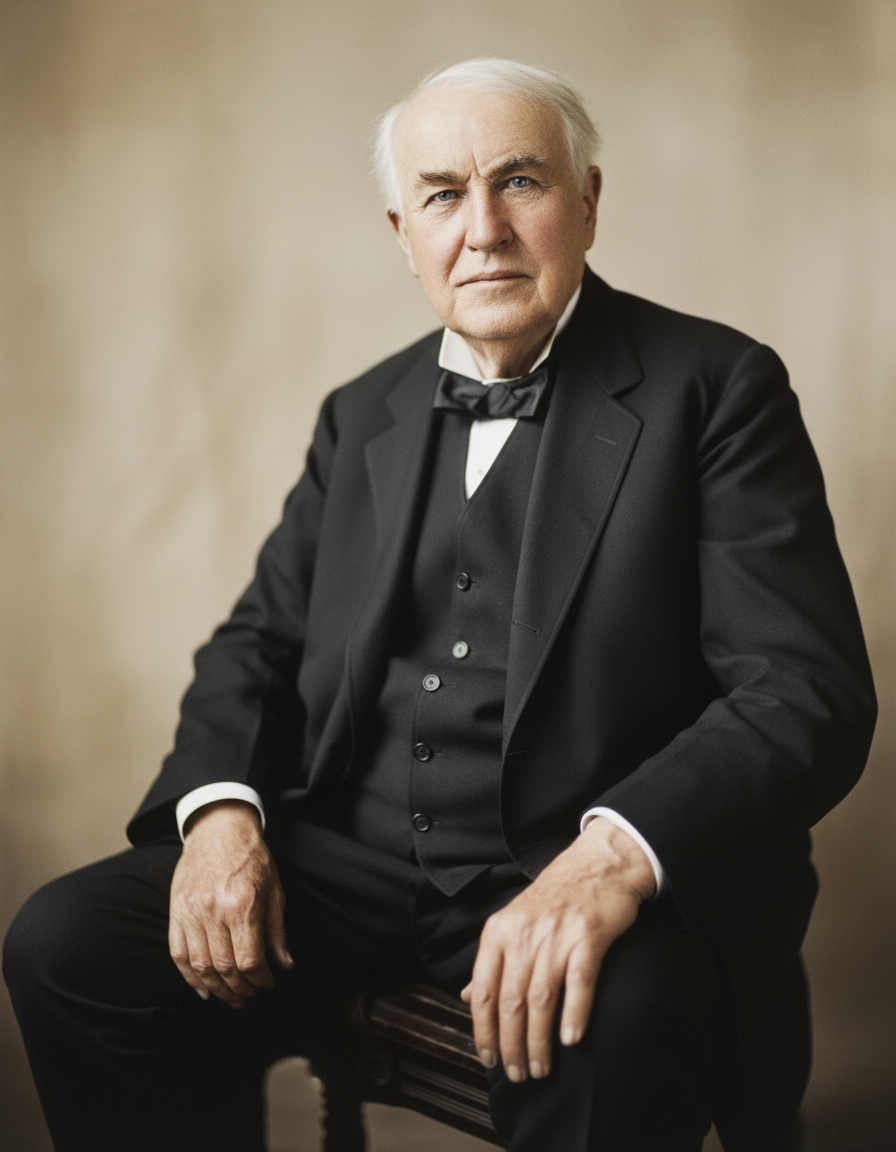
Thomas Edison, an American inventor and businessman, developed many devices that profoundly influenced life around the world, including the phonograph, the motion picture camera, and the long-lasting, practical electric light bulb. He established the first industrial research laboratory.
Biography
Accomplishments
- 01Invented the phonograph in 1877, revolutionizing sound recording and reproduction.
- 02Developed the first commercially practical incandescent light bulb in 1879, alongside a complete system for electricity generation and distribution.
- 03Established 'Menlo Park' in 1876, the world's first industrial research laboratory, institutionalizing systematic innovation.
- 04Founded the Edison Electric Light Company in 1878, which became a foundational component of General Electric, demonstrating vertical integration.
- 05Pioneered the motion picture industry with the invention of the Kinetograph and Kinetoscope in the early 1890s.
- 06Accumulated 1,093 U.S. patents in his lifetime, demonstrating an unparalleled output of registered intellectual property.
- 07Developed an improved stock ticker (Universal Stock Ticker) in 1871, his first significant commercial success, which funded further ventures.
- 08Introduced the first central power station in Pearl Street, New York City, in 1882, initiating widespread electrical utility service.
Lessons for Operators
Key Takeaways
Practical lessons distilled for operators, investors, C-levels, and capital allocators.
Industrializing Invention
Edison transitioned invention from an individual pursuit to a collaborative, industrial process. This model, embodied by Menlo Park, changed how R&D is conducted globally, making innovation scalable and repeatable. Operators should seek to institutionalize ingenuity within their organizations.
Ecosystem, Not Just Product
His success with electric light wasn't just the bulb, but the entire infrastructure enabling its use. This highlights the importance of providing complete, integrated solutions, which creates network effects and defensibility. C-levels should map out the entire value chain required for adoption.
Relentless Experimentation
Edison's ethos was 'Genius is one percent inspiration and ninety-nine percent perspiration.' He systematically tested countless hypotheses. Investors should back leadership teams demonstrating a commitment to rigorous testing, data-driven decisions, and iterative development.
Strategic IP Management
His vast patent portfolio was not accidental but a deliberate strategy to protect innovations and secure market monopolies. Enterprise leaders need robust IP strategies from inception to protect competitive advantages and create asset value for shareholders.
Commercial Acumen in Innovators
Edison was equally skilled at inventing and establishing profitable enterprises. The ability to translate invention into commercial success is paramount. Fund managers should evaluate founders' business development capabilities alongside their technical prowess.
The Power of Agglomeration
The concentration of talent and resources at Menlo Park fostered a fertile ground for breakthroughs. Creating hubs within an organization that bring together diverse skills can accelerate discovery and problem-solving, a lesson for enterprise leaders on fostering innovation culture.
Frameworks & Principles
Named frameworks and strategic principles they popularized or embodied.
The Invention Factory Model
Establishing a dedicated, multi-disciplinary research and development facility with a systematic approach to invention, moving beyond individual genius to collaborative, pipeline-driven innovation.
When to useWhen an organization seeks to generate a continuous stream of new products or processes, requiring structured R&D, cross-functional collaboration, and significant capital allocation to sustained innovation efforts.
Ecosystem Development Strategy
Rather than commercializing a single product, developing and integrating all necessary components (manufacturing, distribution, supporting infrastructure, services) to ensure the viability and widespread adoption of a core innovation.
When to useApplicable for disruptive innovations that require new infrastructure or significant behavioral changes from users. C-levels should use this when entering nascent markets where foundational components are missing or inadequate.
Experimentation-Driven Innovation Cycle
A methodical process of hypothesis formulation, rapid prototyping, exhaustive testing (including 'failure'), learning, and iterative refinement, emphasizing volume and speed of experimentation to achieve desired outcomes.
When to useIdeal for complex problem-solving where theoretical solutions are insufficient, and empirical data from numerous trials is needed to optimize a product or process. Operators and R&D managers can employ this for product development and process improvement.
Sources & Further Reading
Profiles, interviews, podcasts, and articles used to compile and verify this entry. Each link opens at the original publisher.
Explore Related Titans
Other figures in the archive who share Thomas Edison's domain, geography, or era.
More in Energy & Resources







From United States





Contemporaries — 19th century