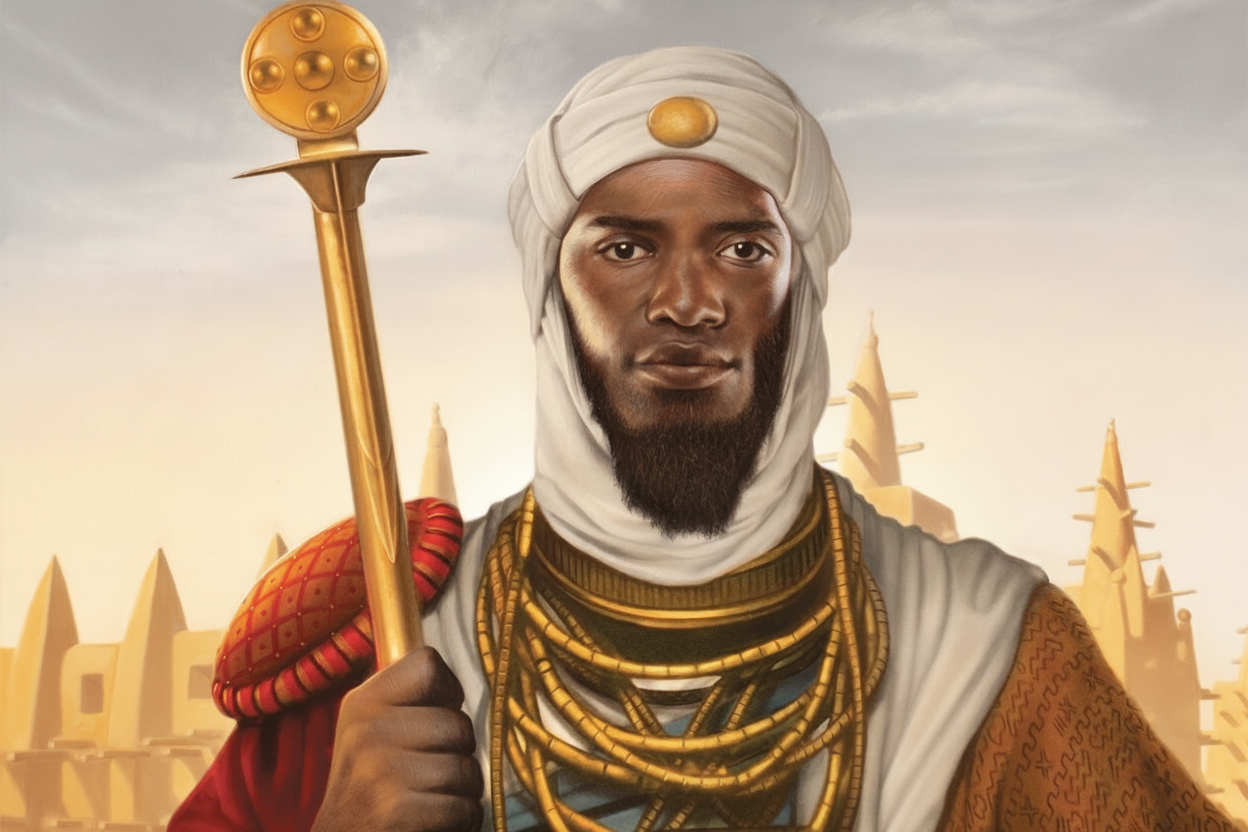
Mansa Musa
The African Emperor who redefined wealth, diplomacy, and global trade routes, demonstrating the power of strategic resource management and international influence.
Mansa Musa I, the tenth Mansa of the Mali Empire, ruled from 1312 to 1337. During his reign, the empire reached its territorial and economic peak, primarily through its control of trans-Saharan trade routes, gold mines, and salt production. His legendary pilgrimage to Mecca in 1324-1325 showcased Mali's immense wealth to the world, impacting Mediterranean and Middle Eastern economies and fostering diplomatic and cultural exchange.
Biography
Accomplishments
- 01Orchestrated the 1324-1325 Hajj, a diplomatic and economic tour de force that globally publicized the Mali Empire's wealth and influence.
- 02Established Timbuktu as a preeminent intellectual and commercial hub, commissioning universities, libraries, and mosques, thereby attracting scholars and merchants globally.
- 03Strategically consolidated control over key trans-Saharan trade routes and gold mines (e.g., Bambuk, Boure), ensuring Mali's economic dominance in gold and salt.
- 04Expanded the Mali Empire to its greatest territorial extent, integrating major trading cities and fortifying its geopolitical position.
- 05Initiated diplomatic relations with various North African and Middle Eastern states, including the Mamluk Sultanate of Egypt and the Marinid Sultanate of Morocco.
- 06Implemented a centralized administrative system, ensuring stability, judicial consistency, and effective tax collection across a vast empire.
Lessons for Operators
Key Takeaways
Practical lessons distilled for operators, investors, C-levels, and capital allocators.
Monopolistic Control of Strategic Assets
Mansa Musa secured Mali's control over the most prolific gold-producing regions and crucial trans-Saharan trade routes. This strategic control allowed Mali to dictate terms, extract maximum value, and accumulate immense wealth. Operators should identify and, where possible, dominate critical components of their value chain or unique resources.
The Power of Calculated Ostentation
Musa's pilgrimage to Mecca was an unprecedented display of wealth, causing economic disruption in Egypt. This act, however, simultaneously advertised Mali's power and riches to the known world, attracting merchants, scholars, and diplomatic attention. Leaders should understand how strategic marketing and visible success can enhance reputation and open new opportunities.
Investment in Human and Intellectual Capital
Post-Hajj, Musa returned with scholars and architects, investing heavily in Timbuktu's infrastructure, turning it into a beacon of Islamic scholarship and commerce. This long-term investment in knowledge and urban development attracted talent and fostered innovation. Enterprises must prioritize investing in education, research, and employee development to sustain competitive advantage.
Effective Governance for Scalability
Managing an empire stretching thousands of miles required sophisticated administration, a strong military for security, and consistent judicial systems. Musa ensured stability, facilitating trade and cultural exchange. Companies scaling internationally must develop robust organizational structures, clear policies, and strong leadership to manage complexity effectively.
Diplomacy as a Commercial Tool
Musa used his Hajj not just for religious fulfillment but as an opportunity for state-level diplomacy. He met with rulers and established direct contacts, which benefited Mali's future trade and political standing. Leaders should view diplomatic engagement and networking as integral to expanding market access and securing partnerships.
Wealth Distribution and Economic Impact
The sheer volume of gold distributed by Musa during his Hajj caused a decade of inflation in Cairo, impacting local economies. This demonstrates the profound influence a major economic actor can wield and the need for foresight regarding capital deployment. Large capital allocators must consider the systemic impact of significant investments or divestments.
Frameworks & Principles
Named frameworks and strategic principles they popularized or embodied.
Strategic Resource Monopoly (SRM)
A framework focused on identifying, securing, and exploiting dominant control over critical natural resources, supply chain components, or unique intellectual property to achieve economic superiority. Mansa Musa leveraged this with gold and salt.
When to useApplicable when a business can establish exclusive or near-exclusive control over a vital input, technology, or distribution channel, creating a sustainable competitive advantage and pricing power.
Global Brand Projection (GBP)
This framework involves intentionally curating and projecting a powerful global image through significant, high-profile activities or achievements to enhance reputation, attract partnerships, and influence international perceptions. Musa's Hajj is a prime historical example.
When to useUtilize when a company seeks to expand its global footprint, attract foreign investment, or elevate its international standing, using high-impact events or communication strategies.
Knowledge Economy Investment (KEI)
A framework for prioritizing and allocating substantial capital towards the development of intellectual infrastructure, education, research, and artistic endeavors to foster innovation, attract talent, and build long-term societal and economic value. Musa's investment in Timbuktu exemplifies this.
When to useApplicable for organizations or nations aiming to become centers of excellence, drive technological advancement, or cultivate a highly skilled workforce, providing long-term returns on human and intellectual capital.
Centralized Governance for Distributed Operations (CGDO)
This framework emphasizes establishing robust central administrative, military, and legal structures to effectively manage and integrate geographically dispersed assets, subsidiaries, or territories, ensuring consistency and control. Mansa Musa's imperial administration demonstrates this.
When to useEssential for multinational corporations, conglomerates, or rapidly expanding enterprises that need to maintain coherent strategy, operational standards, and legal compliance across diverse regions or business units.
Recent Appearances
Latest interviews, keynotes, and press from the past half year.
 youtube.com
 youtube.com
 m.youtube.com
 youtube.com
 youtube.com
 youtube.com
 youtube.com
 youtube.com
 youtube.com
 youtube.com
 youtube.com
 youtube.com
 youtube.com
 youtube.com
 youtube.com
 youtube.com
 youtube.com
 youtube.com
![BGMI [#NEW UPDATE] - YouTube](https://i.ytimg.com/vi/SxIqOqqt75c/hqdefault.jpg) youtube.com
youtube.com youtube.com
 youtube.com
 youtube.com
 youtube.com
 youtube.com
 youtube.com
 youtube.com
 youtube.com
 youtube.com
 youtube.com
 youtube.com
 youtube.com
 m.youtube.com
 youtube.com
 youtube.com
 youtube.com
 m.youtube.com
 youtube.com
Sources & Further Reading
Profiles, interviews, podcasts, and articles used to compile and verify this entry. Each link opens at the original publisher.
Explore Related Titans
Other figures in the archive who share Mansa Musa's domain, geography, or era.
More in Energy & Resources