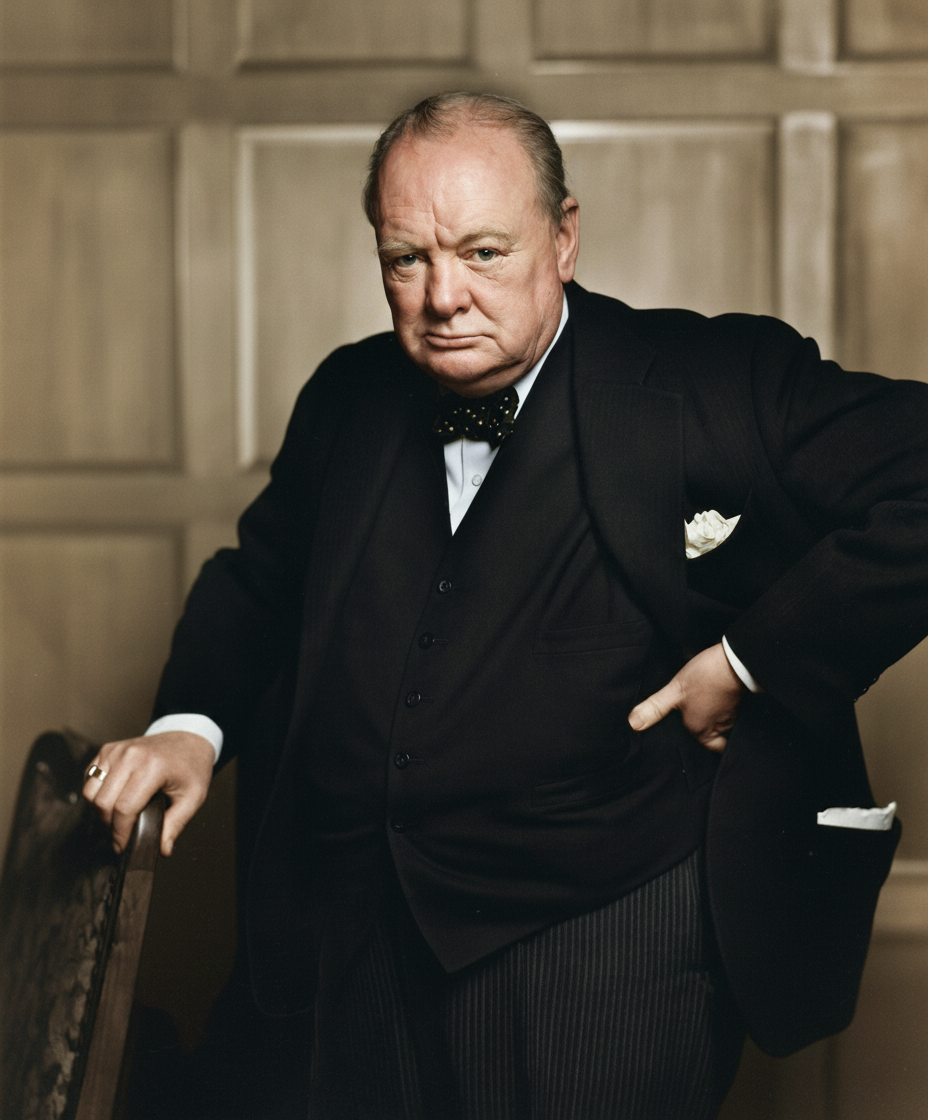
Winston Churchill
The indefatigable statesman who led Britain through its 'finest hour' and shaped the post-war global order.
Winston Spencer Churchill was a prolific British statesman, writer, and orator who served as Prime Minister of the United Kingdom from 1940 to 1945 and again from 1951 to 1955. A dominant figure in British politics for five decades, he is best remembered for his wartime leadership, galvanized by his exceptional oratory and strategic foresight.
Biography
Accomplishments
- 01Led Great Britain as Prime Minister through World War II (1940-1945), successfully mobilizing national morale and resources against Nazi Germany.
- 02Instrumental in forming the Grand Alliance (UK, US, USSR) against the Axis powers, securing vital aid and coordinated strategy.
- 03Orchestrated the evacuation of over 338,000 Allied soldiers from Dunkirk (May-June 1940), transforming a potential catastrophe into a morale-boosting 'miracle'.
- 04Delivered iconic speeches ('Blood, Toil, Tears, and Sweat', 'We Shall Fight on the Beaches') that galvanized public support and maintained national resolve during existential threat.
- 05Served as a leading advocate for European unity post-WWII, delivering the 'Iron Curtain' speech (1946) which highlighted the emerging Cold War geopolitical divide and the necessity of Western alliance.
- 06Authored numerous historical and biographical works, including 'The Second World War' (6 volumes), for which he was awarded the Nobel Prize in Literature in 1953.
Lessons for Operators
Key Takeaways
Practical lessons distilled for operators, investors, C-levels, and capital allocators.
Unflinching Resolve in Adversity
Churchill's leadership during WWII exemplifies how an organization's chief can instill resolve when faced with existential threats. His refusal to consider surrender, despite immense pressure and military disadvantage, set the tone for the entire British war effort. This is directly applicable to business leaders confronting market downturns, disruptive innovations, or strategic failures; a steadfast commitment to the mission is foundational.
The Power of Persuasive Communication
His unparalleled oratorical skills were not just about rhetoric; they were strategic tools. Churchill used words to clarify objectives, unify diverse factions, and inspire action. For leaders, this underscores the necessity of clear, compelling messaging to employees, investors, and partners, especially when navigating complex or challenging initiatives.
Primacy of Strategic Foresight
Churchill spent the 'wilderness years' analyzing intelligence and warning of the Nazi threat, enabling a quicker, albeit still reactive, national response when war broke out. This highlights the value of internal 'red teams' or dedicated strategic intelligence functions that can identify and articulate macro-level risks and opportunities long before they become immediate crises, allowing for proactive positioning.
Coalition Building as a Force Multiplier
He masterfully constructed and maintained the Grand Alliance. Understanding that Britain could not defeat Germany alone, he invested heavily in diplomatic efforts and strategic compromise with the U.S. and Soviet Union. This translates to the imperative for businesses to form robust partnerships, joint ventures, and industry alliances to access complementary resources, expand market reach, or mitigate competitive pressures.
Adaptability Amidst Unpredictability
Despite strong personal convictions, Churchill demonstrated a capacity to adapt military and political strategy as circumstances evolved, from the initial defensive posture to offensive campaigns. Leaders must recognize that initial plans are rarely perfect; continuous assessment and willingness to pivot based on real-time data and changing competitive landscapes are crucial for long-term viability.
Frameworks & Principles
Named frameworks and strategic principles they popularized or embodied.
The 'Blood, Toil, Tears, and Sweat' Doctrine
Churchill's ethos of offering raw, unvarnished truth about the challenges ahead, coupled with a demand for supreme effort, rather than false optimism. He didn't promise easy victories, but rather committed struggle for a worthy goal.
When to useWhen communicating severe challenges or setbacks to stakeholders. Use to set realistic expectations, galvanize collective effort, and demonstrate authentic leadership through transparency in times of crisis or significant transformation, thereby building trust.
The 'Iron Curtain' Prognosis
A strategic articulation of an emerging geopolitical reality, pinpointing an ideological and physical schism. This involved calling out a threat and proposing a collective response, rather than allowing events to unfold passively.
When to useApplicable when identifying and communicating a significant, yet perhaps under-recognized, shift in market dynamics, competitive landscape, or regulatory environment. Use to frame a new strategic imperative and rally support for a pre-emptive or responsive strategy across an organization or industry.
The 'Never Give In' Principle
Churchill's steadfast refusal to countenance surrender or capitulation, even when facing overwhelming odds. It emphasizes the maintenance of strategic objectives and moral high ground despite tactical defeats.
When to useWhen an organization faces intense competitive pressure, a product failure, or a significant financial downturn. Employ to reinforce core values, maintain long-term vision, and motivate teams to persevere through short-term difficulties without sacrificing fundamental objectives or integrity.
Explore Related Titans
Other figures in the archive who share Winston Churchill's domain, geography, or era.
More in Other

From United Kingdom



Contemporaries — 19th century