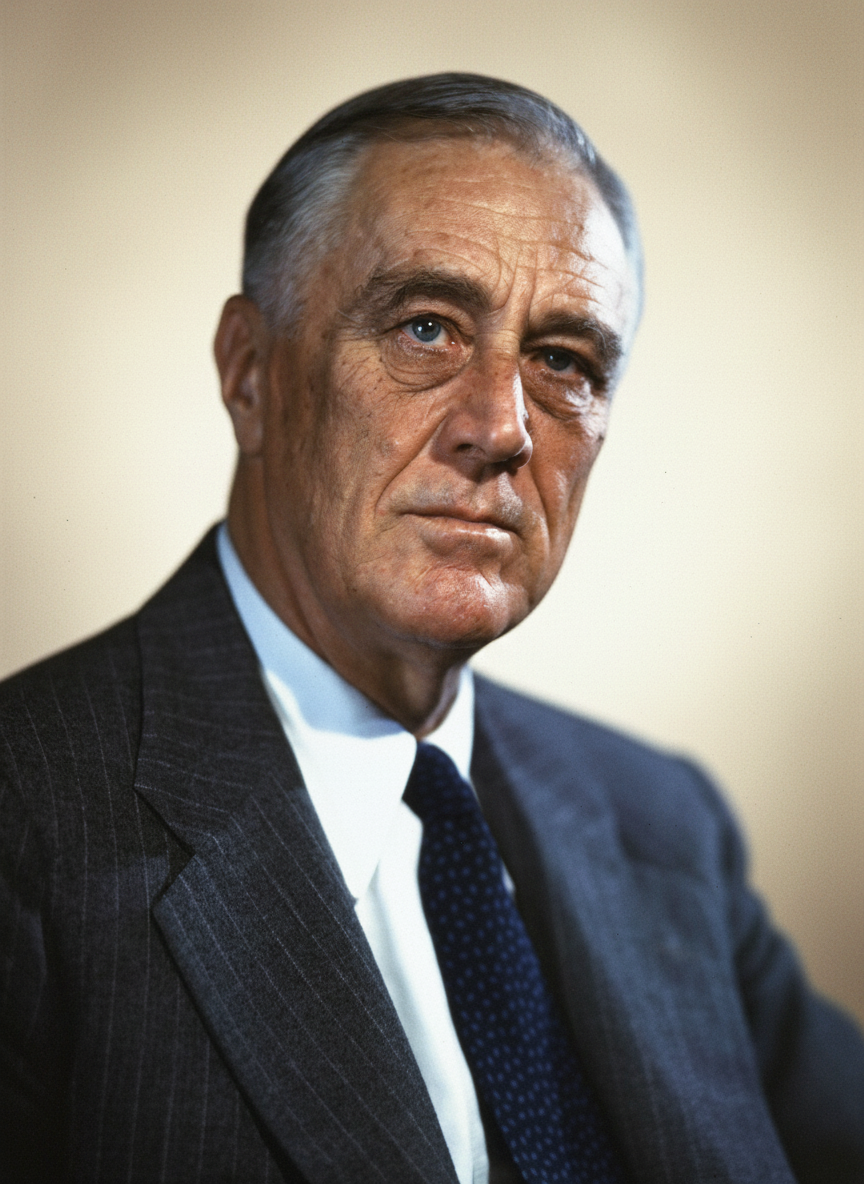
Franklin D. Roosevelt
The architect of modern governmental intervention and a transformative wartime leader.
Franklin D. Roosevelt (FDR) served as the 32nd President of the United States from 1933 until his death in 1945. Leading the nation through the Great Depression and World War II, his New Deal policies fundamentally reshaped the role of government in the economy and society, while his wartime leadership was instrumental in the Allied victory.
Biography
Accomplishments
- 01Implemented the New Deal during the Great Depression (1933-1939), introducing unprecedented federal programs such as the Civilian Conservation Corps (CCC) and the Tennessee Valley Authority (TVA) to stimulate employment and economic development.
- 02Signed the Social Security Act of 1935, creating a foundational social safety net that included unemployment insurance and old-age pensions, permanently altering the role of government in social welfare.
- 03Led the United States through World War II (1941-1945), mobilizing the industrial capacity for war production (e.g., Liberty Ships, aircraft production targets) and forging key international alliances, contributing decisively to Allied victory.
- 04Established a regulatory framework for financial markets with the creation of the Securities and Exchange Commission (SEC) in 1934 and the Glass-Steagall Act (1933), introducing deposit insurance and separating commercial from investment banking.
- 05Maintained public morale and confidence through effective communication, particularly his 'Fireside Chats,' which directly addressed the American people and explained complex policy decisions during times of national crisis.
- 06Laid the diplomatic groundwork for the post-war international order, including the Bretton Woods institutions (IMF, World Bank) and the United Nations, shaping global economic and political structures for decades.
Lessons for Operators
Key Takeaways
Practical lessons distilled for operators, investors, C-levels, and capital allocators.
Bold Interventionism
FDR proved that during extreme market failures or national emergencies, decisive governmental intervention can prevent total collapse and lay the groundwork for recovery. Operators should recognize when market forces alone are insufficient and advocate for or implement corrective actions.
Stakeholder Communication
His 'Fireside Chats' were a masterclass in direct, empathetic communication. Leaders must speak plainly, acknowledge difficulties, and explain their strategies to maintain trust and support from employees, investors, and the public, especially during uncertainty.
Adaptive Strategy
FDR's approach to the New Deal was often characterized by 'bold, persistent experimentation.' Leaders should be willing to launch initiatives, evaluate their effectiveness, and pivot or terminate programs that are not yielding results, rather than clinging to failed strategies.
Long-term Institutional Building
Beyond immediate relief, FDR established institutions (e.g., SEC, Social Security, UN framework) designed to prevent future crises and provide enduring stability. Businesses should focus on creating resilient organizational structures and policies that outlast current challenges.
Crisis as Opportunity
The Great Depression and WWII were profound crises, but FDR leveraged them to fundamentally reshape the American economy and political landscape. Astute leaders identify opportunities for strategic repositioning and transformative change during turbulent periods.
Frameworks & Principles
Named frameworks and strategic principles they popularized or embodied.
New Deal Philosophy (Relief, Recovery, Reform)
A multi-pronged approach to crisis management, focusing on immediate support for those in need (Relief), stimulating economic activity (Recovery), and permanently fixing systemic issues (Reform) to prevent future downturns. Examples include the Emergency Banking Act (Relief), Public Works Administration (Recovery), and Social Security Act (Reform).
When to useApplicable for organizations facing systemic challenges: 1) Stabilize immediate losses/distress, 2) Re-engage core operations and market activity, and 3) Implement structural changes to prevent recurrence or foster long-term growth and resilience.
Fireside Chat Communication Model
A direct, empathetic, and explanatory communication strategy where a leader regularly addresses a broad audience to clarify policies, explain challenges, and build trust and moral. FDR used radio to connect directly with the American public, simplifying complex issues.
When to useDuring periods of high uncertainty, significant organizational change, or widespread anxiety. Useful for leaders to distill complex strategic shifts, major investment decisions, or market challenges into understandable terms for all stakeholders (employees, investors, partners).
Grand Alliance Strategy
The formation of a coalition of disparate entities (Allied powers) with a common, overriding objective (defeat the Axis powers) despite ideological differences, based on shared strategic necessity. Required extensive negotiation, resource coordination, and compromise.
When to useWhen confronting an existential external threat or pursuing a monumental, shared objective that requires collaboration between diverse, sometimes rival, entities. Applicable to joint ventures, multi-firm consortia, or cross-industry alliances where common purpose overrides internal friction.
Sources & Further Reading
Profiles, interviews, podcasts, and articles used to compile and verify this entry. Each link opens at the original publisher.
Explore Related Titans
Other figures in the archive who share Franklin D. Roosevelt's domain, geography, or era.
More in Other


From United States

Contemporaries — 19th century