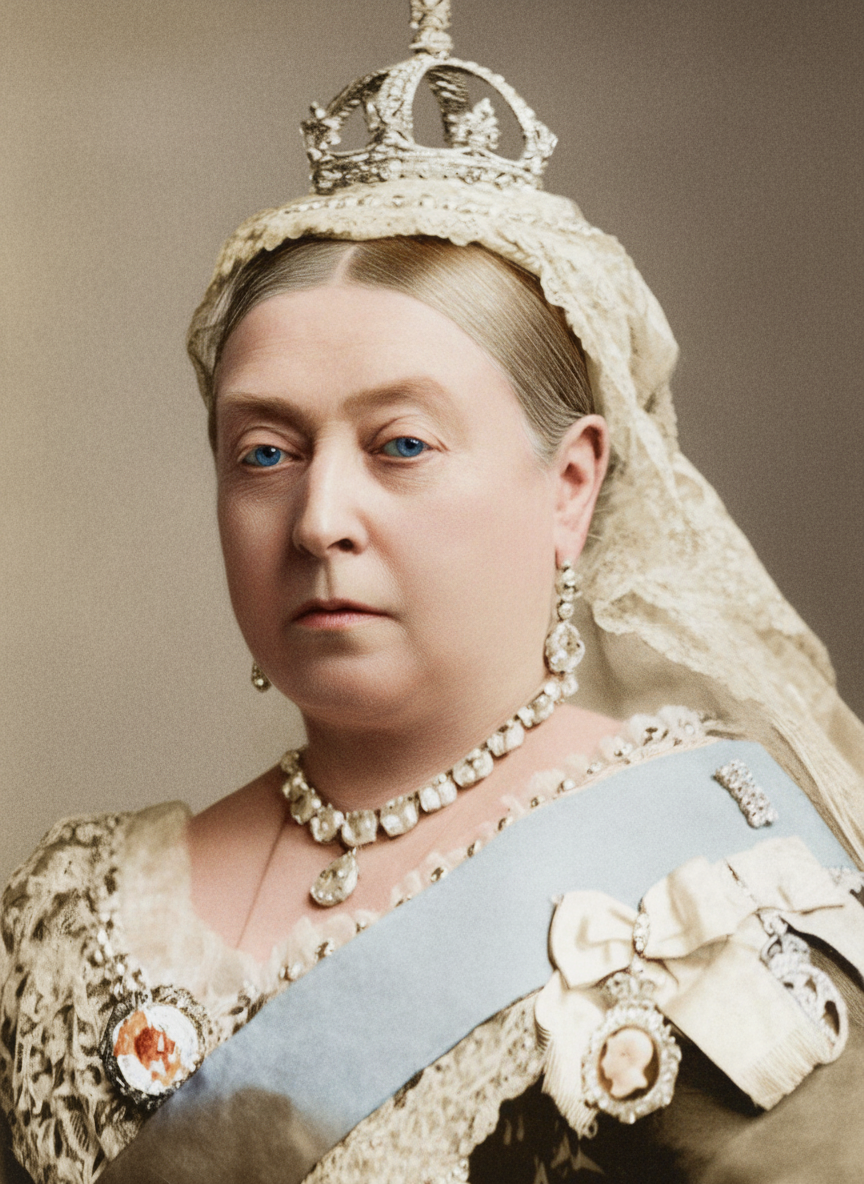
Queen Victoria
The enduring matriarch who presided over an era of unparalleled imperial expansion and industrial transformation.
Alexandrina Victoria, Queen of the United Kingdom of Great Britain and Ireland, Empress of India, reigned for 63 years and seven months, a period known as the Victorian Era. During her reign, the British Empire reached its zenith, encompassing roughly a quarter of the world's population and land area. She navigated constitutional evolution, oversaw massive industrialization, and became a symbol of national stability amidst global change.
Biography
Accomplishments
- 01Presided over the global expansion of the British Empire, which by 1900 controlled approximately 25% of the world's land area and population, ensuring access to raw materials and markets.
- 02Maintained political stability during a period of significant domestic and international upheaval, including waves of industrial unrest and continental revolutions, by adapting the monarchy to a constitutional role.
- 03Championed industrial and technological advancement, notably through her support for the Great Exhibition of 1851, which showcased British manufacturing prowess and fostered international trade and innovation.
- 04Facilitated significant economic growth and the establishment of the 'Pax Britannica,' which provided a stable global environment conducive to British commercial and financial dominance.
- 05Successfully transitioned the British monarchy into a modern, symbolic institution, exercising influence through advice and moral authority rather than direct political intervention.
- 06Oversaw the professionalization of the public service and military, enhancing administrative efficiency and imperial governance.
- 07Through her long reign, fostered a sense of continuity and national identity, which proved critical during periods of rapid social and economic change.
Lessons for Operators
Key Takeaways
Practical lessons distilled for operators, investors, C-levels, and capital allocators.
Adaptability is paramount for enduring leadership.
Victoria's ability to transition the monarchy from an absolute power to a constitutional one, recognizing Parliament's ascendancy, preserved the institution. Organizations must continually adapt their core strategies and structures to changing market dynamics and regulatory environments to ensure long-term viability.
Symbolic leadership can be as powerful as direct command.
While not directly governing, Victoria's moral authority and symbolic presence provided immense stability and unity for the Empire. Leaders should cultivate a strong personal brand and organizational culture, as these 'soft' assets can significantly impact employee morale, public trust, and stakeholder relations.
Strategic global presence minimizes risk and maximizes opportunity.
The British Empire's vast reach secured diverse raw materials, extended trade routes, and opened new markets, reducing dependence on any single region. Businesses should diversify their operational footprint, supply chains, and market access to build resilience against regional disruptions and capitalize on global growth opportunities.
Invest in infrastructure for long-term economic dividends.
The Victorian era witnessed massive investments in railways, shipping, and communication networks across the Empire, which underpinned economic growth and facilitated administration. Fund managers should identify and allocate capital to critical infrastructure projects that provide foundational support for economic expansion and long-term returns.
The importance of a stable political and economic environment.
The 'Pax Britannica' created a stable global order conducive to trade and industrial growth, benefiting British commerce. Capital allocators should prioritize investments in regions with stable governance and predictable regulatory frameworks, as political risk can significantly erode returns.
Frameworks & Principles
Named frameworks and strategic principles they popularized or embodied.
Constitutional Adaptation Model
Examines how an established, centralized authority gradually cedes direct control while maintaining significant influence through counsel, symbolic representation, and moral authority.
When to useApplicable when a legacy organization needs to transition its leadership structure to a more distributed or democratic model without losing its fundamental identity or influence. Useful for family businesses planning succession or large corporations decentralizing decision-making.
Imperial Reach & Resource Diversification Strategy
A strategy focused on establishing control over geographically diverse territories and resources to minimize reliance on any single source or market, ensuring continuous supply and expanded market access.
When to useRelevant for multinational corporations considering market entry, supply chain optimization, or resource acquisition. Useful for assessing geopolitical risks and opportunities in global expansion strategies.
Symbolic Capital Leveraging Model
Outlines how a leader or institution can effectively utilize its historical legacy, public persona, and perceived moral authority to influence stakeholders and maintain stability, even without direct executive power.
When to useUseful for navigating periods of organizational change, reputation management, or establishing brand loyalty. Applicable for C-suite leaders and communications teams shaping public perception and stakeholder trust.
Sources & Further Reading
Profiles, interviews, podcasts, and articles used to compile and verify this entry. Each link opens at the original publisher.
Explore Related Titans
Other figures in the archive who share Queen Victoria's domain, geography, or era.
More in Other










From United Kingdom








Contemporaries — 19th century