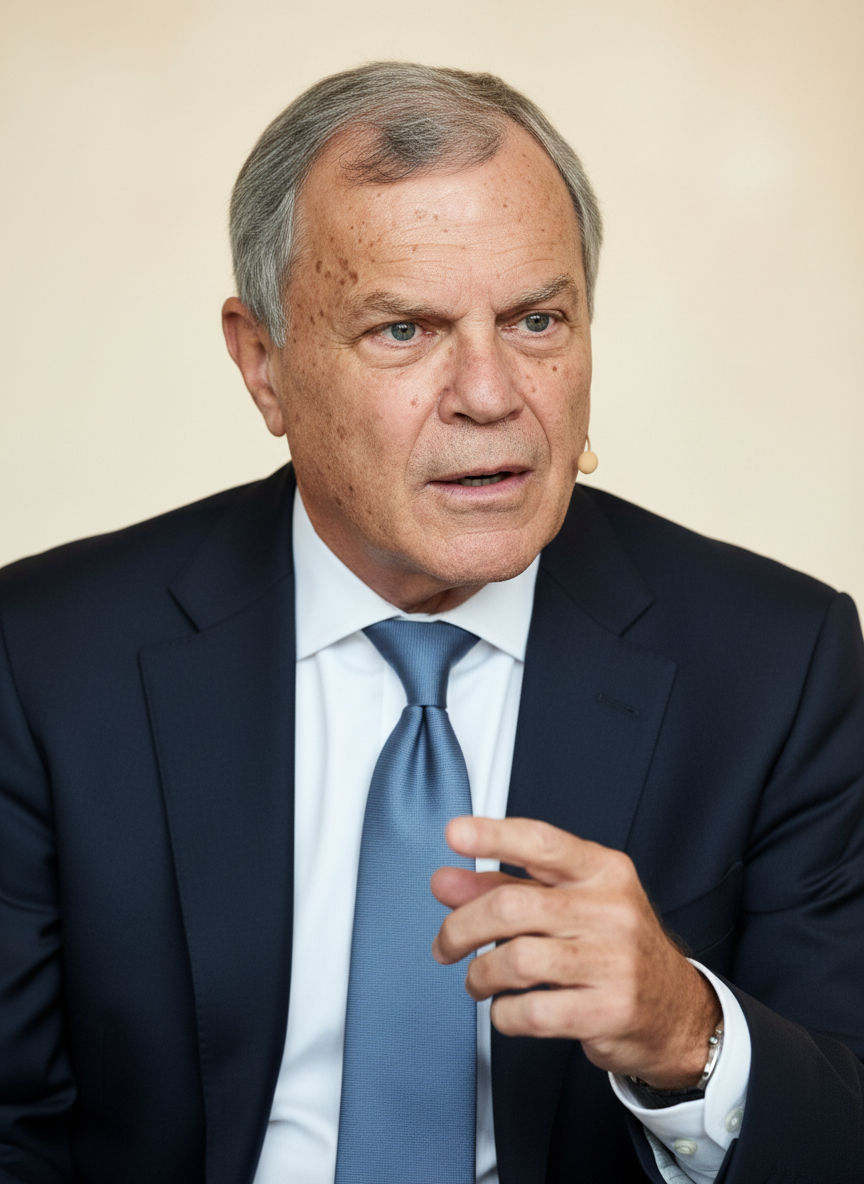
Sir Martin Sorrell
The architect of WPP, transforming a wire-basket manufacturer into the world's largest advertising and marketing services company.
Sir Martin Sorrell is a British advertising executive who founded WPP plc in 1985. Through a series of aggressive acquisitions, he built WPP into the world's largest advertising and marketing services company, overseeing its growth for over three decades.
Biography
Accomplishments
- 01Founded WPP in 1985 and grew it from a small holding company into the world's largest advertising and marketing services group with annual revenues exceeding £15 billion.
- 02Engineered the hostile takeovers of J. Walter Thompson (1987) and Ogilvy & Mather (1989), fundamentally reshaping the advertising industry's structure.
- 03Successfully diversified WPP's offerings beyond traditional advertising into media buying, public relations, branding, and digital marketing, anticipating industry shifts.
- 04Led WPP to establish a significant global presence, particularly in emerging markets, through strategic acquisitions and organic growth.
- 05Pioneered the 'horizontality' model within WPP, encouraging collaboration and service integration across its diverse portfolio of agencies for major clients.
- 06Founded S4 Capital in 2018, rapidly building a new digital-first advertising and marketing services company with a focus on first-party data, programmatic, and content.
- 07Successfully leveraged capital markets and debt financing to fuel an aggressive and sustained acquisition strategy for over three decades.
Lessons for Operators
Key Takeaways
Practical lessons distilled for operators, investors, C-levels, and capital allocators.
The Consolidation Playbook
Sorrell demonstrated that a highly fragmented industry can be systematically consolidated through aggressive, debt-financed acquisitions. This requires a clear vision for scale and strong capital markets access. For operators, this means identifying industries ripe for consolidation and developing executable M&A strategies. For investors, it highlights the potential for value creation in 'roll-up' strategies.
Future-Proofing through Diversification
His consistent acquisition of digital, data, and PR assets showcased a forward-thinking approach to an evolving market. Sorrell understood that traditional advertising alone would not suffice. Leaders must continuously assess their core offerings and seek to acquire or build capabilities that address emerging client needs and technological shifts.
Financial Acumen as a Strategic Advantage
Sorrell's background as a CFO at Saatchi & Saatchi provided him with the financial engineering skills necessary to execute complex, multi-billion-dollar deals. For C-levels and fund managers, this underscores the importance of deep financial understanding in strategic execution, beyond just operational expertise.
The Power of Global Scale and Integrated Services
WPP's 'horizontality' aimed to offer clients a seamless suite of services across geographies and disciplines. This model, while challenging to implement, caters to large multinational clients seeking integrated solutions. Enterprise leaders should consider how to break down internal silos to offer more holistic value propositions.
Resilience and Reinvention
Sorrell's rapid launch of S4 Capital post-WPP demonstrates an unparalleled drive and ability to adapt. He immediately pivoted to a 'new era' model focused on even greater agility and digital specialization. This highlights that entrepreneurial spirit is not tied to a single venture but is a continuous force, demanding constant iteration.
Frameworks & Principles
Named frameworks and strategic principles they popularized or embodied.
The 'Wire and Plastic Products' Shell Strategy
Acquiring a small, publicly listed company (a 'shell') to use its existing listing and structure as the foundation for a completely new, often unrelated, business venture, bypassing a traditional IPO.
When to useWhen seeking a fast track to public markets or a clean corporate vehicle for a new strategic direction, particularly in an industry where rapid consolidation or capital raising is critical. Requires deep financial engineering capability.
Aggressive Hostile Takeover Model
Involves acquiring target companies, often publicly traded, against the wishes of their management or board, typically through direct appeals to shareholders and offering a premium price. Sorrell used this to acquire major agencies like JWT and Ogilvy & Mather.
When to useWhen rapid market share gain, elimination of key competitors, or access to critical assets/talent is paramount, and other acquisition avenues (friendly M&A) are unavailable or too slow. Requires substantial capital, legal expertise, and a willingness to engage in public corporate battles.
Horizontal Integration/WPP 'Horizontality'
A strategy focused on acquiring diverse, complementary businesses within the same value chain or related industries (e.g., advertising, PR, media buying, digital) to offer clients a 'one-stop-shop' for all their marketing needs, encouraging collaboration among portfolio companies.
When to useWhen serving large, complex clients who demand integrated solutions, or when seeking to capture a larger share of client spending across various service lines. Requires strong organizational design and incentive alignment to foster inter-company collaboration.
Sources & Further Reading
Profiles, interviews, podcasts, and articles used to compile and verify this entry. Each link opens at the original publisher.
Explore Related Titans
Other figures in the archive who share Sir Martin Sorrell's domain, geography, or era.
More in Media & Entertainment







From United Kingdom







Contemporaries — born 1940s