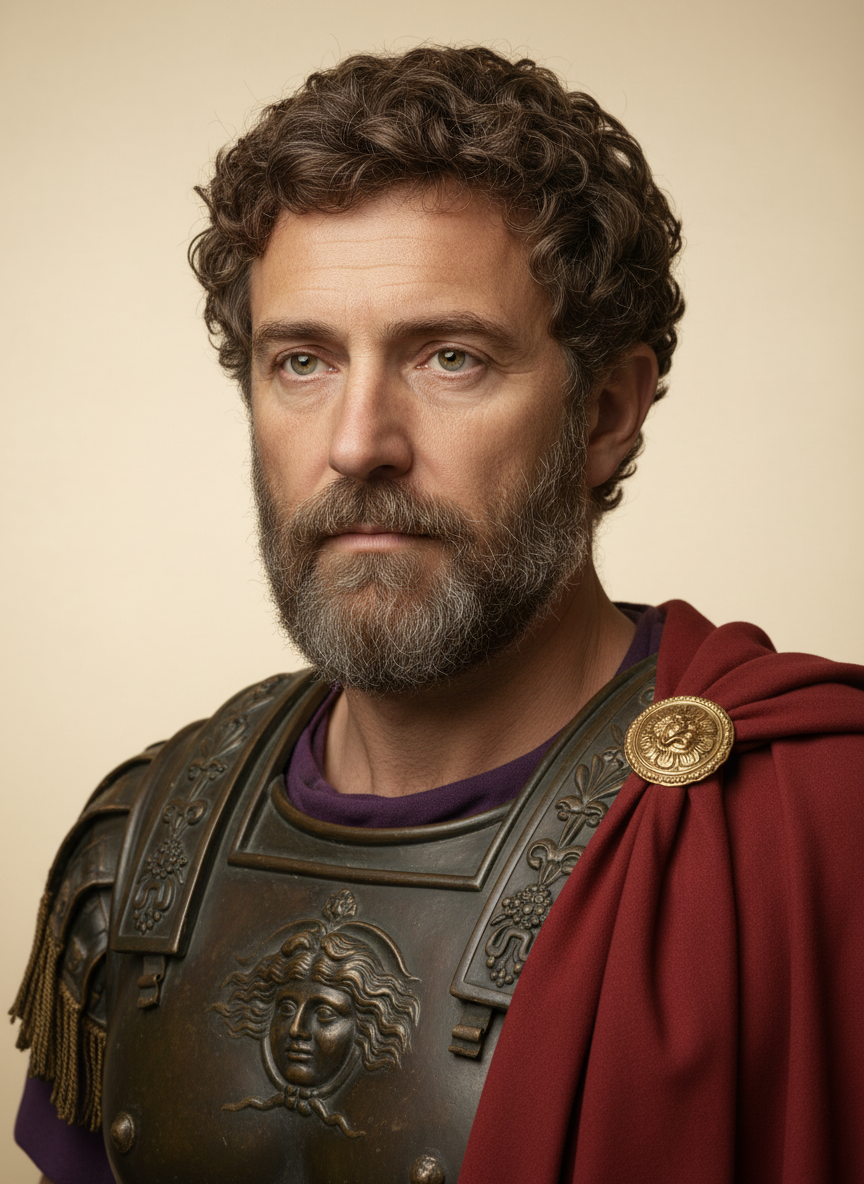
Marcus Aurelius
The Philosopher Emperor: A Stoic Leader Navigating Crisis and Empire.
Marcus Aurelius Antoninus (121-180 CE) was a Roman Emperor who ruled from 161 AD until his death. He is widely considered one of the 'Five Good Emperors' and a pivotal figure in Stoic philosophy. His reign was marked by significant military conflicts, particularly the Marcomannic Wars, and the Antonine Plague, demanding constant strategic and ethical leadership.
Biography
Accomplishments
- 01Successfully prosecuted the Marcomannic Wars (166-180 CE), defending the Roman Empire's northern frontiers against Germanic tribes and Sarmatians, despite significant logistical and resource challenges.
- 02Maintained imperial stability and administrative continuity during the Antonine Plague, a pandemic that severely depopulated parts of the empire, preventing systemic collapse.
- 03Authored 'Meditations,' a foundational text of Stoic philosophy, which provides unique insights into leadership, ethics, and self-governance under extreme pressure.
- 04Fostered legal reforms, emphasizing fairness and the protection of vulnerable populations, including orphans and minors, demonstrating a commitment to ethical jurisprudence.
- 05Ensured a peaceful and orderly succession for nearly a century (180 CE) by establishing Commodus, albeit controversially, as his successor, although this was a deviation from the meritocratic adopted succession model.
Lessons for Operators
Key Takeaways
Practical lessons distilled for operators, investors, C-levels, and capital allocators.
Immutable Mindset in Volatile Markets
Marcus Aurelius demonstrated that cultivating a Stoic mindset—focusing on control over one's reactions and decisions rather than external, uncontrollable events—is paramount for leaders in volatile environments. This psychological resilience prevents panic and enables rational, long-term strategic thinking through crises.
Diversified Risk Mitigation
His approach to imperial security, combining military action, diplomacy, and strategic resettlement, shows the value of a diversified risk mitigation strategy. Relying on multiple levers, rather than a single solution, enhances resilience and adaptability in complex threat landscapes.
Operationalizing Self-Reflection
The 'Meditations' are a practical template for operationalizing self-reflection. Regular personal audits of ethical principles, strategic rationale, and emotional state are critical for C-levels to maintain intellectual and moral clarity, especially when executing high-impact decisions.
Resource Optimization Under Constraint
Aurelius's willingness to liquidate imperial assets to fund critical operations during severe fiscal crises exemplifies acute resource optimization. Leaders must be prepared to make unconventional and potentially unpopular decisions regarding capital allocation to safeguard long-term viability.
Strategic Delegation for Scalability
Effective delegation to trusted and competent subordinates (e.g., generals like Avidius Cassius) freed Aurelius to focus on macro-level imperial strategy. This highlights the necessity of building strong, autonomous teams to achieve scale and sustained execution.
The Imperative of Long-Term Resilience
His continuous engagement in multi-year campaigns, despite their protracted nature and strain on resources, underscores the importance of a long-term strategic vision over short-term gains. Building enduring value often requires sustained effort and perseverance through adversity.
Anchoring Leadership in Ethical Frameworks
Aurelius consistently sought to align his governance with principles of justice and fairness. For modern leaders, grounding corporate strategy in clear ethical frameworks builds enduring trust with stakeholders and fosters a resilient organizational culture, even when faced with expediency.
Frameworks & Principles
Named frameworks and strategic principles they popularized or embodied.
The Dichotomy of Control (Stoicism)
Distinguishes between things that are within one's power (thoughts, actions, reactions) and things that are not (external events, others' opinions, outcomes). The objective is to focus energy and attention solely on what can be controlled, thereby reducing anxiety and enabling rational decision-making.
When to useWhen facing situations with high uncertainty, external pressures, or uncontrollable variables (e.g., market downturns, regulatory changes, competitor actions). Operators can apply this to focus on internal team performance, product quality, and strategic pivots rather than external market sentiment.
Premeditatio Malorum (Premeditation of Evils)
A Stoic practice of mentally rehearsing potential future misfortunes or challenges. By contemplating worst-case scenarios, one can diminish their psychological impact if they occur and proactively plan mitigation strategies.
When to useFor scenario planning, risk assessment, and contingency development in business strategy (e.g., anticipating supply chain disruptions, economic recessions, competitive threats). Investors can use this to stress-test portfolios against various adverse market conditions.
Amor Fati (Love of Fate)
The acceptance and embrace of everything that happens, not merely tolerating it, but actively willing it, recognizing that such events are part of the larger 'logos' or order. It encourages finding agency and purpose within unchangeable circumstances.
When to useIn post-mortem analysis of failures, unwelcomed events (e.g., failed product launches, acquisition failures, market shifts). Rather than dwelling on regret, leaders can use 'Amor Fati' to extract lessons, adapt, and integrate experiences positively into future strategy, fostering resilience and learning.
Memento Mori (Remember You Must Die)
A reflection on the inevitability of death, serving as a reminder of the preciousness of time and the urgency of living virtuously and purposefully. It encourages prioritizing what truly matters and avoiding procrastination.
When to useFor strategic prioritization, time management, and encouraging a bias for action. C-levels and fund managers can use this to focus on high-impact projects, maintain urgency in execution, and ensure that current actions align with long-term vision and legacy, avoiding deferring crucial decisions.
Quotations
"The impediment to action advances action. What stands in the way becomes the way."
"You have power over your mind — not outside events."
Sources & Further Reading
Profiles, interviews, podcasts, and articles used to compile and verify this entry. Each link opens at the original publisher.
Explore Related Titans
Other figures in the archive who share Marcus Aurelius's domain, geography, or era.
More in Other