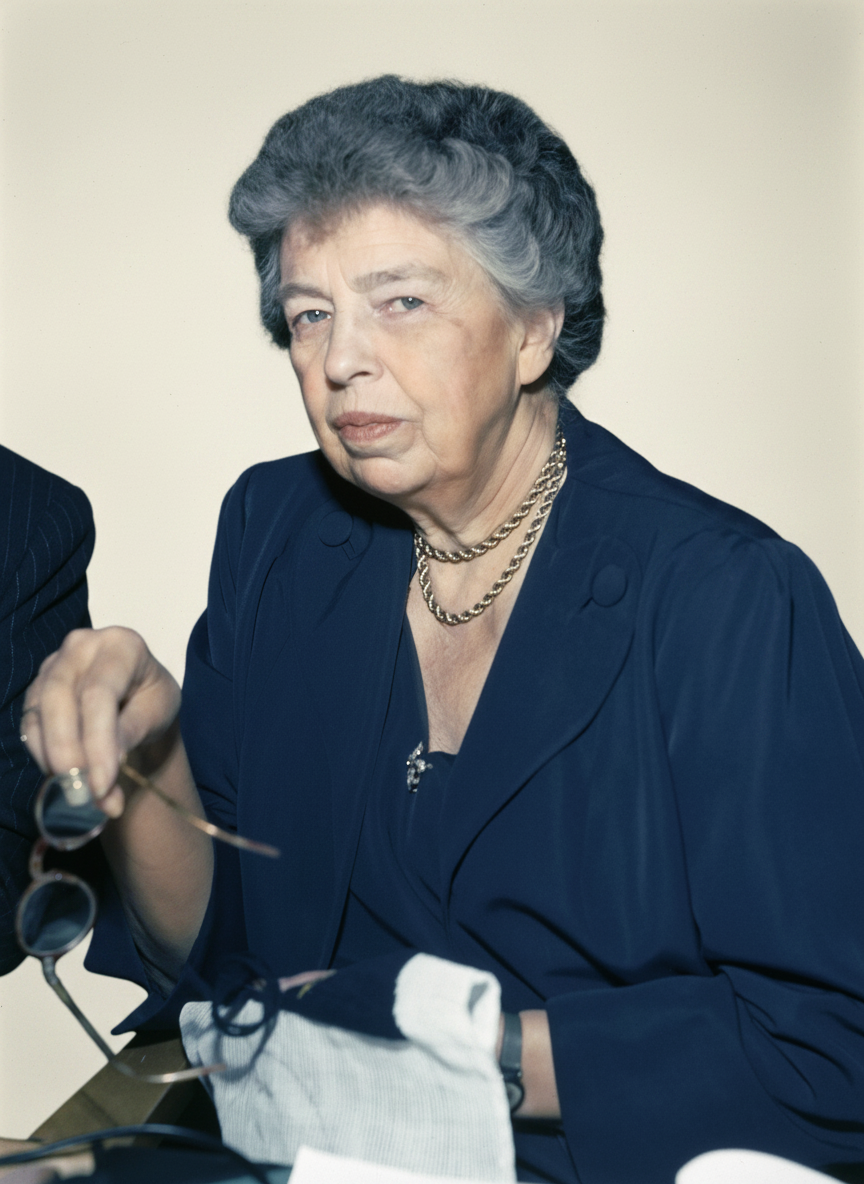
Eleanor Roosevelt
Architect of Modern Diplomacy and Human Rights Advocacy
Eleanor Roosevelt, an American political figure, diplomat, and activist, redefined the role of First Lady. She championed civil rights, human rights, and social justice, leveraging her platform to advocate for marginalized communities and influence domestic and international policy. Post-presidency, she played a pivotal role in drafting the Universal Declaration of Human Rights.
Biography
Accomplishments
- 01Redefined the role of First Lady by actively engaging in policy advocacy, conducting press conferences, and extensive public speaking tours, significantly expanding the office's influence (1933-1945).
- 02Championed civil rights, notably advocating for African Americans and intervening in cases of discrimination, such as arranging Marian Anderson's 1939 Lincoln Memorial concert after the DAR denied her a venue, showcasing direct action against systemic injustice.
- 03Instrumental in advancing women's rights, advocating for women's roles in government and public life, and speaking on behalf of working women and issues affecting families.
- 04Led the drafting committee for the Universal Declaration of Human Rights (UDHR) at the United Nations, successfully overseeing its adoption in 1948, establishing a foundational global standard for human rights.
- 05Served as a U.S. delegate to the United Nations General Assembly (1945-1952), demonstrating effective post-presidency public service and diplomatic leadership.
- 06Authored syndicated newspaper column 'My Day' from 1935 to 1962, reaching millions and providing a direct communication channel to the public on social and political issues.
Lessons for Operators
Key Takeaways
Practical lessons distilled for operators, investors, C-levels, and capital allocators.
Proactive Platform Utility
Do not merely occupy a position; actively deploy its inherent influence. Roosevelt demonstrated that a title’s power is defined by the energy and intention brought to it, expanding the scope of the First Lady's role through direct engagement and advocacy. Operators should proactively define and expand their sphere of influence.
Principled Advocacy for Long-Term Value
Commit to causes aligned with ethical principles, even if they lack immediate popular support. Roosevelt's unwavering commitment to civil rights, despite opposition, eventually laid groundwork for historical progress. This reinforces the idea that true leadership often involves championing long-term societal good over short-term political expediency or market sentiment.
Coalition Building and Diverse Engagement
Success in complex endeavors hinges on bringing together disparate groups. Her ability to unite diverse voices for human rights at the UN exemplifies diplomatic skill. Leaders must actively seek out and integrate varied perspectives to foster robust solutions and gain broader buy-in.
Sustained Public Communication
Consistent and authentic communication is crucial for shaping public opinion and mobilizing support. Her 'My Day' column maintained a direct connection with the populace. C-levels should prioritize transparent, regular communication strategies to build stakeholder trust and align teams effectively.
Post-Primary Role Impact
Impact doesn't end with a role transition. Roosevelt's post-White House work at the UN redefined global human rights. Business leaders and fund managers should consider how their accumulated experience and networks can be repurposed for significant new ventures or societal contributions after exiting primary operational roles.
Direct Action on Injustice
Addressing discrimination requires more than rhetoric; it demands direct, visible action. Her public stand against the DAR showcased leadership through immediate, tangible intervention. Enterprise leaders should be prepared to intervene decisively and publicly against bias or injustice within their organizations.
Frameworks & Principles
Named frameworks and strategic principles they popularized or embodied.
The 'First Amplifier' Model
Utilizing a significant traditional platform (e.g., First Lady, CEO of a major firm) as an 'amplifier' to bring attention and momentum to under-recognized or politically difficult social and policy issues, rather than merely performing ceremonial duties.
When to useWhen occupying a high-profile, influential position with significant public visibility but limited direct executive authority, to drive agenda items through persuasion and public engagement. Applicable for senior advisors, board members, or philanthropic leaders.
Transnational Coalition-Building for Norm Creation
A strategy focused on conveninge diverse international stakeholders to forge consensus on fundamental principles (e.g., human rights) that can establish new global norms and frameworks, transcending national interests.
When to useApplicable for leaders aiming to establish industry standards, create international regulatory frameworks, or drive multi-national initiatives where shared values and principles are critical for success, such as ESG mandates or global supply chain ethics.
The 'Public Conscience' Strategy
Adopting a role as a moral compass or 'public conscience' within a political or corporate structure, challenging conventions and speaking out against injustices even when it conflicts with established institutional norms or short-term gains.
When to useRelevant for ethical leadership in organizations facing pressure to compromise on values, or for industry reformers seeking to shift dominant paradigms through moral suasion and outspoken advocacy. Requires significant personal integrity and courage.
Sources & Further Reading
Profiles, interviews, podcasts, and articles used to compile and verify this entry. Each link opens at the original publisher.
Explore Related Titans
Other figures in the archive who share Eleanor Roosevelt's domain, geography, or era.
More in Other




From United States






Contemporaries — 19th century