
Philip Kotler
The father of modern marketing, Philip Kotler revolutionized marketing theory by integrating economics, behavioral science, and management, defining the discipline for academics and practitioners alike.
Philip Kotler is an American marketing author, consultant, and professor. He is the S. C. Johnson & Son Distinguished Professor of International Marketing at the Kellogg School of Management at Northwestern University. Kotler is widely regarded as one of the world's leading experts on marketing, having authored over 80 books and 150 articles on the subject, most notably 'Marketing Management,' the most widely used marketing textbook in graduate business schools worldwide.
Biography
Accomplishments
- 01Authored 'Marketing Management' (1967), the leading textbook in graduate business schools, now in its 16th edition, which has been translated into over 25 languages and sold millions of copies.
- 02Pioneered the concept of 'social marketing' in the 1970s, applying commercial marketing techniques to promote public health, environmental protection, or other social goals, influencing global public policy campaigns.
- 03Introduced and popularized the concept of 'holistic marketing' in the early 2000s, advocating for a broad, integrated perspective that encompasses relationship marketing, integrated marketing, internal marketing, and societal marketing.
- 04Co-founded the Marketing Science Institute (MSI) in 1961, a leading research organization dedicated to bridging the gap between marketing theory and business practice.
- 05Received numerous awards, including being the first person to receive the American Marketing Association's 'Distinguished Marketing Educator Award' (1985) and being ranked by The Wall Street Journal as one of the top 10 most influential business thinkers.
- 06Developed and disseminated the '4Ps of Marketing' (Product, Price, Place, Promotion), a foundational framework for marketing strategy, alongside Jerome McCarthy, making complex marketing concepts accessible and actionable.
- 07Advocated for 'demarketing,' a strategy to reduce demand for certain products or services, especially when supply is limited or when the product is socially undesirable (e.g., tobacco, overconsumption of resources).
- 08Authored over 80 books and 150 articles, providing foundational knowledge and advanced insights across all facets of marketing, from strategic planning to digital transformation.
Lessons for Operators
Key Takeaways
Practical lessons distilled for operators, investors, C-levels, and capital allocators.
Holistic Marketing Imperative
Modern enterprises must adopt a holistic marketing approach, integrating internal departments (internal marketing), ensuring consistent brand messaging (integrated marketing), fostering customer relationships (relationship marketing), and considering societal impact (societal marketing). This unified strategy ensures all stakeholders work towards a common, customer-focused goal.
Strategic Market Segmentation
Operators and investors must ensure businesses effectively segment their markets. Identifying distinct customer groups based on demographics, psychographics, behaviors, and needs allows for precise targeting, optimized product development, and more efficient allocation of marketing resources, leading to higher conversion rates and customer satisfaction.
The Enduring Power of Brand Equity
Kotler emphasizes that a strong brand is a critical asset. Companies must consistently invest in building and maintaining brand equity through superior product quality, effective communication, and positive customer experiences. A robust brand commands price premiums, fosters loyalty, and provides a significant competitive moat.
Innovation as a Marketing Differentiator
Continuous innovation, whether in product features, service delivery, or business models, is crucial for sustaining market leadership. Companies that fail to innovate risk obsolescence. Investors should prioritize firms demonstrating a clear commitment to R&D and market-driven product cycles.
Data-Driven Marketing Optimization
Leverage analytics and marketing intelligence to track performance, understand customer journeys, and optimize campaigns. C-levels and fund managers should demand quantifiable metrics for marketing spend, moving beyond anecdotal evidence to performance-based allocation.
The Shift to Digital and Relationship Marketing
While Kotler's initial frameworks predated widespread digital transformation, his principles seamlessly adapt. Digital channels facilitate personalized relationship marketing and data collection. Enterprises must integrate digital strategies to build one-to-one customer relationships at scale, fostering loyalty and advocacy in an increasingly connected world.
Marketing for Societal Value
Beyond profit, businesses gain legitimacy and long-term viability by contributing to societal well-being. Incorporate social and environmental considerations into core business and marketing strategies. This resonates with modern consumers and stakeholders, enhancing brand reputation and attracting mission-aligned talent and investors.
Adaptive Marketing for Dynamic Environments
Markets are not static. Businesses must be agile, constantly monitoring external environments (economic, technological, social, competitive) and adapting their marketing strategies accordingly. Scenario planning and flexible marketing budgets are essential for navigating uncertainty and capitalizing on emerging opportunities.
Frameworks & Principles
Named frameworks and strategic principles they popularized or embodied.
The 4 Ps of Marketing (Marketing Mix)
A foundational framework for developing marketing strategy, consisting of Product (what the company offers), Price (how much customers pay), Place (how and where the product is distributed), and Promotion (how customers are informed and persuaded).
When to useUse when developing or auditing a core marketing strategy for any product or service. Essential for ensuring comprehensive consideration of all key marketing elements before launch or strategic pivot.
Holistic Marketing
An integrated approach that emphasizes a broad, integrated perspective on marketing, encompassing relationship marketing (building long-term relationships), integrated marketing (consistent messaging across channels), internal marketing (aligning employees), and societal marketing (ethical and social considerations).
When to useApply when formulating a comprehensive, long-term marketing strategy, especially in complex organizations or competitive markets. Ideal for ensuring internal alignment and external relevance, building strong brand equity, and fulfilling corporate social responsibility.
STP (Segmentation, Targeting, Positioning)
A three-step process for identifying and serving specific market segments. Segmentation divides the market into distinct groups, Targeting selects which segments to serve, and Positioning creates a unique value proposition for the chosen segments.
When to useUtilize when entering new markets, launching new products, or seeking to refine existing market strategies. Critical for optimizing resource allocation and developing highly effective, tailored marketing campaigns for specific customer groups.
Customer Value Delivery Process
A three-phase process: choosing the value (segmentation, targeting, positioning), providing the value (product development, pricing, sourcing, distribution), and communicating the value (sales force, advertising, promotions). It emphasizes creating and delivering superior customer value at every stage.
When to useEmploy when designing a new product-market strategy or evaluating the end-to-end customer experience. Ensures that value creation is integrated throughout the business process, from conceptualization to post-purchase support.
Recent Appearances
Latest interviews, keynotes, and press from the past half year.
 youtube.com
 youtube.com
 m.youtube.com
 youtube.com
 youtube.com
 youtube.com
 youtube.com
 youtube.com
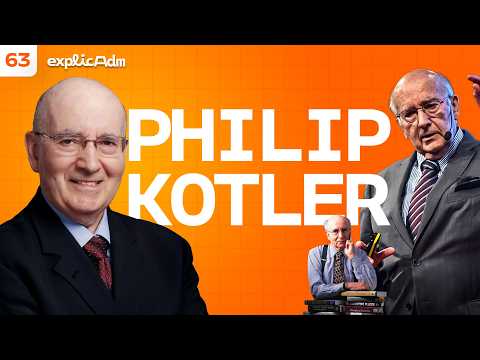 youtube.com
 youtube.com
 youtube.com
 youtube.com
 youtube.com
 youtube.com
 youtube.com
 youtube.com
 youtube.com
 youtube.com
 youtube.com
 youtube.com
 youtube.com
 youtube.com
 m.youtube.com
 youtube.com
 youtube.com
Sources & Further Reading
Profiles, interviews, podcasts, and articles used to compile and verify this entry. Each link opens at the original publisher.
Explore Related Titans
Other figures in the archive who share Philip Kotler's domain, geography, or era.
More in Media & Entertainment








From United States










Contemporaries — born 1930s