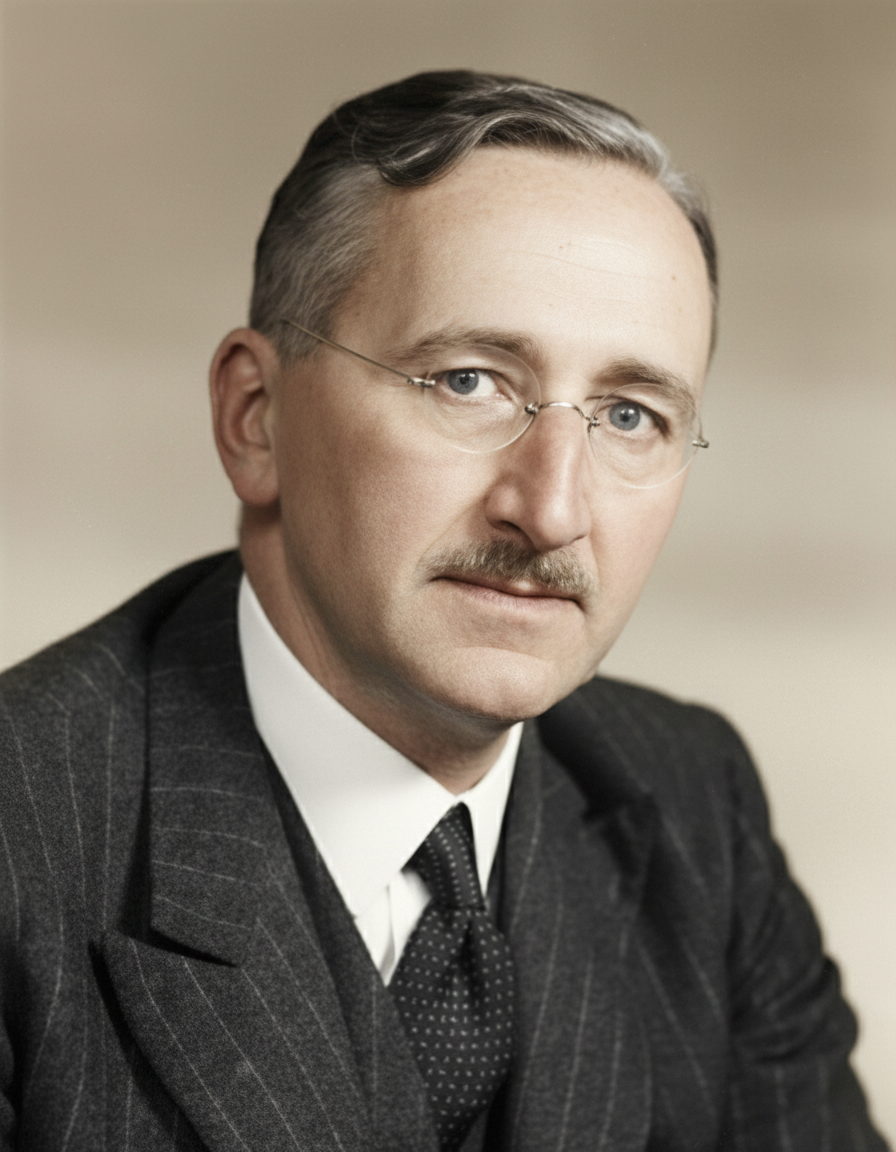
Friedrich Hayek
Nobel laureate economist who championed individual liberty, free markets, and the perils of central planning.
Friedrich August von Hayek was an Austrian-born British economist and philosopher best known for his defense of classical liberalism and free-market capitalism against socialist and collectivist thought. He was a prominent member of the Austrian School of economics and received the Nobel Memorial Prize in Economic Sciences in 1974.
Biography
Accomplishments
- 01Awarded the Nobel Memorial Prize in Economic Sciences in 1974 for his work on the theory of money, economic fluctuations, and the interdependence of economic, social, and institutional phenomena.
- 02Authored 'The Road to Serfdom' (1944), a highly influential book warning against the dangers of socialism and central planning, shaping conservative and libertarian thought globally.
- 03Co-founded the Mont Pèlerin Society in 1947, bringing together classical liberal scholars to promote free-market ideas and principles.
- 04Developed the concept of 'spontaneous order,' explaining how complex social structures can emerge from decentralized individual actions without central direction.
- 05Pioneered the 'knowledge problem,' arguing that centralized economic planning is inherently inefficient due to the impossibility of central authorities acquiring and processing all dispersed, localized knowledge necessary for optimal resource allocation.
- 06Made significant contributions to monetary theory, critiquing Keynesian economics and arguing for the destabilizing effects of central bank interventions on the business cycle.
Lessons for Operators
Key Takeaways
Practical lessons distilled for operators, investors, C-levels, and capital allocators.
Decentralization of Knowledge
Hayek posited that knowledge is dispersed, tacit, and contextual. Operators should empower teams with autonomy and information at the periphery, rather than centralizing decision-making. Investors should be wary of top-down mandates that ignore localized market intelligence.
Spontaneous Order in Organizations
Highly effective organizations often develop 'spontaneous order' – emergent processes and solutions that arise from the interaction of individuals, rather than being rigidly designed from above. Leaders should create environments conducive to this, fostering collaboration and experimentation, rather than over-prescribing.
The Perils of Over-Regulation
Excessive regulation, even with good intentions, can stifle innovation, distort price signals, and create unintended negative consequences. Business leaders must articulate the practical costs of regulatory creep to policymakers and seek agile regulatory frameworks.
Market Process as Discovery
Competition is not merely about winners and losers; it's a dynamic process of discovery of new methods, products, and services. Investors should favor companies that embrace competition, continuously innovate, and adapt to changing market signals rather than seeking protective barriers.
Importance of Rule of Law and Institutions
Predictable, transparent legal frameworks and stable institutions are foundational for economic prosperity. Capital allocators should prioritize investments in regions with robust rule of law, protecting property rights and contractual agreements, as this reduces risk and encourages long-term capital formation.
Frameworks & Principles
Named frameworks and strategic principles they popularized or embodied.
The Knowledge Problem
This framework highlights that the dispersed, tacit, and contextual nature of knowledge makes centralized economic planning inherently inefficient. No single entity can ever possess all the information needed to optimally allocate resources across a complex economy.
When to useApply when analyzing the effectiveness of centralized versus decentralized organizational structures, evaluating the feasibility of top-down mandates in complex systems, or arguing for market-based solutions over government intervention.
Spontaneous Order
This concept explains how complex social and economic phenomena (like markets, language, or common law) arise not from deliberate design by a central authority, but from the uncoordinated actions of many individuals pursuing their own goals. These emergent orders are often more robust and efficient than designed ones.
When to useUtilize when seeking to understand how resilient systems develop, designing flexible organizational structures that empower individual decision-making, or promoting bottom-up innovation over centrally planned initiatives.
The Road to Serfdom Thesis
This framework argues that attempts at centralized economic planning and increasing state control, even in democratic societies, can gradually lead to the erosion of individual liberties and a trajectory towards totalitarianism, as the state needs ever more control to enforce its plans.
When to useEmploy when evaluating the long-term societal and economic implications of increased government intervention, advocating for policies that protect individual freedom and free markets, or assessing the risks of mission creep in public sector projects.
Explore Related Titans
Other figures in the archive who share Friedrich Hayek's domain, geography, or era.
More in Other




From Austria

Contemporaries — 19th century