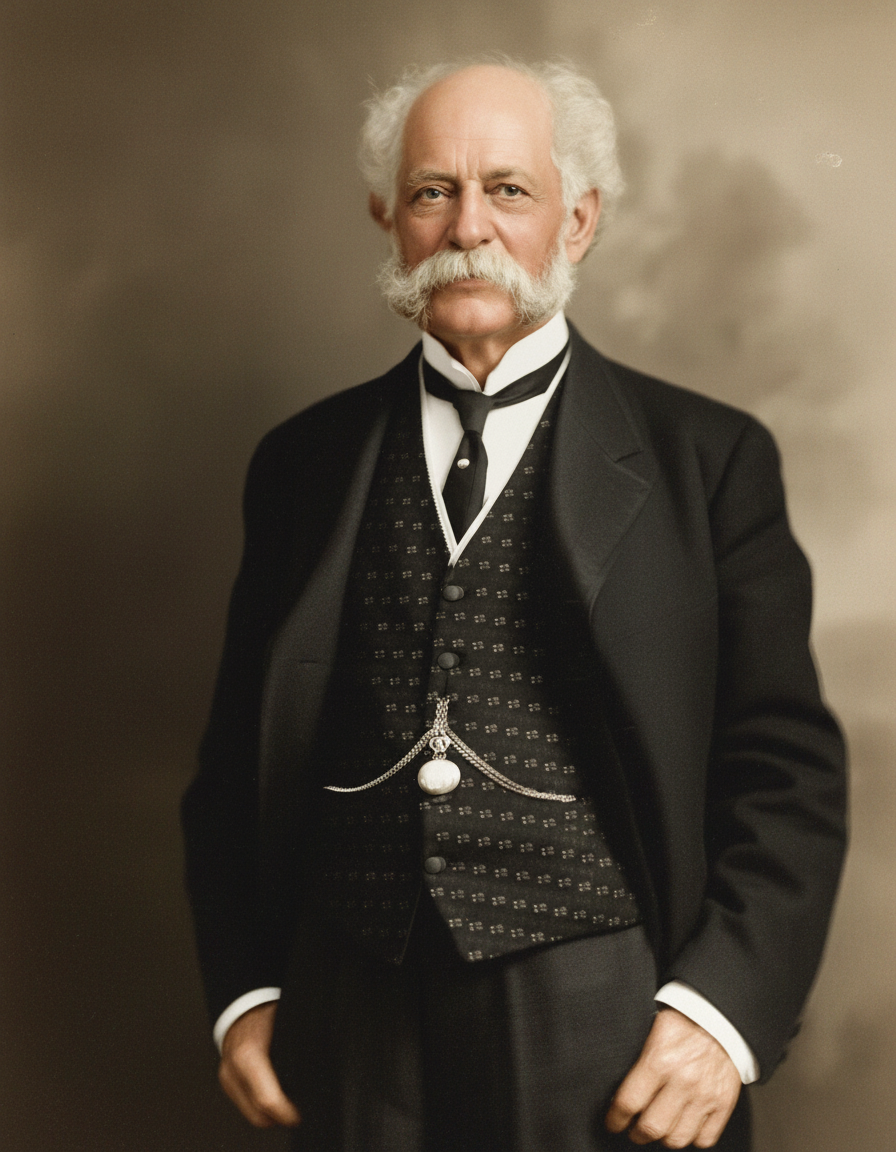
Ludwig von Mises
The intellectual architect of modern Austrian economics and a staunch defender of free markets against socialist and interventionist doctrines.
Ludwig von Mises was a leading economist and social philosopher of the Austrian School. He argued extensively for economic liberalism and against socialism and government intervention. His work laid foundational principles for market-based analysis, emphasizing individual action, subjective value, and the critical role of prices in resource allocation.
Biography
Accomplishments
- 01Published 'The Theory of Money and Credit' (1912), developing the 'regression theorem' to explain the origin of money's value and integrating monetary theory into general value theory.
- 02Authored 'Socialism: An Economic and Sociological Analysis' (1922), systematically demonstrating the impossibility of rational economic calculation under socialism due to the absence of private property and market prices.
- 03Developed Praxeology, the formal science of human action, as the methodological foundation for economic science in 'Human Action: A Treatise on Economics' (1949).
- 04Influenced a generation of economists and intellectuals through his private seminar in Vienna (1920s-1930s), including Nobel laureates F.A. Hayek and Oskar Morgenstern.
- 05Formulated a robust defense of classical liberalism and free markets, contributing significantly to the philosophical and economic arguments against interventionism and collectivism.
- 06Articulated the 'Austrian theory of the business cycle,' explaining booms and busts as consequences of artificial credit expansion by central banks.
Lessons for Operators
Key Takeaways
Practical lessons distilled for operators, investors, C-levels, and capital allocators.
The Indispensability of the Price System
Mises demonstrated that genuine economic calculation, essential for rational resource allocation, is impossible without market-generated prices. These prices convey vast amounts of decentralized knowledge about scarcity and preferences. Operators must ensure their internal systems and market analysis are grounded in real-time, undistorted price signals to make optimal capital allocation decisions.
Critique of Socialism and Central Planning
His 'socialist calculation argument' proved that centrally planned economies could not achieve rational allocation due to the lack of private property and a functional price mechanism. For businesses, this underscores the perils of over-centralization and the need to empower teams with market-analogous information and decision-making autonomy.
Methodological Individualism (Praxeology)
Mises insisted economics must start from the purposeful action of individuals. This means understanding consumer behavior, incentive structures, and entrepreneurial foresight. C-levels should focus on how policies and products impact individual choices and motivations, rather than relying solely on aggregate data that can obscure causal links.
The Austrian Theory of the Business Cycle
Mises argued that business cycles are caused by central bank interventions, specifically artificial credit expansion, which distorts interest rates and misdirects investment. Fund managers and investors should critically assess periods of easy money and identify sectors prone to malinvestment when credit is artificially cheap.
The Dangers of Interventionism
Any government intervention, from price controls to tariffs, inevitably distorts markets and leads to unintended consequences that often require further interventions, creating a downward spiral. Enterprise leaders must champion free-market principles and carefully assess the long-term impact of regulatory or political interventions on their operating environment and competitive landscape.
The Entrepreneur as the Driver of Progress
Mises celebrated the entrepreneur as the primary agent of change and progress, whose innovative actions and risk-taking drive economic development. Capital allocators should identify and support entrepreneurs who possess genuine market insight and the courage to challenge the status quo, understanding that their efforts are crucial for wealth creation.
Frameworks & Principles
Named frameworks and strategic principles they popularized or embodied.
Socialist Calculation Argument
This framework posits that without private ownership of the means of production and the resulting price system, a socialist economy cannot rationally allocate resources because it lacks the necessary information to determine the relative scarcity and value of goods and services.
When to useApply this when evaluating investment opportunities in heavily regulated or state-controlled industries, or when assessing the efficiency and viability of large, centrally managed internal projects lacking transparent P&L structures and internal pricing mechanisms.
Praxeology (The Science of Human Action)
Praxeology is Mises's methodology for economics, asserting that economic laws are derived from the logical implications of the universal fact of human action – that individuals act purposefully to achieve desired ends.
When to useUtilize this framework to understand consumer behavior, employee motivation, and competitive strategies by focusing on the individual choices and incentives driving actions. It's particularly useful in market analysis, product design, and incentive structuring within organizations.
The Regression Theorem (Monetary Theory)
Explains that the purchasing power of money today is ultimately derived from its purchasing power yesterday, which was in turn derived from its purchasing power the day before, tracing back to a time when it functioned as a commodity with inherent non-monetary utility.
When to useApply this when analyzing the stability and long-term viability of new currencies (especially digital currencies) or monetary systems. It highlights the importance of historical precedent and underlying commodity value for initial acceptance, and the dangers of fiat currency without a credible institutional history.
Austrian Business Cycle Theory
This theory posits that business cycles (booms and busts) are caused by central bank interventions that artificially lower interest rates below their natural market level, leading to malinvestment in long-term capital projects and unsustainable economic expansion.
When to useUse this to anticipate and navigate economic downturns, particularly during periods of historically low interest rates and expansive monetary policy. Investors should be wary of industries propelled by artificially cheap credit and prepare for subsequent contractions as malinvestments are liquidated.
Sources & Further Reading
Profiles, interviews, podcasts, and articles used to compile and verify this entry. Each link opens at the original publisher.
Explore Related Titans
Other figures in the archive who share Ludwig von Mises's domain, geography, or era.
More in Other










Contemporaries — 19th century