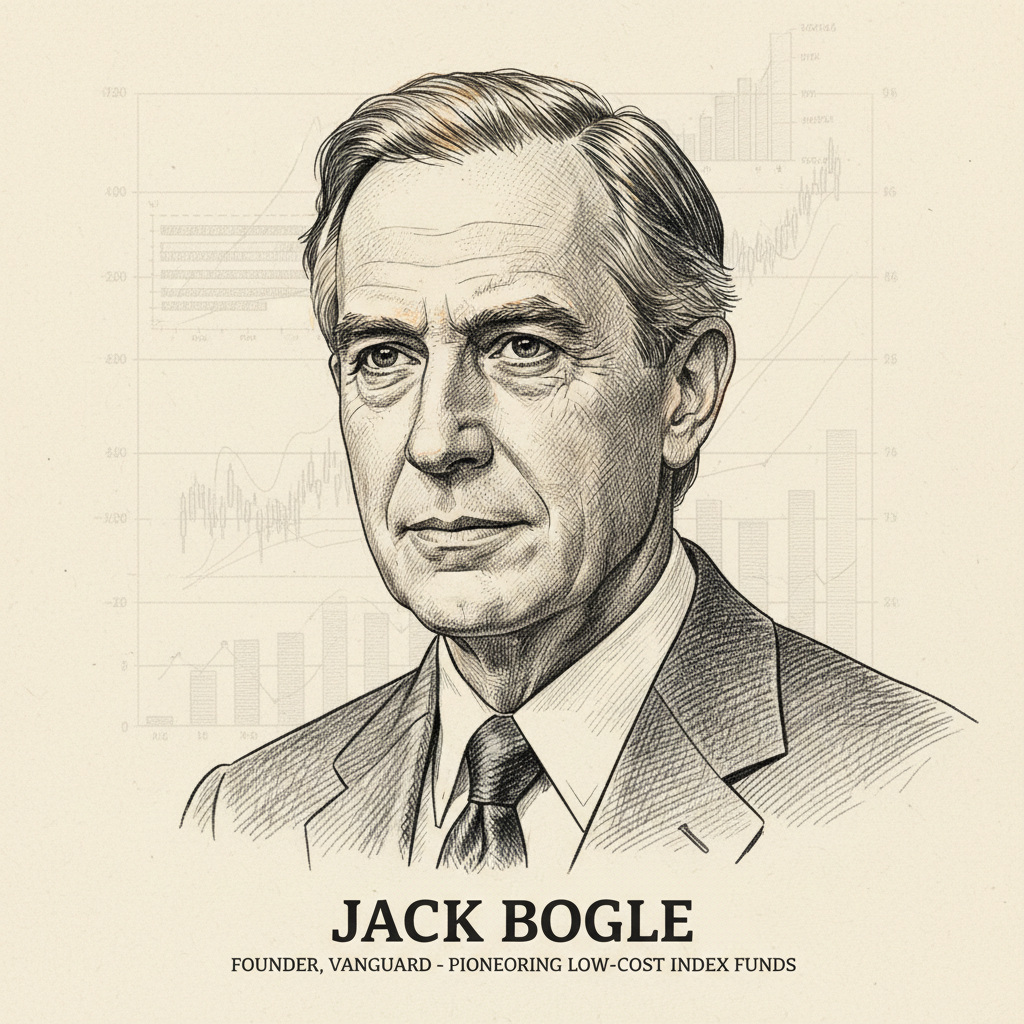
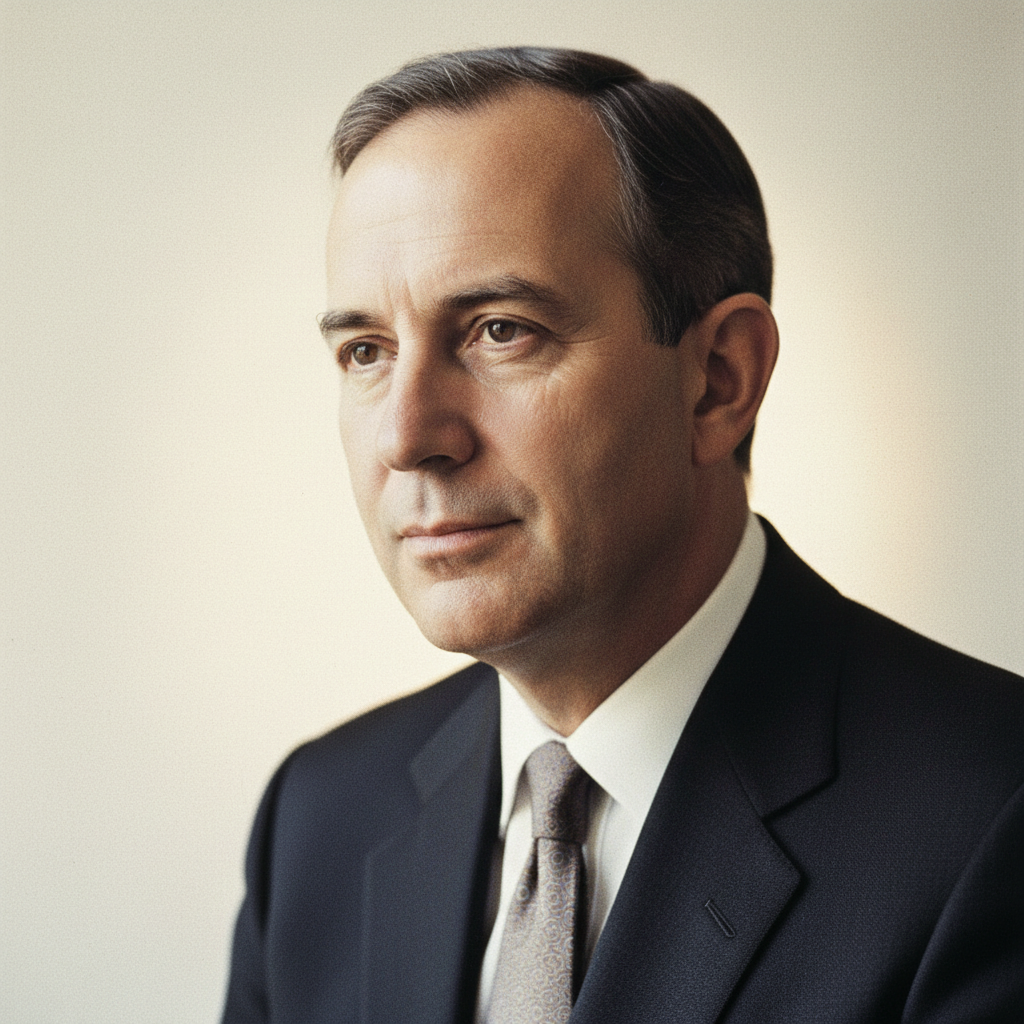
John Bogle
Revolutionized investing by founding Vanguard and championing low-cost index funds.
John Clifton 'Jack' Bogle was an American investor and business magnate. He founded The Vanguard Group in 1975, pioneering the concept of the retail index fund. Bogle's unwavering advocacy for low-cost, broadly diversified index investing fundamentally transformed the mutual fund industry, making investing more accessible and profitable for millions of individuals. He authored several influential books, including 'Common Sense on Mutual Funds: New Imperatives for the Intelligent Investor'.
Biography
Accomplishments
- 01Founded The Vanguard Group (1975), establishing a unique mutual corporate structure owned by its fund shareholders, eliminating external profit motives.
- 02Launched the First Index Investment Trust (1976), the first retail index mutual fund, pioneering passive investing for individual investors.
- 03Championed low-cost investing, drastically reducing expense ratios across the mutual fund industry and saving investors trillions of dollars.
- 04Authored 'Common Sense on Mutual Funds' (1999), a seminal work advocating for long-term, low-cost index investing, widely regarded as a foundational text in personal finance.
- 05Grew Vanguard from a nascent concept into one of the world's largest investment managers, overseeing trillions in assets under management.
- 06Created the 'Boglehead' investing philosophy, inspiring a community committed to rational, low-cost, diversified investment strategies.
Lessons for Operators
Key Takeaways
Practical lessons distilled for operators, investors, C-levels, and capital allocators.
Investor-Centric Business Models
Bogle's creation of Vanguard as a mutual company, owned by its fund shareholders, revolutionized the financial industry by demonstrating that a business could prioritize client returns over corporate profits. This model fostered transparency and enabled sustained cost reductions, proving that aligning incentives directly with the customer can create immense long-term value and market dominance. Operators should assess how their current business models align with core customer interests.
The Compounding Effect of Fees
His relentless focus on minimizing investment costs highlighted the exponential impact of expense ratios on long-term returns. Bogle quantified how even seemingly small annual fees (e.g., 1-2%) could erode a significant portion of an investor's wealth over decades. Fund managers and capital allocators must scrutinize every basis point of cost, as these directly detract from net alpha and overall portfolio performance.
Power of Passive Investing
Bogle popularized the index fund, asserting that for the vast majority, simply owning the market at minimal cost would outperform active management after fees. This insight, backed by decades of data, challenged the active fund industry and empowered individual investors. Leaders in any sector should evaluate if their 'active' interventions truly add value beyond a baseline, or if a more 'passive,' systemic approach would yield better outcomes with less friction.
Communication and Education as Strategy
Beyond product innovation, Bogle was a tireless educator and advocate. His clear, accessible writing and consistent messaging built trust and educated millions about sound investment principles. His 'Common Sense' approach was not just about products but about empowering investors with knowledge. Enterprise leaders should recognize that clear, consistent communication of their core value proposition and educational outreach can build enduring customer loyalty and market share.
Visionary Leadership and Persistence
Launching the first index fund was initially ridiculed. Bogle faced significant skepticism and entrenched industry opposition. His ability to articulate a long-term vision, stay true to his principles, and relentlessly advocate for investor interests ultimately transformed the industry. This demonstrates that revolutionary ideas often require profound conviction and persistence to overcome initial resistance and achieve widespread adoption.
Simplicity and Transparency
Bogle advocated for investment products that were simple to understand, transparent in their operations, and low in cost. This stood in contrast to the increasingly complex and opaque offerings prevalent in the financial sector. This focus on clarity and simplicity not only built trust but also reduced cognitive load for investors, proving that straightforward solutions often deliver superior results.
Frameworks & Principles
Named frameworks and strategic principles they popularized or embodied.
Boglehead Investment Philosophy
A set of principles for individual investors derived from John Bogle's teachings, emphasizing low-cost, broadly diversified index fund investing, long-term holding, and minimal trading. Core tenets include: investing in low-cost index funds, diversifying broadly, keeping costs low, minimizing taxes, and staying the course.
When to useApplicable for individual investors, retirement savers, and financial advisors seeking a disciplined, evidence-based approach to long-term wealth accumulation with minimal effort and cost. Also relevant for fund managers and capital allocators looking to understand efficient market hypothesis applications.
Vanguard's Mutual Structure Model
A unique corporate governance model where The Vanguard Group is owned by its U.S.-domiciled funds, which in turn are owned by their shareholders. This structure eliminates external shareholders and their profit motives, allowing the company to return profits to investors through lower expense ratios.
When to useUseful for business leaders and entrepreneurs considering alternative ownership structures, particularly in industries where aligning stakeholder interests with long-term customer benefit is paramount. Can be adapted by co-operatives, non-profits, or any entity seeking to embed customer-centricity at its foundational level.
Cost-Benefit Analysis for Active vs. Passive Investing
A framework for evaluating investment strategies by comparing the potential for active management outperformance against the guaranteed drag of higher fees. Bogle's work consistently highlighted that the gross return advantage of active managers rarely translates to net return superiority after costs, taxes, and behavioral errors.
When to useEssential for institutional investors, fund selectors, and individuals deciding between actively managed funds and index funds. Also applicable for C-levels assessing internal resource allocation: does the 'active' pursuit of a strategy justify its cost and risk profile versus a 'passive' market-following or industry-standard approach?
Sources & Further Reading
Profiles, interviews, podcasts, and articles used to compile and verify this entry. Each link opens at the original publisher.
Explore Related Titans
Other figures in the archive who share John Bogle's domain, geography, or era.
More in Finance & Investing








From United States






Contemporaries — born 1920s