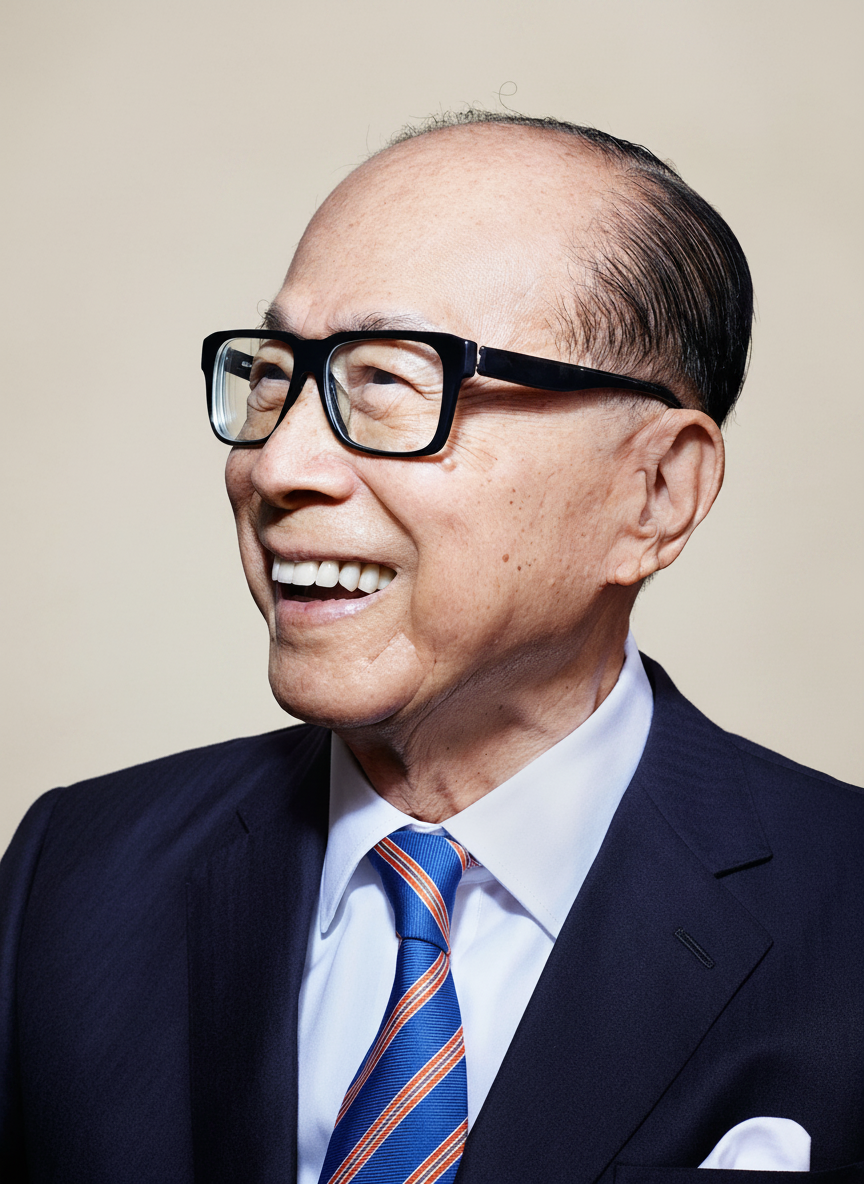
Li Ka-shing
From plastics to global ports, infrastructure, and telecoms: A master of diversified conglomerate building and strategic asset allocation.
Li Ka-shing is a Hong Kong business magnate who built a global empire spanning real estate, ports, infrastructure, retail, and telecommunications from humble beginnings in plastics manufacturing. Known for his prescient deal-making and aggressive expansion, he became one of Asia's wealthiest and most influential entrepreneurs.
Biography
Accomplishments
- 01Founded Cheung Kong Industries (now CK Hutchison Holdings) in 1950, transforming it from a plastics manufacturer into a global diversified conglomerate.
- 02Acquired Hutchison Whampoa Limited in 1979 from HSBC, gaining control of extensive international port operations, retail chains (e.g., ParknShop, Watson's), and diverse industrial holdings.
- 03Pioneered investment in 3G mobile technology in Europe (e.g., '3' network), demonstrating foresight in telecommunications despite initial market skepticism, and later achieved significant divestments.
- 04Built one of the world's largest independent port operators, Hutchison Port Holdings, with operations spanning over 50 ports in 27 countries.
- 05Successfully navigated multiple economic and political shifts in Hong Kong and globally, consistently growing his empire through strategic acquisitions and timely divestments.
- 06Executed a major restructuring of his conglomerate in 2015, separating real estate and infrastructure assets from other diversified business, enhancing transparency and investor focus.
- 07Established the Li Ka Shing Foundation in 1980, allocating over US$3.8 billion to philanthropic initiatives globally, with a significant focus on education and healthcare.
Lessons for Operators
Key Takeaways
Practical lessons distilled for operators, investors, C-levels, and capital allocators.
Strategic Agility & Opportunism
Li's empire was not built on a single innovation but on a relentless pursuit of undervalued assets and emerging markets (e.g., Hong Kong real estate in the 1960s, global port expansion in the 1980s, European telecom in the 1990s). His ability to pivot between industries (plastics to property to ports to telecom) and geographies (Hong Kong to global, then into China, and back to global) demonstrates unparalleled strategic agility. Operators should continuously scan for macro shifts and inefficiencies, not just within their core business.
Capital Allocation Mastery
His track record is a clinic in efficient capital allocation – acquiring assets when cheap (e.g., Hutchison Whampoa from HSBC), developing them, and divesting when rich (e.g., selling Orange plc, numerous European utility stakes). This cycle of 'buy low, build, sell high' funded subsequent expansions. Investors should analyze capital allocation decisions of leadership, looking for similar patterns of value creation, not just operational metrics.
Patience and Long-Term Vision
While known for deals, many of his core holdings like ports and infrastructure are long-term assets requiring significant upfront capital and patience for returns. His willingness to make large, foundational investments and hold them for decades is a hallmark of his strategy. Fund managers should assess management's ability to balance short-term performance with long-term strategic building, recognizing that not all value is created quarter-to-quarter.
Risk Mitigation Through Diversification
The sheer breadth of his conglomerate across diverse and often uncorrelated sectors (real estate, logistics, retail, utilities, telecom) and geographies provided significant resilience against economic downturns or regulatory headwinds in any single market or industry. C-levels should evaluate the systemic risks within their portfolio and consider strategic diversification, whether through M&A or organic expansion, to build a more antifragile enterprise.
Geopolitical Acumen
Li consistently navigated complex political landscapes, particularly between Hong Kong, mainland China, and Western markets. His ability to anticipate policy shifts and manage relationships at the highest levels was instrumental in securing major projects and protecting assets. Enterprise leaders must integrate geopolitical analysis into their strategic planning, understanding its direct impact on market access, regulatory environment, and competitive dynamics.
Restructuring for Value Creation
The 2015 restructuring of his empire into CK Hutchison Holdings and CK Asset Holdings was a sophisticated move to simplify the structure, unlock value, and make the businesses more understandable and attractive to investors. This move increased transparency and provided a clearer investment thesis for different asset classes. Capital allocators should look for management teams willing to undertake bold structural changes to optimize shareholder value and improve market perception.
Frameworks & Principles
Named frameworks and strategic principles they popularized or embodied.
Opportunistic Diversification Matrix
Li Ka-shing's strategic approach involved systematically identifying and entering diverse sectors and geographies, often unrelated, that presented undervalued assets or high-growth potential. He used profits from one successful venture to fund the next, continuously reallocating capital to maximize returns across a broad portfolio.
When to useApplicable for operators and investors seeking to build resilient, long-term enterprises. Use when existing core business generates significant free cash flow and opportunities for M&A or organic expansion exist in adjacent or even distant sectors, provided the fundamental value proposition and market timing are strong. Requires deep market intelligence and a robust capital allocation framework.
Asset Cycle Management (Acquire-Develop-Monetize)
This framework centers on acquiring assets (often distressed or undervalued) at a low point in their market cycle, actively developing or optimizing them, and then monetizing them (through sale or spin-off) at or near peak valuation. Li famously applied this to real estate, port operations, and telecommunications.
When to useIdeal for fund managers and enterprise leaders engaged in M&A, private equity, or real asset development. Apply when a clear understanding of market cycles exists, capabilities for operational improvement are strong, and exit strategies are well-defined. Requires significant patient capital and the ability to execute complex transactions.
Geopolitical Sensitivity & Relationship Building
Recognizing that business success, especially in complex regions like Asia, is inextricably linked to political stability and governmental relations. This involves proactively understanding policy shifts, building high-level relationships, and adapting business strategies to mitigate political risk and leverage state-driven opportunities.
When to useCrucial for C-levels and cross-border investors operating in politically sensitive or emerging markets. Apply when significant regulatory hurdles, state involvement, or international tensions could impact operations or investment returns. Requires continuous geopolitical intelligence gathering and adept stakeholder management.
Sources & Further Reading
Profiles, interviews, podcasts, and articles used to compile and verify this entry. Each link opens at the original publisher.
Explore Related Titans
Other figures in the archive who share Li Ka-shing's domain, geography, or era.
More in Industrial & Manufacturing






From Hong Kong
Contemporaries — born 1920s