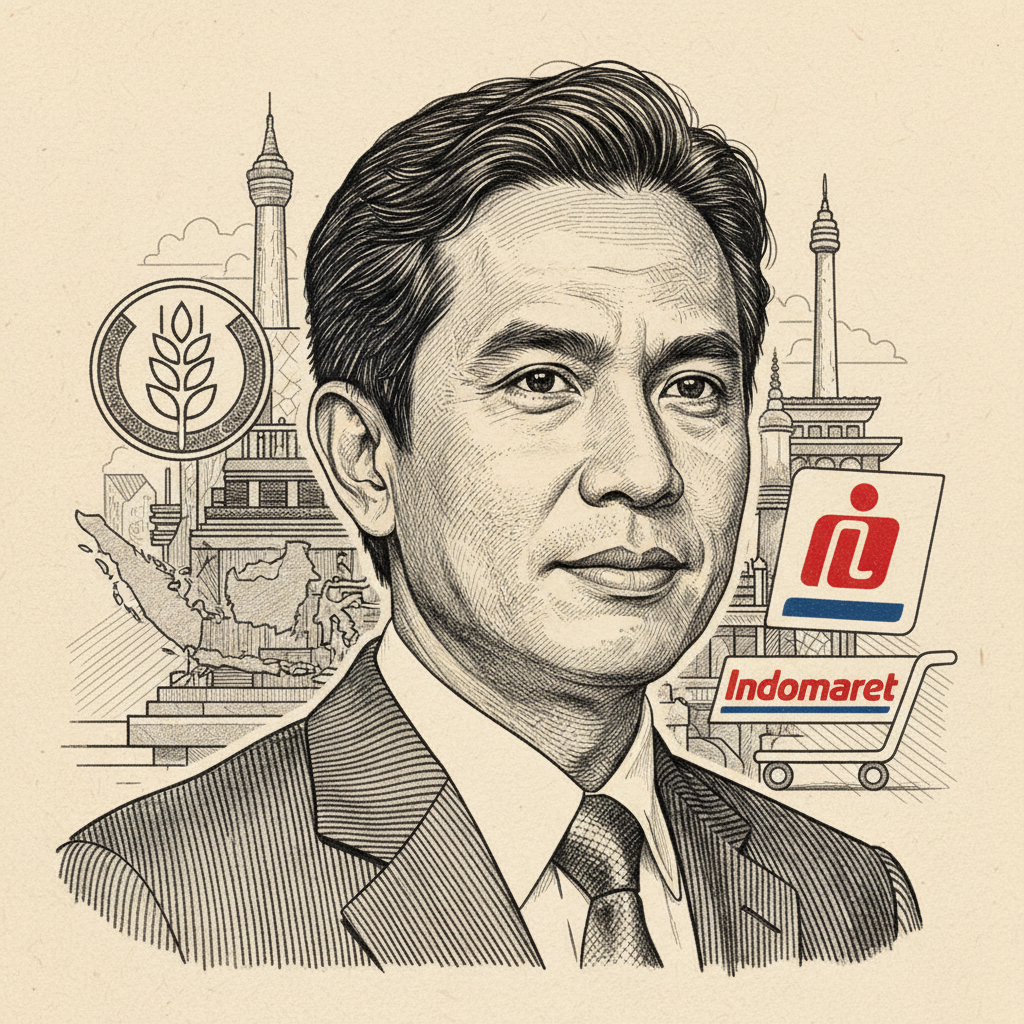
Salim Group
Salim Group: A global diversified conglomerate with deep roots in Indonesian commerce and a strategy of extensive market dominance through strategic M&A and vertical integration.
The Salim Group is one of Indonesia's largest and most influential conglomerates, founded in October 1972 by Sudono Salim and Sutanto Djuhar. The group is known for its vast holdings across multiple sectors, most notably through Indofood Sukses Makmur (the world's largest instant noodle producer), Indomobil Group (a major automotive player), Indomaret (Indonesia's largest convenience store chain), and Bogasari (a significant flour-milling operation). Under the leadership of Anthoni Salim, son of the founder, the group has navigated economic shifts, maintaining and expanding its market leadership through strategic acquisitions and operational excellence.
Biography
Accomplishments
- 01Founded in October 1972, developing into one of Indonesia's largest conglomerates with diverse holdings.
- 02Established Indofood Sukses Makmur, which became the world's largest instant noodle producer under brands like Indomie, achieving unparalleled market penetration.
- 03Developed Indomaret into Indonesia's largest convenience store chain through aggressive expansion and strategic location planning.
- 04Built Bogasari into a dominant flour mill, securing a critical position in the food supply chain.
- 05Navigated the 1997-1998 Asian financial crisis by restructuring and subsequently reacquiring key assets, demonstrating resilience and strategic foresight.
- 06Diversified its portfolio into automotive (Indomobil Group), telecommunications, and palm oil, creating multiple revenue streams and reducing single-sector dependency.
Lessons for Operators
Key Takeaways
Practical lessons distilled for operators, investors, C-levels, and capital allocators.
Mastery of Vertical Integration
Understand and implement vertical integration strategies to control critical supply chain components, optimize costs, and build substantial barriers to entry.
Agility in Crisis
Develop and maintain strategic flexibility to adapt to economic downturns, including the readiness to divest and strategically reacquire assets to ensure long-term survival and growth.
Unrivalled Market Penetration
Focus on building dominant brands supported by extensive distribution channels to capture and maintain leading market shares in key consumer segments.
Diversified Portfolio for Resilience
Strategically diversify across multiple industries to mitigate risks associated with single-sector reliance and enhance overall corporate stability.
Strategic Asset Leveraging
Recognize and leverage existing assets, such as extensive retail networks, beyond their primary function to create new revenue streams and competitive advantages.
Robust Leadership Continuity
Prioritize robust succession planning and cultivate resilient leadership capable of navigating complex economic landscapes and driving sustained growth.
Frameworks & Principles
Named frameworks and strategic principles they popularized or embodied.
Porter's Five Forces Analysis
Analyze the competitive intensity and market attractiveness by examining the bargaining power of buyers and suppliers, threat of new entrants and substitute products, and rivalry among existing competitors.
When to useApplicable for operators and investors to assess the competitive landscape of any industry where Salim Group operates (e.g., instant noodles, retail, automotive) and understand the sustainability of its market power.
SWOT Analysis (Strengths, Weaknesses, Opportunities, Threats)
A framework for evaluating an organization's internal strengths and weaknesses, as well as external opportunities and threats.
When to useUseful for C-levels and fund managers to quickly assess Salim Group's internal capabilities (e.g., strong brands, vertical integration) and external factors (e.g., economic instability, regulatory changes) which could impact its future performance.
Ansoff Matrix (Product-Market Expansion Grid)
A strategic planning tool that provides four growth strategies: market penetration, market development, product development, and diversification.
When to useC-levels and enterprise leaders can apply this to understand Salim Group's historical growth strategies (e.g., market penetration with Indomie, diversification into new sectors like retail or automotive) and to plan future expansion initiatives.
Recent Appearances
Latest interviews, keynotes, and press from the past half year.
 youtube.com
 youtube.com
 youtube.com
 youtube.com
 youtube.com
 youtube.com
 youtube.com
 youtube.com
 youtube.com
 youtube.com
 youtube.com
 youtube.com
 youtube.com
 youtube.com
 youtube.com
 youtube.com
 youtube.com
 youtube.com
 youtube.com
 youtube.com
 youtube.com
 youtube.com
 youtube.com
 youtube.com
Sources & Further Reading
Profiles, interviews, podcasts, and articles used to compile and verify this entry. Each link opens at the original publisher.
Explore Related Titans
Other figures in the archive who share Salim Group's domain, geography, or era.
More in Industrial & Manufacturing










From Indonesia