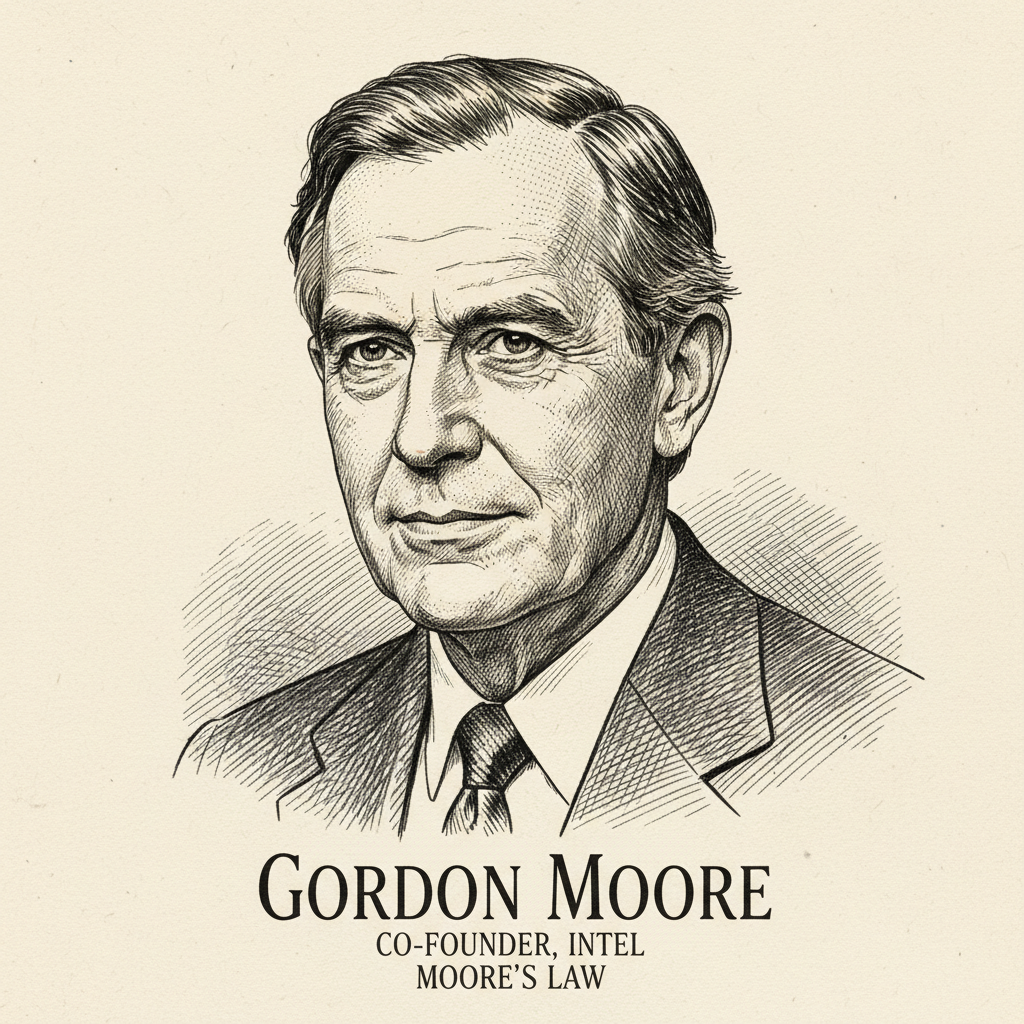
Gordon Moore
Co-founder of Intel and formulator of Moore's Law, fundamentally shaping the trajectory of the semiconductor industry and global technology.
Gordon E. Moore was an American electrical engineer, computer scientist, and businessman. He co-founded Fairchild Semiconductor in 1957 and Intel Corporation in 1968, serving as CEO from 1975 to 1987 and Chairman until 1997. Moore is best known for 'Moore's Law,' his 1965 prediction that the number of transistors on an integrated circuit would double approximately every two years, driving relentless innovation and cost reduction in microelectronics.
Biography
Accomplishments
- 01Co-founded Fairchild Semiconductor, establishing a foundational company for Silicon Valley's emergence and attracting critical talent to the region.
- 02Co-founded Intel Corporation in 1968, which evolved into the world's largest semiconductor company and a dominant force in microprocessor development.
- 03Formulated 'Moore's Law' in 1965, an empirical observation that became a driving force and strategic imperative for the semiconductor industry, dictating exponential performance gains and cost efficiencies for decades.
- 04Led Intel as CEO during its pivotal shift from memory products to microprocessors, securing its leadership in the personal computer revolution.
- 05Oversaw the development and commercialization of the Intel 4004, the world's first single-chip microprocessor, enabling widespread digital computing.
- 06Championed research and development that led to the x86 architecture, which remains dominant in personal computing and server markets.
- 07Established the Gordon and Betty Moore Foundation, contributing billions to science, environmental conservation, and patient care, demonstrating significant philanthropic leadership.
- 08Guided Intel's early public offerings and sustained growth, creating substantial shareholder value and establishing a model for high-tech company scaling.
Lessons for Operators
Key Takeaways
Practical lessons distilled for operators, investors, C-levels, and capital allocators.
The Power of Exponential Growth (Moore's Law)
Moore's observation articulated how relentless technological advancement, when consistently pursued, can lead to exponential performance improvements and cost reductions. This principle is not confined to semiconductors; it underscores the transformative potential of compounding progress in any R&D-intensive industry. Capital allocators should seek ventures that demonstrate similar 'exponential engines' where iterative improvements yield disproportionate gains.
Strategic Founders' Dilemma and Opportunity
Moore's involvement in both Fairchild Semiconductor and Intel illustrates a critical decision point for innovators: when to depart an existing successful enterprise to found a new one that can fully realize a novel vision or exploit a market opportunity. This requires both conviction in the new idea and the ability to attract and mobilize top-tier talent. This is relevant to fund managers evaluating spin-offs or new ventures from established companies.
Technology as a Business Differentiator
Intel's dominance under Moore was built on its technological prowess and manufacturing excellence. For C-levels and enterprise leaders, this emphasizes that deep technical differentiation, coupled with efficient production, can create formidable competitive moats, even in highly competitive markets. Investing in core technological capabilities, rather than just market-facing features, is paramount.
The Interplay of Prediction and Execution
Moore's Law wasn't merely a forecast; it became a rallying cry and an industry roadmap. Its fulfillment required immense engineering effort and capital investment. This highlights how clear, ambitious, and widely accepted predictions can galvanize an entire ecosystem, transforming a hypothesis into a guiding principle for execution and resource allocation across multiple organizations.
Manufacturing as a Strategic Asset
Moore understood that control over advanced manufacturing was a critical competitive advantage. Intel's Integrated Device Manufacturer (IDM) model, with design and fabrication under one roof, allowed for tighter integration and performance optimization. For operators and investors, this underscores the strategic value of proprietary manufacturing capabilities, particularly in foundational industries like semiconductors, as evidenced by current geopolitical emphasis on domestic chip fabrication (e.g., Intel's Arizona fabs, recent policy discussions).
Leadership Through Technical Acumen
Moore was a scientist and engineer first, bringing deep technical understanding to his executive roles. This technical credibility fostered trust among engineers and informed strategic decisions, particularly during complex product development cycles. This speaks to the value of leaders who possess a profound grasp of their company's core technology.
The Long-Term Arc of Innovation
Moore's Law sustained innovation for over five decades. This demonstrates that truly disruptive ideas often require persistent, multi-generational effort and investment. Leaders must cultivate a culture that supports long-term research and development, understanding that significant breakthroughs rarely happen overnight and often require sustained capital allocation.
Beyond the Product: Industry Shaping
Moore's influence extended far beyond Intel's specific products; he shaped the entire semiconductor industry's paradigm for growth. Successful enterprise leaders and fund managers should analyze how their initiatives can not only capture market share but also redefine industry expectations, standards, and future trajectories, creating 'gravity wells' for talent and capital.
Frameworks & Principles
Named frameworks and strategic principles they popularized or embodied.
Moore's Law as a Strategic Planning Heuristic
Moore's Law suggests that the complexity (number of transistors) of integrated circuits doubles approximately every two years, leading to exponential improvements in computing power and cost efficiency. This isn't a physical law but an economic and engineering target.
When to useApply this framework when forecasting technological advancements, setting R&D budgets, and planning product roadmaps in industries driven by exponential technological progress (e.g., AI, biotech, data storage). It serves as a benchmark for expected improvement and helps identify where current progress might be lagging or exceeding industry norms.
The 'Traitorous Eight' Spin-Off Model
This model describes how a highly talented group within an existing organization departs to form a new venture, often due to disagreements over strategy, compensation, or creative control. These spin-offs can leverage prior experience and talent to rapidly innovate.
When to useRelevant for investors evaluating new startups originating from established tech companies, assessing the potential of internal 'skunkworks' projects that might become independent, or for C-levels considering how to retain or manage high-potential teams with divergent visions. It underscores the dual challenge and opportunity of intrapreneurship.
Integrated Device Manufacturer (IDM) Strategy
Intel's original IDM model involved designing, manufacturing (fabricating), and packaging integrated circuits in-house. This contrasts with fabless models (design-only) or pure-play foundries (manufacture-only). The IDM model offers tighter integration, control over intellectual property, and potential for performance optimization.
When to useApplicable for operators and capital allocators in hardware-intensive industries considering the benefits and drawbacks of vertical integration versus specialization. Evaluate this when deciding whether to own critical manufacturing assets, weighing capital expenditure against supply chain control, cost efficiency, and intellectual property protection, especially in sectors with high strategic national interest like semiconductors (e.g., current global push for domestic chip fabrication).
Market Pivoting for Long-Term Relevance
Intel, under Moore's leadership, successfully pivoted from being primarily a memory manufacturer to the dominant microprocessor provider. This involved recognizing emerging market needs and re-allocating significant R&D and capital resources.
When to useUtilize this framework when a core product market is maturing or facing intense competition. Operators should constantly assess adjacent markets, invest in R&D for disruptive technologies, and be prepared to make strategic shifts in product focus and resource allocation to ensure long-term corporate relevance and growth.
Recent Appearances
Latest interviews, keynotes, and press from the past half year.
 youtube.com
 youtube.com
 youtube.com
 youtube.com
 youtube.com
 youtube.com
 youtube.com
 youtube.com
 youtube.com
 youtube.com
 youtube.com
 youtube.com
 youtube.com
 youtube.com
 youtube.com
![[ EP 2 ] GUARDING THE IMPERATIVES || Life & Leadership ...](https://i.ytimg.com/vi/NPn9ql7W4-k/hqdefault.jpg) youtube.com
youtube.com![[ EP 3 ] HOW TO MOVE IN THE ANOINTING || Life ...](https://i.ytimg.com/vi/u-SqA3oFJmw/hqdefault.jpg) youtube.com
youtube.com youtube.com
 youtube.com
 youtube.com
 youtube.com
 youtube.com
 youtube.com
 youtube.com
 youtube.com
 youtube.com
 youtube.com
 youtube.com
 youtube.com
 youtube.com
 youtube.com
 youtube.com
 youtube.com
Sources & Further Reading
Profiles, interviews, podcasts, and articles used to compile and verify this entry. Each link opens at the original publisher.
- interviewIntel aims to find clients and catch TSMC with new chip fab in Arizonacnbc.com→
- interview2026 Forbes Power Women's Summitforbes.com→
- interviewThis Innovation Could Make the Perfect Silicon Chip—and ... - WSJwsj.com→
- interview'Founder's Fire' Review: The Power to Prosper - WSJwsj.com→
- interviewInside Intel's Tricky Dance With Trump - WSJwsj.com→
- podcastChris Gaborit's Post - LinkedInlinkedin.com→
- podcastTranscript: The Man Who Followed Elon Musk Everywheresingjupost.com→
- podcastThis is how the world started caring about the chipsets that power all ...instagram.com→
- podcastCongratulations to James Patterson and Patrick Leddin ... - Facebookfacebook.com→
- podcastThe Second Half of the Chessboard - The World in 20292029agi.com→
- podcastAtheists told him that God would be guilty of a hate crime if he did ...facebook.com→
- podcast10 Lessons From ANDY !!! Before Silicon Valley was cool, there was ...facebook.com→
- podcastPhil Pringle with John Pearce, Gordon Moore & Steve Burgessyoutube.com→
- podcastHow Moore's Law Transformed Tech: Startup Lessons from Intel's ...youtube.com→
- podcastCrews begin draining sinkhole at Gordon Moore Park in Altonyoutube.com→
- podcastC3 Church Global Podcast - YouTubeyoutube.com→
- podcastwith Ps Phil Pringle & Ps Sam Picken [ EP 1 ] - YouTubeyoutube.com→
- podcastHouse to House - YouTubem.youtube.com→
- podcastIn Motion - Jan/Feb 2023 - YouTubeyoutube.com→
- podcastFrameshifts with Benjamin Arya - Apple Podcastspodcasts.apple.com→
- podcastMad Money w/ Jim Cramer - Podcast - Apple Podcastspodcasts.apple.com→
- podcastData Skeptic - Podcast - Apple Podcastspodcasts.apple.com→
- podcastBest Stocks Now with Bill Gunderson - Podcast - Apple Podcastspodcasts.apple.com→
- podcastThe Al Franken Podcast - Apple Podcastspodcasts.apple.com→
- podcastSpittin Chiclets - Podcast - Apple Podcastspodcasts.apple.com→
- podcastVSiN Best Bets - Podcast - Apple Podcastspodcasts.apple.com→
- podcastlo stesso anno in cui Morris Chang, Pat Haggerty, Weldon Word, Jay ...instagram.com→
- podcastTechnology Made Everything Cheaper. Why Not Housing, Health ...instagram.com→
- podcastKevin Buehler's Post - LinkedInlinkedin.com→
- podcastWorth a listen Seagate CEO Dave Mosley explains a pattern we've ...facebook.com→
- podcastNo more Moore? So, what then for microchips? And for China?kaskaziconsulting.squarespace.com→
- podcastAmerica, Incorporated: The Era of the Portfolio Statefpri.org→
- podcastWhat does it mean that A.I. systems like Claude seem ... - Instagraminstagram.com→
- podcastHemant Taneja: Building a whole new class of venture capitalistsforbesindia.com→
- podcastMIT Economics professor Daron Acemoglu spoke with Los Angeles ...facebook.com→
- podcastDecoder with Nilay Patel - Podcast Summariespod-chive.com→
- podcastDavid Sun and John Tu are both among the five biggest wealth ...facebook.com→
- podcastIn this exclusive interview, Axios co-founder Mike Allen sits down ...facebook.com→
- podcastTSMC (Remastered) — Acquired Transcriptpodcasts.happyscribe.com→
- podcastDave Heasty - Portland, Oregon, United States | Professional Profilelinkedin.com→
- podcastButterflies and the Value of Terror - by Brad Abare - Antagonist at Workantagonistatwork.com→
- podcastphillies not signing bichette due to cost | Philadelphia, PA - Facebookfacebook.com→
- podcast股神之路:伯克希尔·哈撒韦的崛起与巴菲特的投资哲学(I)zhuanlan.zhihu.com→
- podcastInformation Systems: A Manager's Guide to Harnessing Technologystudylib.net→
- podcastmlb teams releasing players with guaranteed contracts - Facebookfacebook.com→
- podcastJim Keller, The S curve, and how to ride it using the Unreasonable ...substack.com→
- podcastAt the Congress of Future Medical Leaders, Delegates aren't just ...facebook.com→
- podcastSupermicro in Silicon Valley Supermicro founder & CEO ... - Facebookfacebook.com→
- podcastThe Hidden Truth About Tech Usage Among Industry Leaders - TikToktiktok.com→
- podcastThe ultimate tech moat. Why is Nvidia dominating the AI ... - Instagraminstagram.com→
- podcastThe Compounding Fallacies of AI Hype - Being Bayesianbeingbayesian.in→
- podcast: https://trib.al/TgVKh8g Anthropic's cofounder is, in his telling, the ...facebook.com→
- podcast[Outliers] Andy Grove: Only the Paranoid Survive [The Knowledge ...fs.blog→
- podcastHe went from janitor to executive with one spicy idea. In Flamin' Hot ...facebook.com→
- podcastEntrepreneurship Book Summaries | AudiobookHubaudiobookhub.net→
- podcastBlue-Chip Stocks Enter Oversold Zones Amid Market Fear - LinkedInlinkedin.com→
- podcastConclusion of a very productive and sucessful Moores Rowland ...facebook.com→
- podcastBlue-Chip Stocks in Oversold Zones: Opportunity or Panic? - LinkedInlinkedin.com→
- podcastTapiwa Cheuka (@TR_Cheuka) / Posts / X - Twitterx.com→
- podcastReel by Augment Business School (@augment_org) · May 20, 2026instagram.com→
- podcastErick El Mayor Genio De La Tecnología Silicon Valley Es Despedidotiktok.com→
- podcastDavid Senra | Eric Jorgenson. Author of The Book of Elon. Tomorrow ...instagram.com→
- podcastWhat needs to happen? Then go make it happen... - Instagraminstagram.com→
Explore Related Titans
Other figures in the archive who share Gordon Moore's domain, geography, or era.
More in Technology








From United States


Contemporaries — born 1920s