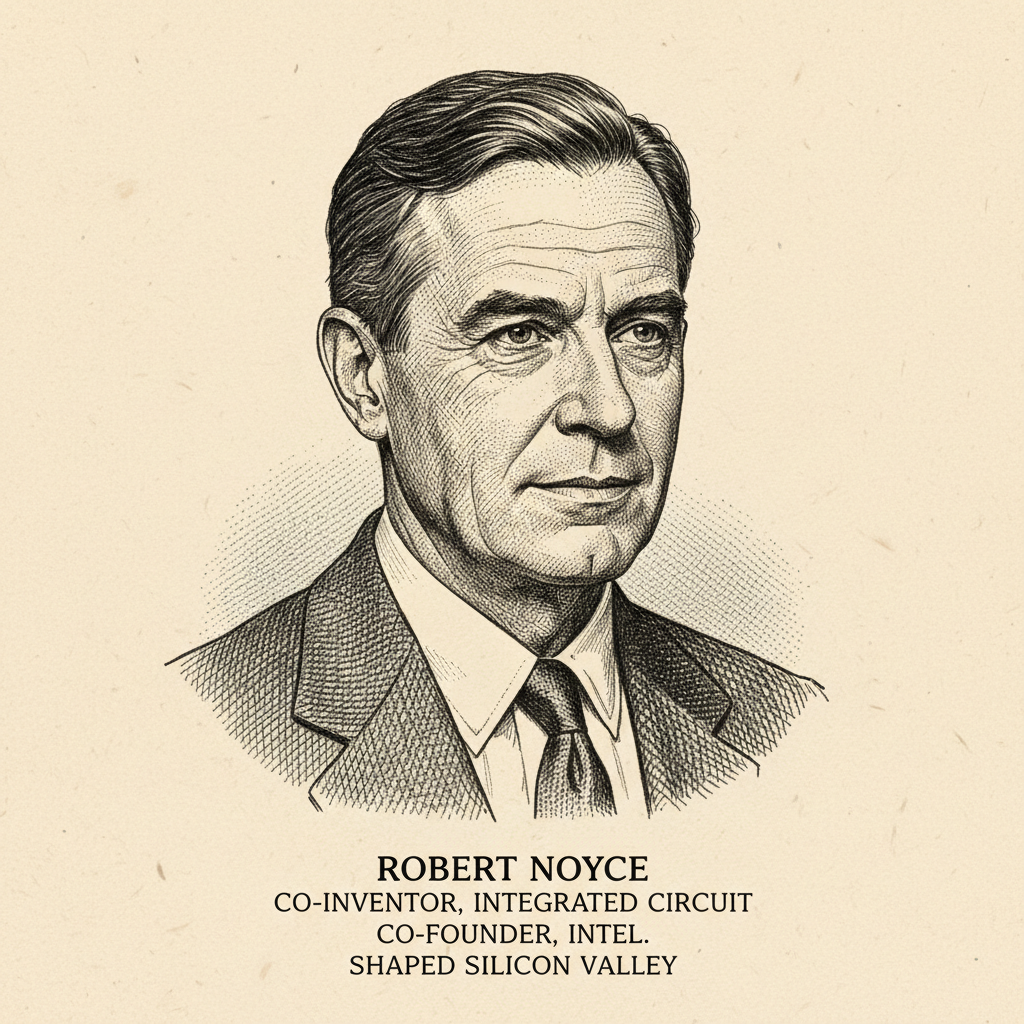
Robert Noyce
The visionary co-founder of Fairchild Semiconductor and Intel, credited with the invention of the integrated circuit, which catalyzed the digital revolution and established Silicon Valley's preeminence.
Robert Norton Noyce, widely known as 'the Mayor of Silicon Valley,' was a pivotal American physicist and entrepreneur. He distinguished himself by co-founding two of the semiconductor industry's most influential companies, Fairchild Semiconductor in 1957 and Intel Corporation in 1968. Noyce is also independently credited with the invention of the integrated circuit, a foundational innovation that enabled the personal computer revolution and gave rise to the geographic and technological identity of Silicon Valley.
Biography
Accomplishments
- 01Co-founded Fairchild Semiconductor in 1957, establishing a seminal institution in the semiconductor industry and pioneering the silicon-based integrated circuit.
- 02Independently conceived and developed the monolithic integrated circuit (microchip) in 1959, which drastically reduced manufacturing costs and enabled miniaturization, a parallel development to Jack Kilby's work.
- 03Co-founded Intel Corporation in 1968, leading it as CEO during its foundational years, driving innovation in memory (DRAM) and microprocessor technology (e.g., Intel 4004 in 1971).
- 04Developed a flat, collaborative management style at both Fairchild and Intel, fostering innovation and becoming a template for Silicon Valley's organizational culture.
- 05Played a critical role in the formation of Sematech in 1987, serving as its CEO, a consortium aimed at revitalizing the U.S. semiconductor manufacturing industry against foreign competition.
- 06Awarded the National Medal of Technology by President Ronald Reagan in 1987 for his contributions to the microchip and the U.S. semiconductor industry.
Lessons for Operators
Key Takeaways
Practical lessons distilled for operators, investors, C-levels, and capital allocators.
The Power of Vertical Integration and Process Innovation
Noyce's pioneering of the integrated circuit and his subsequent roles at Fairchild and Intel highlight the critical importance of marrying fundamental scientific breakthroughs with robust manufacturing processes. Investors and operators should prioritize ventures that not only innovate in design but also control or significantly influence their production methodologies to create defensible moats and scale efficiently.
Talent Mobility and Entrepreneurial Catalyst
The 'Traitorous Eight' saga underscores that concentrated talent, when unfulfilled by existing structures, will coalesce elsewhere to build new value. For investors, this means actively seeking out strong teams even if they emerge from established firms. For executives, it means fostering an environment where top talent can innovate and lead, or risk becoming an incubator for future competitors.
Visionary Leadership in Nascent Industries
Noyce identified the profound implications of miniaturization and computing power early on. Leaders must cultivate a long-term strategic vision, not just incremental improvements, to guide capital allocation and R&D in transforming technologies. This involves anticipating market needs before they are explicitly articulated.
Culture as a Competitive Advantage
Noyce's flat, informal management style at Intel challenged traditional hierarchies and became a hallmark of Silicon Valley's innovative culture. Enterprises should actively design and maintain cultures that promote individual ownership, direct communication, and rapid iteration, as these intangible assets can significantly accelerate product development and market responsiveness.
Industrial Policy and Collaborative Innovation
His involvement with Sematech demonstrates that in certain strategic sectors, inter-company collaboration, sometimes with government support, can be vital for maintaining national competitiveness. Capital allocators and enterprise leaders should consider participating in or advocating for industry consortia to address shared challenges and elevate foundational technologies.
Frameworks & Principles
Named frameworks and strategic principles they popularized or embodied.
The 'Intel Model' for Value Creation
Combines relentless innovation in core technology (microprocessors) with aggressive manufacturing scale-up, often referred to as 'Moore's Law' applied to business strategy. This involves reinvesting significant capital into R&D and fabrication to maintain a technology lead and drive down unit costs.
When to useApplicable for industries characterized by rapid technological advancement, high capital expenditure in manufacturing, and strong network effects where market leadership is tied to a continuous cycle of performance gains and cost reduction. (e.g., advanced computing, biotechnology, specialized materials).
The 'Traitorous Eight' Spin-out Strategy
A paradigm where a high-performing team or 'tiger team' departs from an incumbent organization, often due to strategic misalignment or lack of autonomy, to form a better-aligned and more agile startup, often with external funding.
When to useFor investors, identify highly skilled and cohesive groups within larger companies who are capable of executing on overlooked or undervalued opportunities. For executives, this is a cautionary tale to foster intrapreneurship and provide sufficient resources and autonomy to prevent loss of critical talent to competitors or new ventures.
Noyce's Open-Door Leadership
A management philosophy emphasizing accessibility, direct communication, and a non-hierarchical approach to problem-solving and decision-making.
When to useEffective in R&D-intensive environments, startups, or highly dynamic organizations where rapid information flow and employee empowerment are crucial for innovation. This fosters a sense of ownership and reduces bureaucratic friction, leading to faster execution.
Strategic Industry Consortia (Sematech Model)
A collaborative approach where competing firms pool resources and expertise to address shared, pre-competitive challenges (e.g., manufacturing processes, basic research) to strengthen an entire industry sector against external threats or to develop foundational technologies.
When to useTo be employed by industry leaders or policymakers when an industry faces significant common threats (e.g., foreign competition, supply chain fragility, high-cost R&D infrastructure) that no single company can effectively tackle alone. Requires strong leadership and trust among participants.
Recent Appearances
Latest interviews, keynotes, and press from the past half year.
 youtube.com
 youtube.com
 youtube.com
 youtube.com
 youtube.com
 youtube.com
 youtube.com
 youtube.com
 youtube.com
 youtube.com
 youtube.com
 youtube.com
 youtube.com
 youtube.com
 youtube.com
 youtube.com
 youtube.com
 youtube.com
 youtube.com
 youtube.com
 youtube.com
 youtube.com
 youtube.com
 youtube.com
 youtube.com
 youtube.com
 youtube.com
 youtube.com
 youtube.com
Sources & Further Reading
Profiles, interviews, podcasts, and articles used to compile and verify this entry. Each link opens at the original publisher.
Explore Related Titans
Other figures in the archive who share Robert Noyce's domain, geography, or era.
More in Technology





From United States


Contemporaries — born 1920s