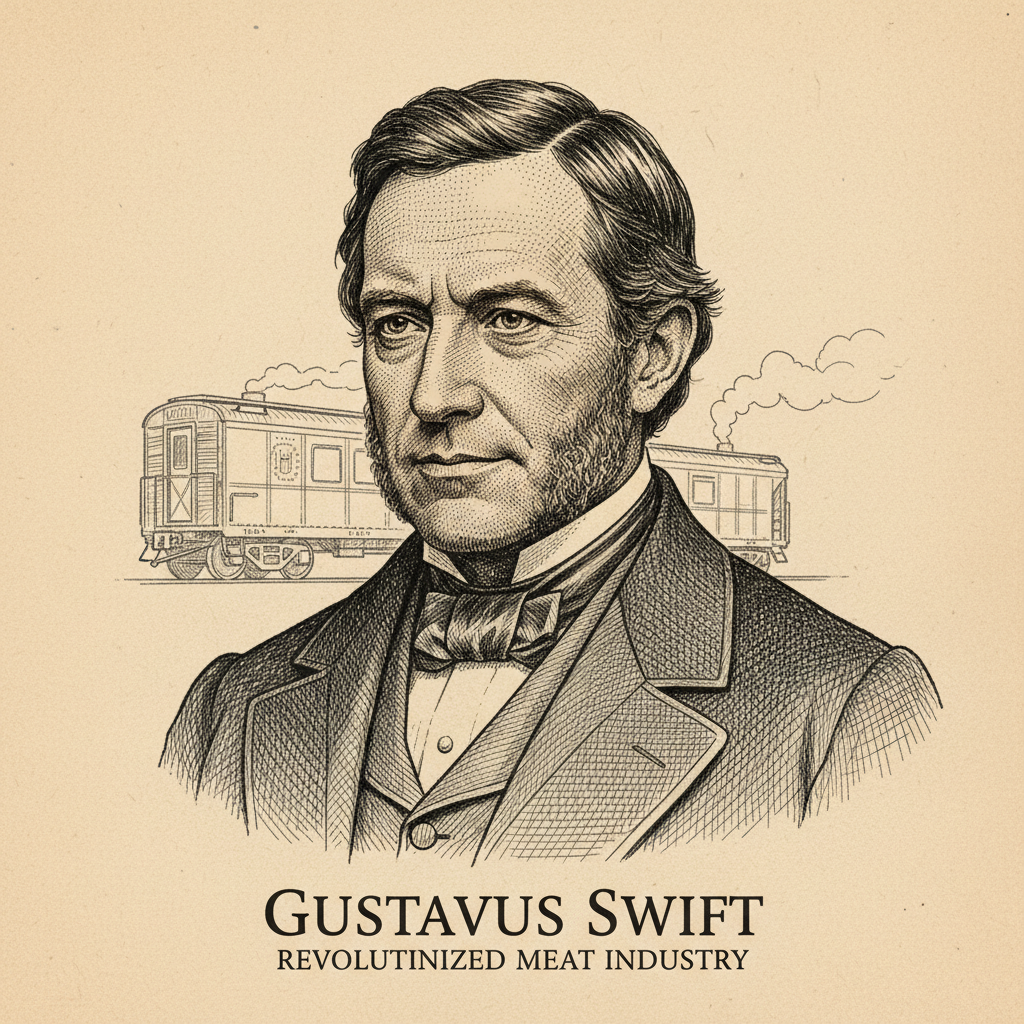
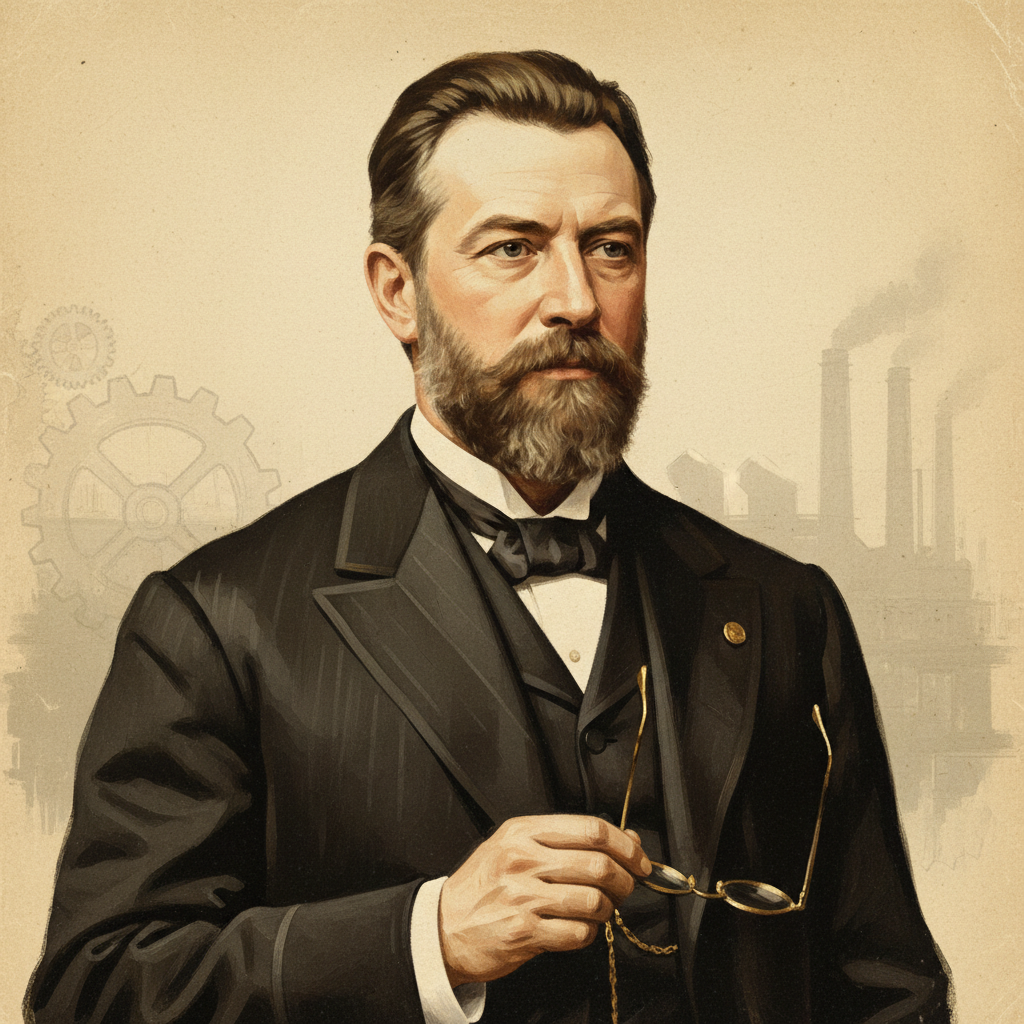
Gustavus Swift
The architect of modern meatpacking and cold chain logistics, transforming a local commodity into an industrial marvel.
Gustavus Franklin Swift revolutionized the American meat industry through vertical integration, large-scale processing, and the pioneering use of refrigerated railcars, establishing an efficient, national cold chain that made fresh meat accessible nationwide.
Biography
Accomplishments
- 01Pioneered the commercialization and widespread adoption of refrigerated railcars (circa 1877), enabling efficient national distribution of dressed beef from Chicago.
- 02Established vertically integrated operations for Swift & Company, encompassing livestock procurement, slaughtering, processing, distribution, and retail sales, minimizing intermediaries and optimizing costs.
- 03Developed sophisticated by-product utilization processes, transforming nearly every part of the slaughtered animal into marketable goods (e.g., glue, fertilizer, soap, leather), significantly increasing profitability and reducing waste.
- 04Built a national network of cold storage warehouses and branch houses, ensuring consistent product quality and availability across diverse geographic markets.
- 05Scaled Swift & Company into one of the largest industrial enterprises in the United States by the late 19th century, profoundly impacting urban diets and agricultural economics.
- 06Instituted strict operational efficiencies and division of labor within slaughterhouses, a precursor to modern assembly-line production methods.
Lessons for Operators
Key Takeaways
Practical lessons distilled for operators, investors, C-levels, and capital allocators.
Integrated Value Chains
Swift's success stemmed from controlling the entire process from 'hoof to table.' Companies should evaluate areas where external dependencies introduce significant cost, risk, or inefficiency, and consider strategic integration. This reduces transactional costs and enhances control over quality and delivery.
First-Mover Advantage in Enabling Tech
While not the inventor, Swift was the first to effectively commercialize refrigerated transport at scale. Identify enabling technologies that can fundamentally alter your industry's economics or distribution, and aggressively pursue their adoption and scaling. Proprietary infrastructure can become a formidable barrier to entry.
Revenue Diversification from By-products
Swift turned waste into profit. Enterprises should meticulously analyze their operational outputs for potential secondary markets or value-added applications. This not only improves financial performance but also enhances resource efficiency and ESG credentials.
Strategic Hub-and-Spoke Distribution
Swift established Chicago as a processing hub and then distributed nationwide. For capital-intensive industries or those with perishable goods, a centralized processing/manufacturing hub combined with an efficient spoke-like distribution network optimizes production scale and market reach, minimizing costs associated with scattered production.
Relentless Cost Reduction
Every step of Swift's process was scrutinized for efficiency. Leaders must cultivate a culture of continuous improvement and cost-consciousness, leveraging scale, technology, and process innovation to maintain competitive pricing and superior margins.
Frameworks & Principles
Named frameworks and strategic principles they popularized or embodied.
Vertical Integration Analysis
Assess the strategic benefits and risks of integrating up or down the supply chain. Analyze potential cost savings, quality control improvements, market power enhancement versus increased capital expenditure and complexity.
When to useWhen evaluating opportunities to acquire suppliers, distributors, or adjacent businesses, or when critical dependencies in the supply chain pose significant risks or inefficiencies. Useful for mature industries seeking competitive advantage.
By-Product & Waste Stream Monetization
A systematic approach to identifying, evaluating, and commercializing waste products or ancillary outputs from core operations. This involves market research for potential applications, technology assessment for processing, and financial modeling for new revenue streams.
When to useApplicable across manufacturing, agriculture, and service industries where significant material or informational 'waste' is generated. Useful for improving sustainability, increasing profitability, and diversifying revenue.
Cold Chain Logistics Optimization
A comprehensive framework for designing, implementing, and managing temperature-controlled supply chains. Focuses on infrastructure (warehouses, transport), processes (monitoring, handling), and technology (refrigeration, IoT sensors) to ensure product integrity and extend shelf life.
When to useEssential for businesses dealing with perishable goods (food, pharmaceuticals, chemicals) that require strict environmental controls during storage and transportation to maintain quality and regulatory compliance.
Recent Appearances
Latest interviews, keynotes, and press from the past half year.
 youtube.com
 youtube.com
 youtube.com
 youtube.com
 youtube.com
 youtube.com
 youtube.com
 youtube.com
Sources & Further Reading
Profiles, interviews, podcasts, and articles used to compile and verify this entry. Each link opens at the original publisher.
Explore Related Titans
Other figures in the archive who share Gustavus Swift's domain, geography, or era.
More in Transportation & Logistics









From United States








Contemporaries — 19th century