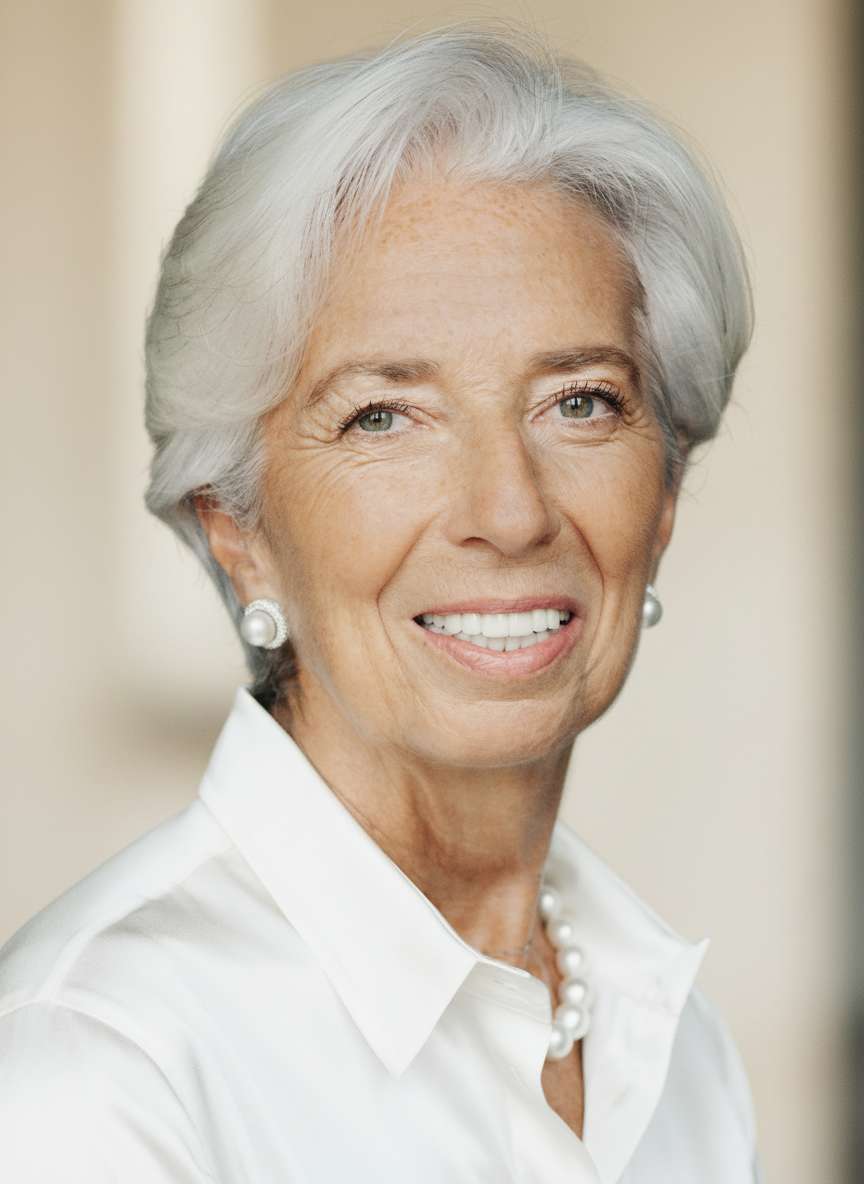
Christine Lagarde
The first woman to lead the European Central Bank (ECB) and the International Monetary Fund (IMF), a pivotal figure in global finance.
Christine Lagarde is a French lawyer and politician who has held significant global economic leadership roles. She served as France's Minister of Finance from 2007 to 2011, the Managing Director of the International Monetary Fund (IMF) from 2011 to 2019, and currently serves as the President of the European Central Bank (ECB) since 2019. Her career is marked by navigating major economic crises and advocating for global financial stability.
Biography
Accomplishments
- 01First female Chair of Baker & McKenzie (1999), demonstrating early leadership in a male-dominated professional field.
- 02French Minister of Economy, Finance and Industry (2007-2011), steering France's economic policy during the 2008 global financial crisis and contributing to G20 coordination.
- 03Managing Director of the International Monetary Fund (2011-2019), navigating the Eurozone sovereign debt crisis, securing multi-billion dollar rescue packages, and advocating for global economic stability.
- 04First female President of the European Central Bank (2019-Present), leading the Eurozone's monetary policy response to the COVID-19 pandemic and initiating a significant strategic review.
- 05Championed gender equality and climate change as core economic issues, integrating them into the IMF's agenda and the ECB's strategic review.
- 06Successfully managed complex international financial negotiations, including sensitive bailout conditions for Greece during her IMF tenure.
Lessons for Operators
Key Takeaways
Practical lessons distilled for operators, investors, C-levels, and capital allocators.
Multinational Governance Expertise
Lagarde's career exemplifies mastery in navigating and leading complex multinational organizations (Baker & McKenzie, IMF, ECB). This requires exceptional diplomatic skills, cultural intelligence, and the ability to forge consensus among diverse member states or global partners to drive policy and strategic outcomes.
Crisis Management & Stability
She consistently operated at the forefront of major economic crises, from the 2008 global financial meltdown to the Eurozone debt crisis and the COVID-19 pandemic. Her approach highlights the importance of decisive, coordinated action, combined with clear communication, to maintain financial stability and instill confidence during periods of extreme uncertainty.
Holistic Economic Framework
Lagarde broadened the scope of traditional economic policy to include crucial areas like gender equality and climate change. This demonstrates a forward-thinking perspective that recognizes the interconnectedness of social, environmental, and economic factors for sustainable growth and stability, moving beyond purely quantitative metrics.
Strategic Leadership Evolution
Her impressive trajectory illustrates the power of strategic career evolution – from a top-tier corporate legal professional to a national political figure and then to the pinnacle of international financial institutions. This demonstrates adaptability, a willingness to embrace new challenges, and the transferability of high-level leadership skills across sectors.
Institutional Modernization
At the ECB, Lagarde initiated a comprehensive strategic review of its monetary policy framework. This reflects a commitment to continually adapt and modernize institutional mandates and tools in response to evolving economic landscapes, ensuring relevance and effectiveness in a rapidly changing global environment.
Frameworks & Principles
Named frameworks and strategic principles they popularized or embodied.
Inclusive Growth Agenda
Lagarde consistently advocated for economic policies that address inequality and promote gender parity, asserting that these are not just social issues but crucial for sustainable economic growth and stability. At the IMF, she pushed for tailored policies that consider the social impact of structural reforms.
When to useWhen developing national or international economic policies, corporate CSR strategies, or investment theses that aim for long-term health and stability, considering societal impact beyond immediate financial returns. Useful for assessing ESG factors within investment portfolios or corporate governance.
Multilateral Coordination in Crisis
Her leadership during the 2008 financial crisis and the Eurozone debt crisis underscored the necessity of robust multilateral cooperation among governments and international institutions to prevent systemic collapse and implement effective rescue packages. This involves information sharing, coordinated policy responses, and financial assistance.
When to useApplicable in scenarios requiring cross-border business alliances, international supply chain management, or navigating global regulatory challenges. Companies facing complex international risks, such as geopolitical instability or global health crises, can benefit from anticipating and fostering multilateral responses.
Central Bank Communication Strategy (ECB)
As ECB President, Lagarde has emphasized clear, forward-looking communication to manage market expectations and enhance the effectiveness of monetary policy. This includes transparently explaining policy decisions, the ECB's economic outlook, and its strategic review processes to diverse stakeholders.
When to useEssential for C-level executives and fund managers communicating with investors, employees, and the public during periods of market volatility or significant strategic shifts. Adapt this framework to ensure clear, consistent messaging that builds trust and aligns expectations regarding organizational performance or strategy.
Sources & Further Reading
Profiles, interviews, podcasts, and articles used to compile and verify this entry. Each link opens at the original publisher.
Explore Related Titans
Other figures in the archive who share Christine Lagarde's domain, geography, or era.
More in Finance & Investing





From France







Contemporaries — born 1950s