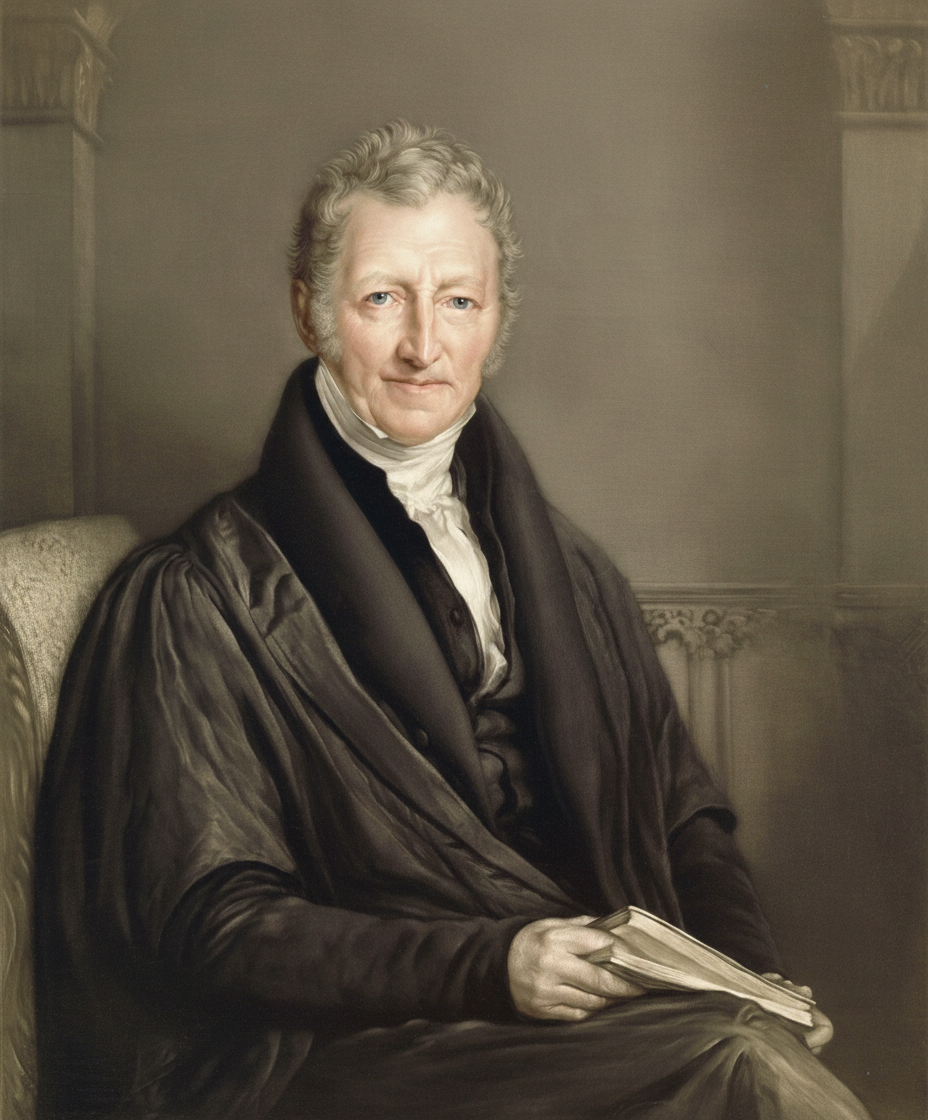
Thomas Malthus
The prophet of population dynamics whose equations still reverberate in economic models and resource allocation.
Thomas Robert Malthus was an English cleric and scholar, influential in the fields of political economy and demography. His most famous work, 'An Essay on the Principle of Population' (1798), posited that unchecked population growth would inevitably outstrip food supply, leading to famine, disease, and war. While often critiqued for its grim predictions and policy implications, his theory profoundly impacted economic thought, social reform debates, and later, environmentalism and resource management.
Biography
Accomplishments
- 01Authored 'An Essay on the Principle of Population' (1798), a foundational text in demography and political economy.
- 02Pioneered the mathematical modeling of population growth, establishing distinct arithmetic and geometric progressions for resources and population, respectively.
- 03Served as the first professor of political economy in Britain at the East India Company College at Haileybury (1805-1834), institutionalizing the academic study of economics.
- 04Influenced seminal thinkers in biology (Charles Darwin, Alfred Russel Wallace) and economics (David Ricardo, John Maynard Keynes) regarding resource scarcity and competition.
- 05Developed concepts of 'positive checks' (mortality factors) and 'preventive checks' (fertility factors) to population growth, providing a framework for demographic analysis.
Lessons for Operators
Key Takeaways
Practical lessons distilled for operators, investors, C-levels, and capital allocators.
Evaluate Scarcity as a Primary Business Constraint
Malthus's core insight—that resources are finite—requires businesses to move beyond perpetual growth assumptions. Leaders must integrate resource audits (supply chain, talent, capital, energy) into strategic planning, projecting long-term availability against demand. This informs decisions on diversification, efficiency investments, and market selection. For example, a global technology firm evaluating expansion into emerging markets must consider not just market size, but also the local availability of skilled labor, infrastructure, and regulatory stability, which are all 'resources' in the Malthusian sense.
Model Growth with Realistic Constraint Functions
While hockey-stick growth curves are appealing, Malthus's arithmetic vs. geometric progression highlights the danger of models that assume unbound linear resource growth. Fund managers and capital allocators should critically assess ventures whose projections do not explicitly account for scaling limits in critical inputs. Any business plan must incorporate saturation points, diminishing returns, and hard ceilings on physical resources. A logistics company, for instance, cannot assume its fleet can grow indefinitely without encountering limits in fuel supply, driver availability, or warehouse space, regardless of market demand.
Proactive Management of Demand-Supply Imbalances
Malthus demonstrated the natural tendency for demand (population) to outpace supply (food). In business, this translates to internal capacity vs. customer demand, or talent supply vs. organizational needs. Enterprise leaders must implement robust demand forecasting and capacity planning. This includes investing in predictive analytics for supply chains, developing talent pipelines well in advance of need, and identifying bottlenecks before they lead to service failures or missed opportunities. For example, a semiconductor manufacturer failing to anticipate future demand surges for specific chip types faces market share loss and inability to capitalize on growth, akin to a Malthusian crisis in supply.
The Imperative of Efficiency and Innovation, but within Bounds
Malthus did not foresee the scale of technological advancements that would boost food production, but his framework still holds that resource enhancement is a temporary reprieve. Operators should constantly seek efficiency gains and disruptive innovations to extend resource utility (e.g., circular economy models, energy efficiency). However, these efforts should be viewed as means to mitigate scarcity, not eliminate it. A heavy industry firm adopting AI-driven process optimization extends resource life, but the finite nature of raw materials remains a long-term strategic concern that may necessitate portfolio shifts or new business paradigms.
Societal and Environmental Interdependencies Impact Business
Malthus's work highlights that economic prosperity is inextricably linked to demographic trends and resource availability. Investors and C-levels must recognize that societal factors (e.g., aging populations, migration patterns, health crises) and environmental factors (e.g., climate change impacts on agriculture, water scarcity) are not external 'externalities' but critical inputs to long-term business viability. Ignoring these macro-Malthusian pressures can lead to systemic risk. A food retailer, for instance, must factor in the long-term effects of climate change on agricultural yields and stability of supply regions, impacting product selection and sourcing strategy.
Frameworks & Principles
Named frameworks and strategic principles they popularized or embodied.
Malthusian Growth Model (Population vs. Resources)
This model posits that population grows geometrically (exponentially) while resources, particularly food, grow arithmetically (linearly). The inevitable divergence leads to scarcity and 'checks' on population growth.
When to useApplicable when evaluating any long-term business plan heavily reliant on a finite or slow-growing resource (e.g., rare earth minerals, skilled talent pool, arable land, specific energy sources). Use to stress-test growth projections and identify potential resource ceilings or chokepoints. Useful for capital allocators assessing the sustainability of business models in resource-intensive sectors.
Positive and Preventive Checks Analysis
Malthus identified 'positive checks' (famine, disease, war) that increase mortality and 'preventive checks' (moral restraint, delayed marriage, birth control) that reduce fertility as mechanisms to restore the balance between population and resources.
When to useFor operators, this translates to analyzing systemic risks. 'Positive checks' are analogous to market crashes, supply chain implosions, or labor shortages that impact a business via external forces. 'Preventive checks' are proactive strategies a business or market can employ, such as investing in R&D to boost resource efficiency, strategic resource stockpiling, or implementing workforce development programs. Use for risk management and strategic planning, identifying where external stressors might occur versus where internal controls can be applied.
The Law of Diminishing Returns (Implicit)
While not explicitly Malthus's 'law', his arithmetic progression of food supply against geometric population growth implicitly illustrates diminishing returns. Adding more labor to a fixed amount of land eventually yields less than proportional increases in output.
When to useRelevant for assessing the scalability of production. When increasing one input while holding others constant, recognize that output will eventually increase at a decreasing rate. For investors, apply this when evaluating capital expenditure requests; ensure that additional investment in a particular area (e.g., marketing spend, factory expansion) is still yielding proportional or increasing returns, rather than hitting a point of diminishing impact.
Sources & Further Reading
Profiles, interviews, podcasts, and articles used to compile and verify this entry. Each link opens at the original publisher.
Explore Related Titans
Other figures in the archive who share Thomas Malthus's domain, geography, or era.
More in Other










From United Kingdom









Contemporaries — 18th century