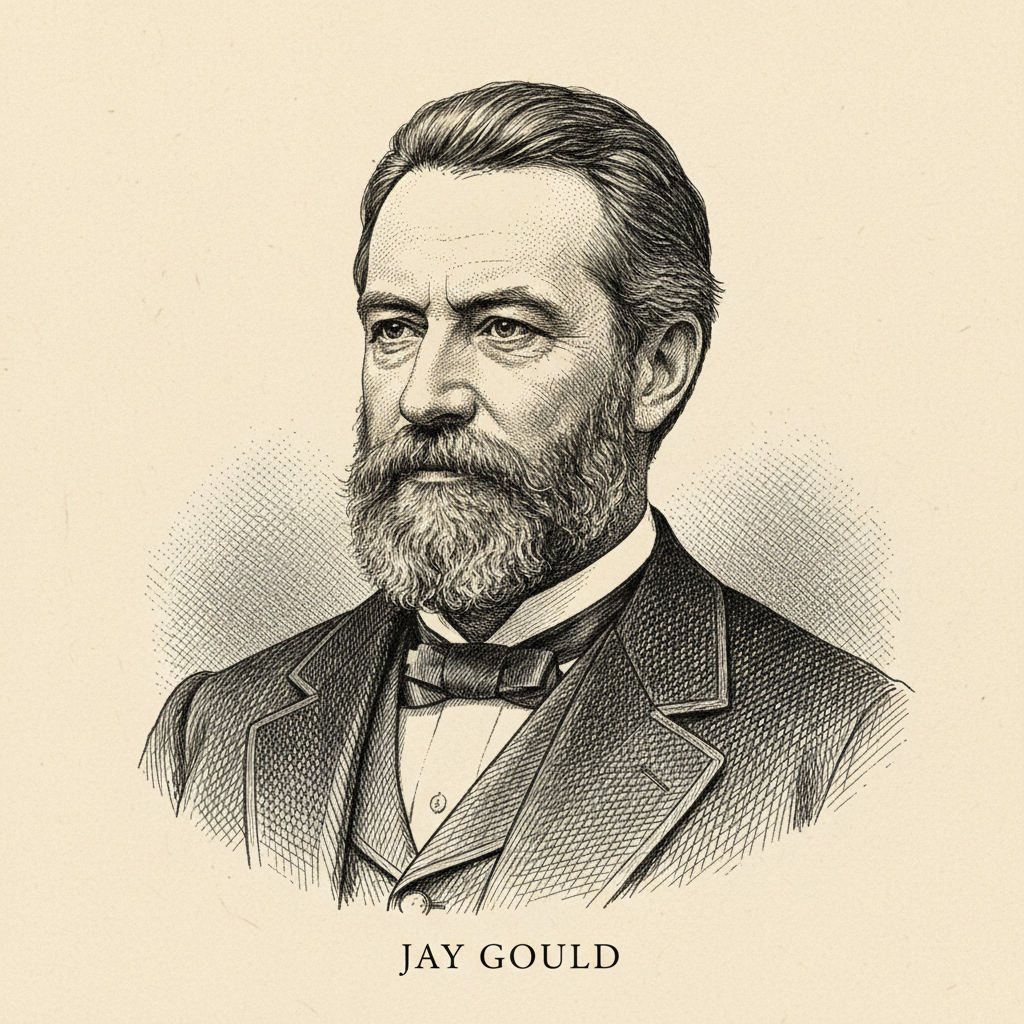
Jay Gould
The archetypal 'robber baron,' Jay Gould was a master of financial manipulation, strategic asset acquisition, and aggressive corporate control during America's Gilded Age.
Jay Gould was a central figure in American finance and railroad development during the Gilded Age. Known for his aggressive tactics and complex financial maneuvers, he amassed a fortune by consolidating and controlling vast railroad networks and the Western Union Telegraph Company, often through controversial means.
Biography
Accomplishments
- 01Orchestrated the consolidation and financial restructuring of numerous bankrupt or undervalued railroad lines, including the Union Pacific and Missouri Pacific, creating cohesive, profitable networks.
- 02Gained control of the Western Union Telegraph Company in 1881, integrating telegraphy with his vast railroad network to achieve immense synergies and establish a near-monopoly.
- 03Successfully leveraged political influence and legal complexitiesto engage in the Erie Railroad War (1867-1868), thwarting Cornelius Vanderbilt's takeover attempt through stock watering and strategic litigation.
- 04Accumulated over 10,000 miles of railroad track by 1882, representing approximately one-ninth of the total U.S. rail mileage at the time, dominating key transportation corridors.
Lessons for Operators
Key Takeaways
Practical lessons distilled for operators, investors, C-levels, and capital allocators.
Opportunistic Acquisition
Gould excelled at identifying undervalued or distressed assets and acquiring them at favorable terms. This contrarian approach, buying when others feared, allowed him to build his empire from financially weak companies.
Network Control
His primary strategy was not just owning assets, but controlling critical networks (railroads, telegraphs) to exert significant market power and create barriers to entry for competitors. Focus on strategic assets that confer network effects or monopoly advantages.
Aggressive Capital Deployment
Gould was unafraid to deploy significant capital, often borrowed or via creative financing, to execute large-scale acquisitions and expansion. This aggressive stance, balanced with calculated risk, drove rapid growth.
Pragmatic Adaptability
He frequently shifted his focus from one investment to another (e.g., from Erie to Western railroads, then to telegraphs) based on where the greatest opportunities or vulnerabilities lay. Do not become overly attached to a specific industry or asset if better opportunities emerge elsewhere.
Frameworks & Principles
Named frameworks and strategic principles they popularized or embodied.
Distressed Asset Acquisition Model
Identify and acquire companies or assets that are undervalued due to financial distress, poor management, or market neglect. Restructure, consolidate, and optimize for long-term value creation.
When to useApplicable for private equity, venture capital, and corporate development teams analyzing potential acquisitions in challenging economic cycles or fragmented industries.
Network Consolidation Strategy
Focus on horizontal integration to gain control over critical infrastructure or service networks within an industry (e.g., transportation, communication). This aims to achieve economies of scale, reduce competition, and increase pricing power.
When to useRelevant for companies in industries with high fixed costs, strong network effects, or those seeking to dominate a regional or national market segment. Ideal for strategic planners in telecommunications, logistics, or digital platforms.
Regulatory Arbitrage & Lobbying
Actively exploit or influence legislative and regulatory environments to gain a competitive advantage, protect market share, or facilitate corporate maneuvers. This involves detailed legal analysis and strategic political engagement.
When to useEssential for businesses operating in heavily regulated sectors (e.g., finance, energy, telecommunications) where policy changes can significantly impact profitability and market position. Utilized by legal teams, government affairs, and C-suite leadership.
Recent Appearances
Latest interviews, keynotes, and press from the past half year.
 youtube.com
 youtube.com
 youtube.com
 youtube.com
 youtube.com
 youtube.com
 youtube.com
 youtube.com
 youtube.com
 youtube.com
 youtube.com
 youtube.com
 youtube.com
![1982 | [Stephen Jay Gould] | Evolution as Fact and Theory - YouTube](https://i.ytimg.com/vi/T_an5ok--W8/hqdefault.jpg) youtube.com
youtube.com youtube.com
 youtube.com
 youtube.com
 youtube.com
 youtube.com
 youtube.com
 youtube.com
 youtube.com
 youtube.com
 youtube.com
Sources & Further Reading
Profiles, interviews, podcasts, and articles used to compile and verify this entry. Each link opens at the original publisher.
Explore Related Titans
Other figures in the archive who share Jay Gould's domain, geography, or era.
More in Technology










From United States




Contemporaries — 19th century