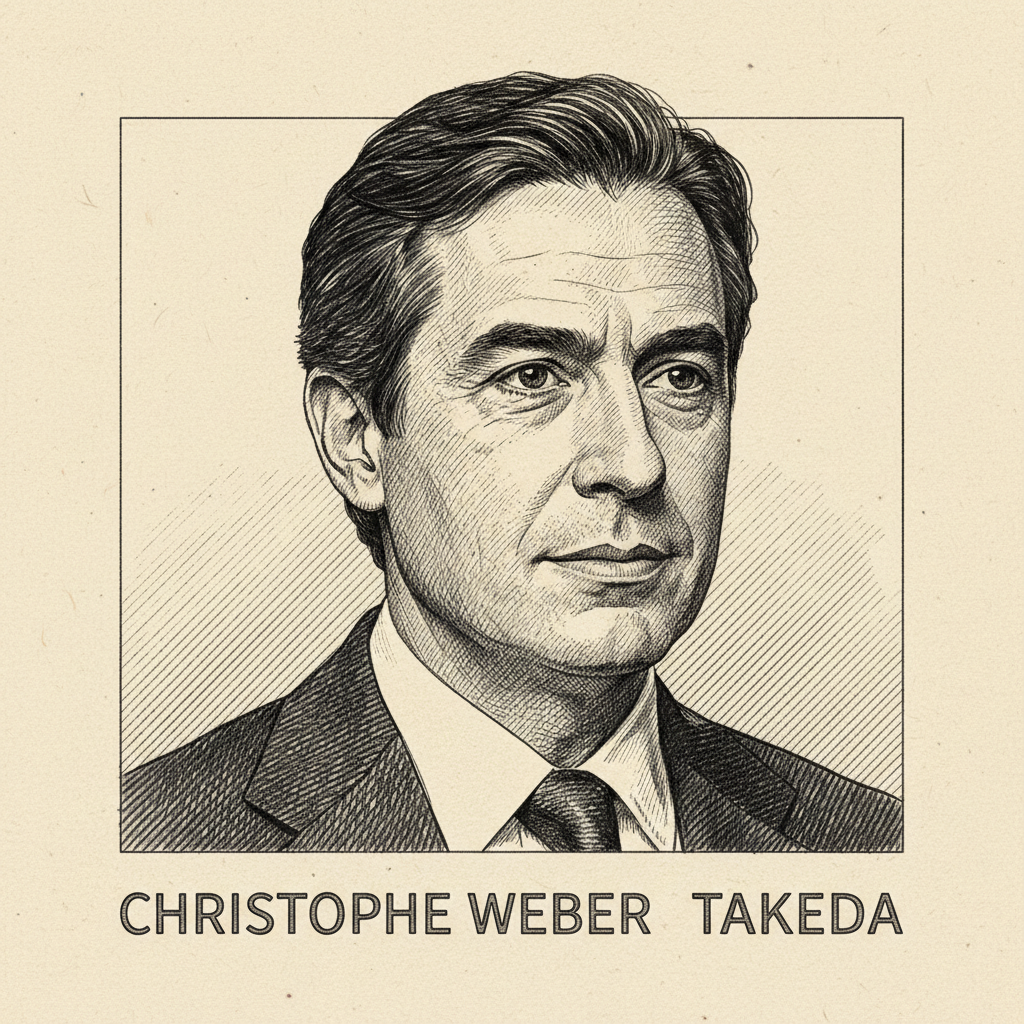
Christophe Weber
Architect of Takeda's global biopharmaceutical transformation.
Christophe Weber is a French business executive who has served as the CEO of Takeda Pharmaceutical Company Limited, Japan's largest pharmaceutical company, since June 2014. He is credited with leading a significant strategic overhaul, pivoting the company towards global biopharmaceuticals and specialty medicines through aggressive M&A and R&D prioritization.
Biography
Accomplishments
- 01Orchestrated the strategic transformation of Takeda from a Japan-focused company to a global biopharmaceutical leader, significantly expanding its presence in Western markets and specialty therapeutic areas.
- 02Led the acquisition of Shire plc for approximately $62 billion in 2019, the largest outbound acquisition by a Japanese company, which diversified Takeda's product portfolio and enhanced its pipeline in rare diseases, neuroscience, and plasma-derived therapies.
- 03Successfully executed a multi-year divestiture program post-Shire acquisition, shedding approximately $14 billion in non-core assets to reduce debt and streamline operations, generating significant capital for reinvestment.
- 04Implemented a rigorous R&D prioritization framework, shifting focus towards high-value biopharmaceutical assets in oncology, gastroenterology, and rare diseases, leading to several new drug approvals and pipeline advancements.
- 05Achieved significant debt reduction targets following the Shire acquisition earlier than projected, demonstrating strong financial discipline and integration capabilities.
- 06Fostered a more diverse and globally-oriented corporate culture at Takeda, integrating diverse talent and operating models.
- 07Navigated Takeda through challenging regulatory and market environments, maintaining strong financial performance and shareholder value amidst large-scale transformation.
Lessons for Operators
Key Takeaways
Practical lessons distilled for operators, investors, C-levels, and capital allocators.
Bold Transformational M&A
Weber's leadership in the Shire acquisition serves as a case study for how large-scale, strategic M&A can fundamentally reshape a company's identity and market position, moving it into higher-growth, more specialized segments. Investors should evaluate management's capacity for identifying and executing such transformative deals.
Post-Acquisition Integration & Divestiture
The success isn't just in the acquisition, but in the subsequent integration and the disciplined divestment of non-core assets. Operators and C-levels must have a clear plan for both integration and portfolio optimization to unlock value and manage debt effectively post-merger.
R&D Focus and Prioritization
Takeda's shift to specialized biopharmaceuticals under Weber highlights the critical need for continuous evaluation and strategic prioritization of R&D investments. Capital allocators should scrutinize a company's R&D pipeline and its alignment with future market trends and core competencies.
Global Leadership and Cultural Transformation
Weber's role as a non-Japanese CEO leading a Japanese multinational underscores the value of bringing in diverse leadership to drive global expansion and cultural change. Enterprises looking to globalize must consider how leadership diversity can accelerate integration and innovation.
Financial Discipline in Debt Management
Despite the massive debt incurred from the Shire acquisition, Takeda demonstrated strong financial discipline in its rapid deleveraging. This sends a clear signal to investors about management's commitment to financial health and sustainable growth.
Frameworks & Principles
Named frameworks and strategic principles they popularized or embodied.
Portfolio Rationalization Matrix
A framework used to evaluate existing business units or product lines based on their strategic fit, market attractiveness, and competitive position, leading to decisions about investment, hold, or divestiture.
When to useApplicable after major acquisitions (e.g., Shire), during strategic reviews, or when optimizing resource allocation across a diversified portfolio to identify non-core assets for sale or underperforming units for re-prioritization.
M&A Integration Playbook
A structured approach outlining the phases, tasks, and responsibilities for integrating two companies post-acquisition, covering functional integration (HR, IT, finance), cultural integration, and synergy realization.
When to useEssential for any significant merger or acquisition, particularly one of Takeda's scale with Shire, to ensure a smooth transition, retain talent, and achieve projected synergies and cost efficiencies.
Strategic R&D Prioritization Model
A model that systematically assesses potential R&D projects or therapeutic areas based on criteria such as market potential, scientific feasibility, competitive landscape, regulatory pathway, and alignment with core business strategy.
When to useUsed by biopharma companies like Takeda to allocate finite R&D resources to the most promising projects, driving innovation in high-value areas (e.g., oncology, rare diseases) and de-emphasizing less attractive ones.
Recent Appearances
Latest interviews, keynotes, and press from the past half year.
 youtube.com
 youtube.com
 youtube.com
 youtube.com
 youtube.com
 youtube.com
 youtube.com
 youtube.com
 youtube.com
 youtube.com
 youtube.com
 youtube.com
 youtube.com
Explore Related Titans
Other figures in the archive who share Christophe Weber's domain, geography, or era.
More in Healthcare & Biotech







From France







Contemporaries — born 1960s