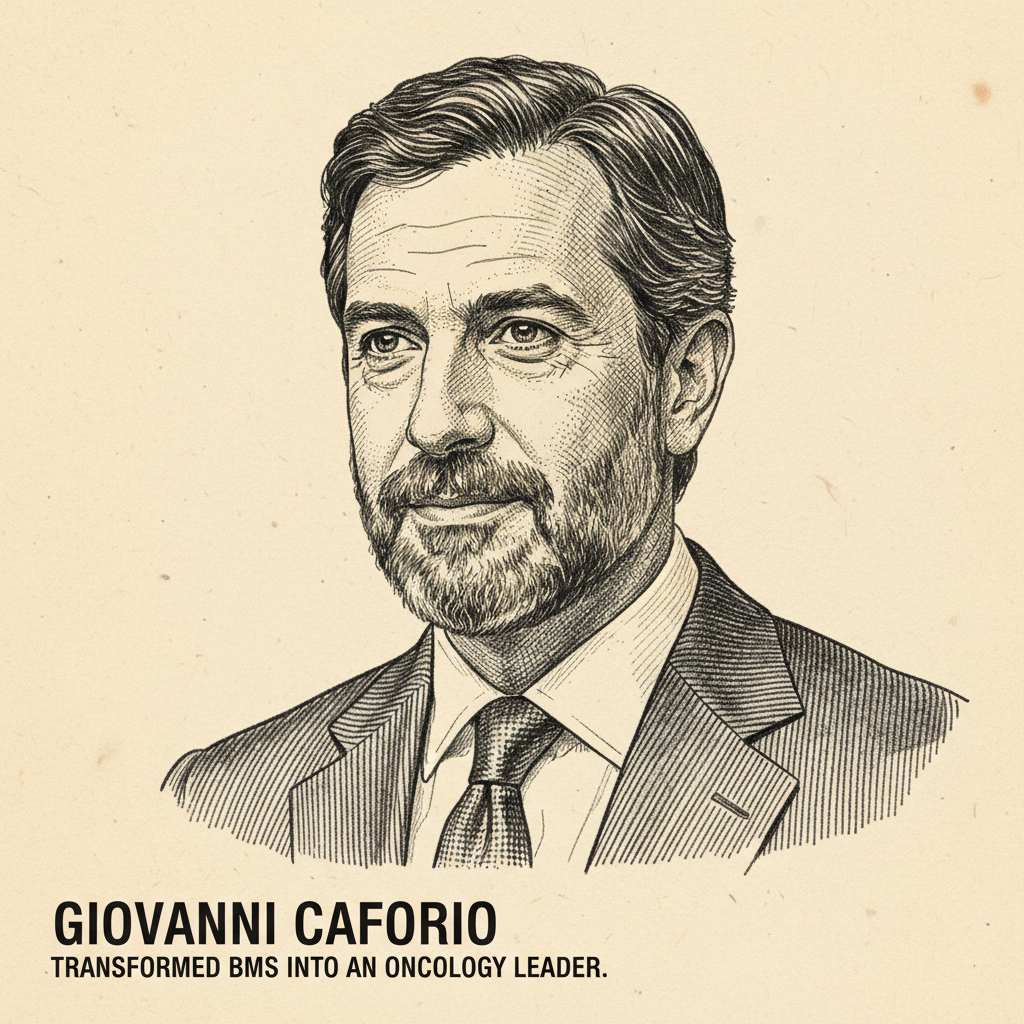
Giovanni Caforio
Giovanni Caforio: The Architect of Strategic Transformation in Biopharma.
Giovanni Caforio, an Italian physician by training, led Bristol Myers Squibb (BMS) through a period of significant strategic reorientation and M&A, most notably orchestrating the acquisition of Celgene. His tenure as CEO (2015-2023) focused on solidifying BMS's leadership in oncology, immunology, and cardiovascular diseases, while divesting non-core assets and navigating patent cliffs.
Biography
Accomplishments
- 01Orchestrated the $74 billion acquisition of Celgene (2019), significantly expanding BMS's oncology and immunology franchises and creating a top-tier biopharmaceutical company.
- 02Successfully managed the integration of Celgene, including the complex divestiture of Otezla to Amgen for $13.4 billion to comply with antitrust regulations.
- 03Divested non-core assets, including the consumer health business to Reckitt Benckiser for $4.2 billion (2017), sharpening BMS's strategic focus on biopharmaceuticals.
- 04Oversaw the successful launch and commercialization of key pipeline assets across oncology (e.g., Opdivo, Yervoy), hematology, and immunology, driving sustained revenue growth.
- 05Navigated significant patent expirations for key products like Revlimid, implementing strategies to mitigate impact through pipeline diversification and new product launches.
Lessons for Operators
Key Takeaways
Practical lessons distilled for operators, investors, C-levels, and capital allocators.
Portfolio Pruning for Strategic Clarity
Actionable Insight: Regularly assess your business units against core strategic objectives. Divest underperforming or non-differentiating assets to free up capital and management attention for high-growth, high-impact areas. BMS's divestment of consumer health and diabetes assets exemplifies this.
Aggressive Pipeline Fortification
Actionable Insight: In industries with high R&D intensity and patent clock pressures, proactive and bold M&A can be crucial. Caforio's acquisition of Celgene, though massive, was a necessary move to secure a robust pipeline and revenue stream for future decades. Don't shy away from scale if the strategic fit is compelling.
Mastering Post-Merger Complexities
Actionable Insight: Large-scale M&A is just the beginning. Dedicate significant resources to integration planning, regulatory compliance (e.g., anti-trust divestitures), and cultural alignment from day one. The successful divestment of Otezla was critical to the Celgene deal's completion and value realization.
Long-Term Value Creation Over Short-Term Gains
Actionable Insight: Prioritize investments in R&D and strategic acquisitions that yield sustainable competitive advantage, even if it impacts near-term earnings. Caforio's leadership demonstrated a commitment to foundational science and portfolio diversification to endure market volatility and patent cliffs.
Leadership in Transition
Actionable Insight: Effectively managing leadership transitions and succession planning is paramount. Caforio's smooth transition out of the CEO role, while remaining Chairman for a period, provides continuity and stability, allowing for strategic initiatives to take root under new leadership.
Frameworks & Principles
Named frameworks and strategic principles they popularized or embodied.
Portfolio Rationalization Matrix
A tool to evaluate business units or product lines based on strategic fit and financial performance (e.g., market share vs. market growth, or core competency vs. profitability). Businesses are categorized for investment, divestment, or harvest.
When to useWhen assessing which business units or product lines to retain, invest in, or divest to optimize capital allocation and focus resources on core strategic objectives, as Caforio did with BMS's non-pharma assets.
Integration Management Office (IMO) Model
A structured approach to managing complex post-merger integrations, involving dedicated teams for each functional area (e.g., R&D, commercial, HR, IT) to ensure seamless transition, synergy realization, and risk mitigation.
When to useEssential for large-scale acquisitions like the Celgene merger, where numerous operational, cultural, and regulatory challenges must be systematically addressed to maximize deal value and minimize disruption.
Patent Cliff Mitigation Strategy
A proactive framework for pharmaceutical companies to anticipate and counteract revenue declines due to patent expirations. Involves pipeline diversification, lifecycle management of existing drugs, and strategic M&A to acquire new assets.
When to useWhen a significant portion of a company's revenue is derived from products nearing patent expiration. Caforio applied this by building robust pipelines through acquisition and internal R&D to offset future revenue loss.
Sources & Further Reading
Profiles, interviews, podcasts, and articles used to compile and verify this entry. Each link opens at the original publisher.
Explore Related Titans
Other figures in the archive who share Giovanni Caforio's domain, geography, or era.
More in Healthcare & Biotech










From Italy










Contemporaries — born 1960s