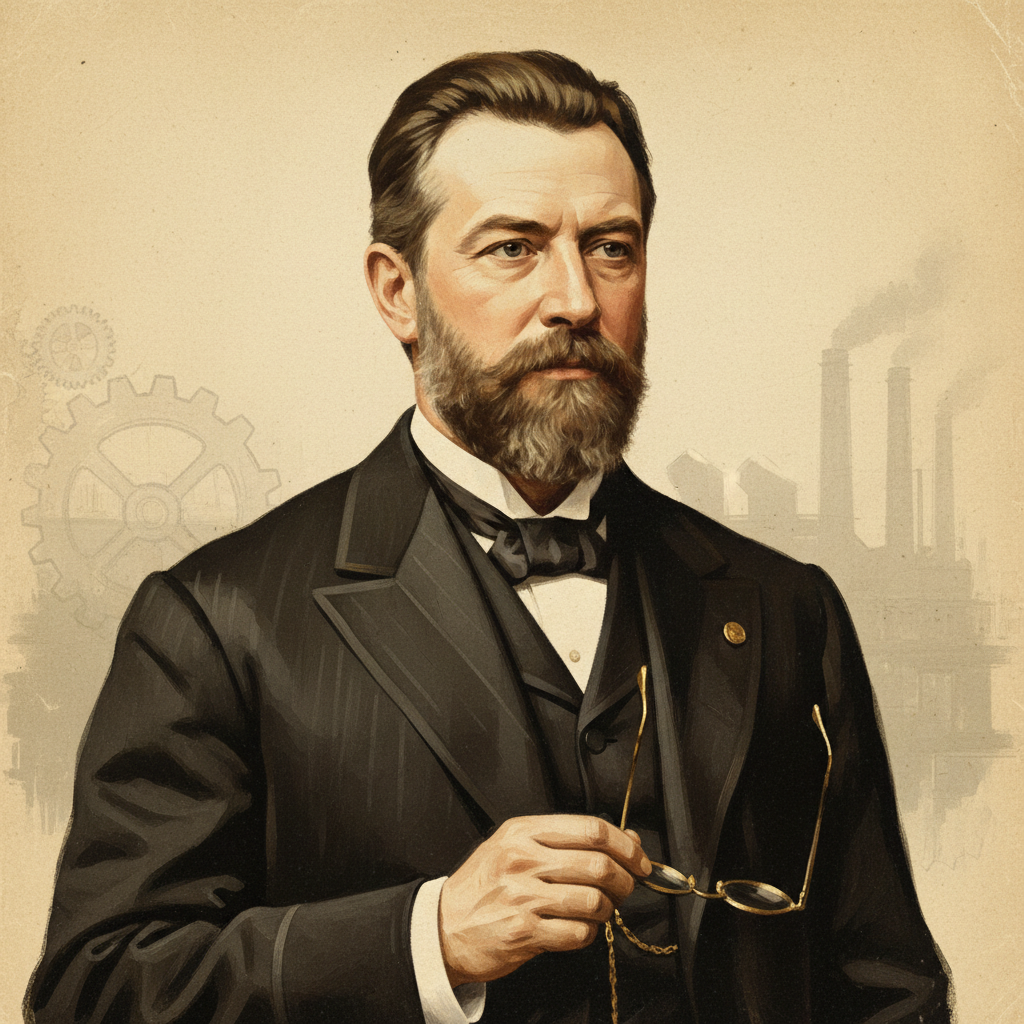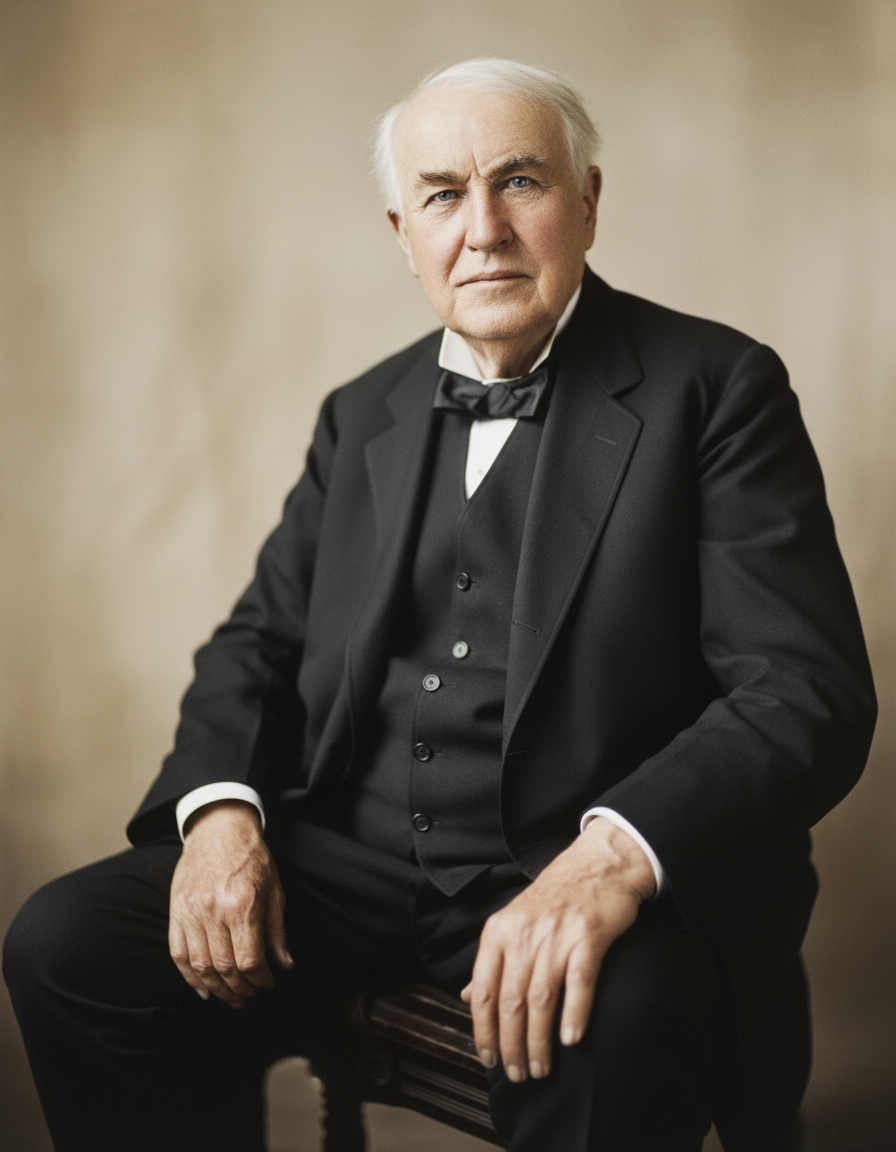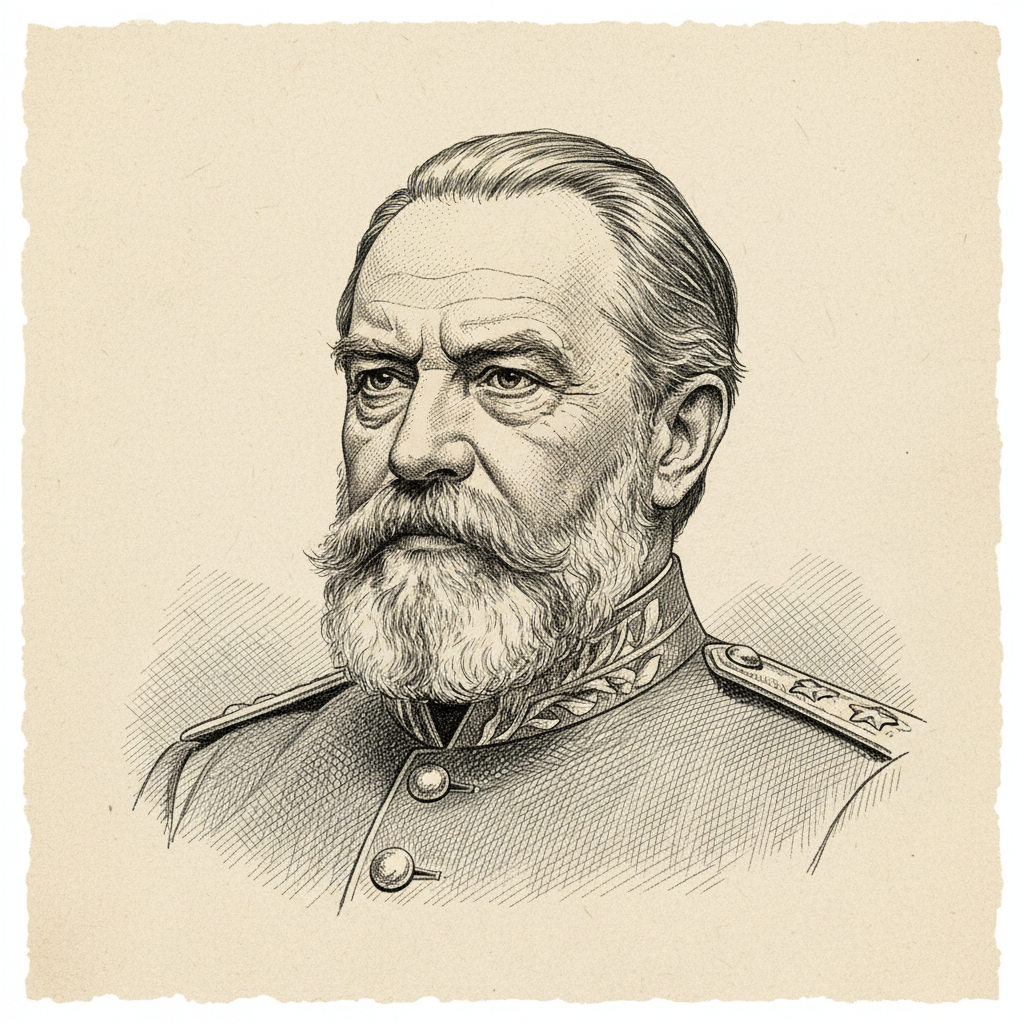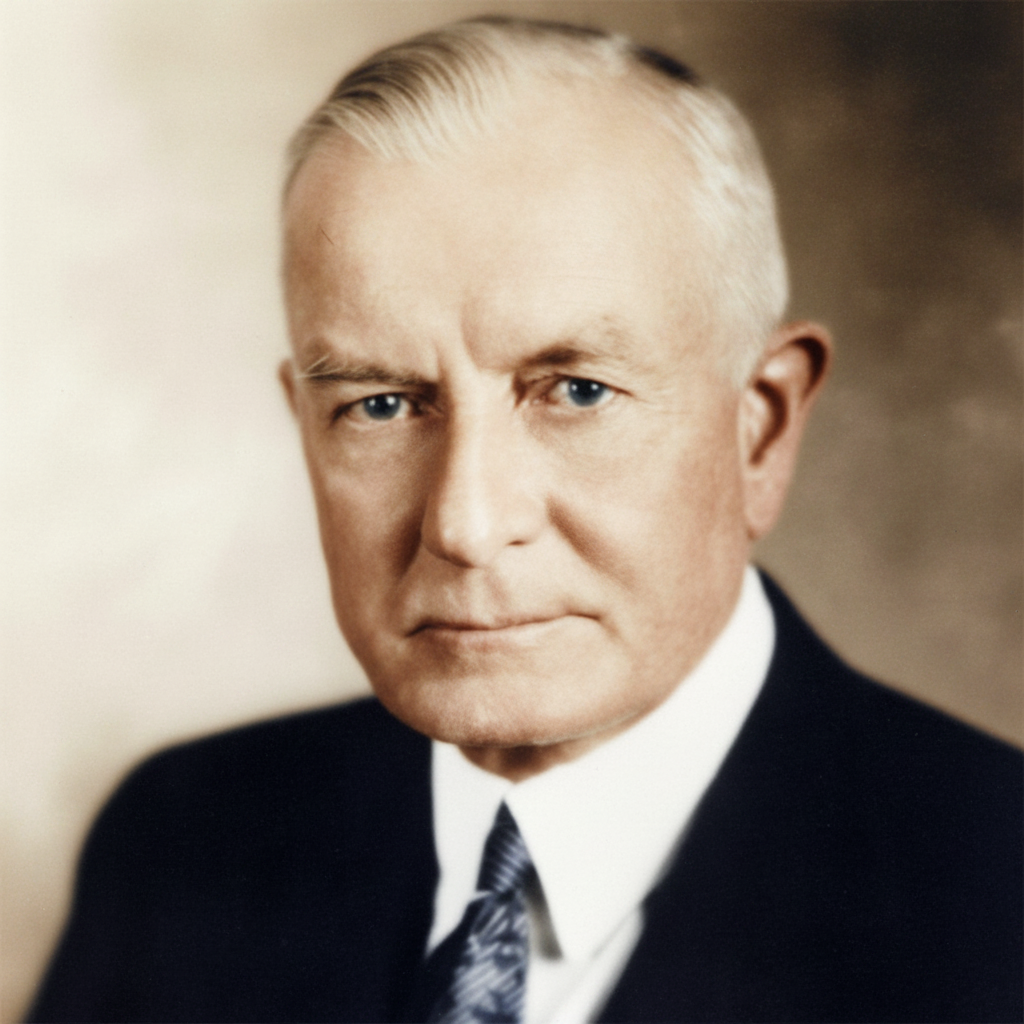
Portrait of Thomas J. Watson Sr.
Historical Mind · 1874 — 1956

Thomas J. Watson Sr.

Thomas J. Watson Sr. transformed Computing-Tabulating-Recording Company into International Business Machines (IBM), establishing a global technology and information services powerhouse through aggressive sales, employee welfare, and a vision for 'thinking machines.'

Country
United States
Continent
North America
Industry
Information Technology
Role
CEO, Chairman

Thomas J. Watson Sr. led IBM for over four decades, from 1914 to 1956. He transformed a fragmented computing and tabulating machine manufacturer into a dominant force in the nascent information technology industry. Watson's leadership emphasized customer service, employee loyalty, and a forward-looking approach to technology, laying the groundwork for IBM's long-term success and its pivotal role in the digital age.

Biography

Thomas J. Watson Sr. was born in Campbell, New York, in 1874. After a brief period as a bookkeeper and music teacher, he joined the National Cash Register Company (NCR) in 1896, quickly distinguishing himself as a top salesman under John Henry Patterson. By 1903, he was general manager, but his tenure ended in 1912 after being convicted of antitrust violations (later overturned). In 1914, Watson was hired as general manager of the struggling Computing-Tabulating-Recording Company (CTR), a merger of four different firms: the Tabulating Machine Company, International Time Recording Company, Computing Scale Company of America, and Bundy Manufacturing Company. Watson immediately focused on sales, engineering, and employee morale, introducing the now-famous 'Think' motto. He renamed the company International Business Machines (IBM) in 1924, reflecting his global ambitions. Under his leadership, IBM expanded its product lines from tabulating machines to electric typewriters, time recorders, and ultimately, early electronic computers. During the Great Depression, while many companies cut costs, Watson increased investment in research and development and maintained his workforce, positioning IBM for significant growth when the economy recovered. IBM secured the landmark Social Security Act contract in 1935, providing tabulating equipment for millions of employment records. He maintained strict control over the company, fostering a highly disciplined and sales-driven culture. Watson also championed employee welfare programs, including pension plans and educational initiatives, long before they were common. He retired as CEO in 1952, handing the reins to his son, Thomas Watson Jr., and passed away in 1956, having built one of the world's most enduring and influential corporations.

Accomplishments

  • 01Transformed CTR into IBM in 1924, establishing a globally recognized brand and expanding its international operations significantly.
  • 02Secured and executed the critical Social Security Act contract in 1935, positioning IBM as indispensable to large-scale data processing for government.
  • 03Pioneered the 'machines as a service' model by leasing equipment rather than selling, ensuring recurring revenue and customer lock-in during the early 20th century.
  • 04Cultivated a strong corporate culture focused on sales excellence, employee loyalty (e.g., no layoffs during the Great Depression), and continuous innovation.
  • 05Oversaw IBM's entry into electronic computing, including the development of machines like the Harvard Mark I, which paved the way for modern computing.
  • 06Instituted robust R&D programs, maintaining IBM's technological edge through economic downturns and periods of rapid industrial change.
  • 07Successfully navigated two world wars and the Great Depression, growing IBM's market share and profitability consistently throughout his tenure.
  • 08Established IBM's enduring 'Think' motto, symbolizing a commitment to problem-solving and intellectual rigor within the company and its products.

Lessons for Operators

Invest in R&D counter-cyclically: Watson increased R&D spending during the Great Depression, which allowed IBM to emerge stronger and with superior products when the economy recovered. This is applicable when economic downturns create opportunities for strategic long-term investments.
Prioritize customer relationships and service: IBM's success was built on understanding customer needs and providing comprehensive support, ensuring deep integration with client operations. This is crucial for businesses seeking sustainable, high-value client relationships, particularly in enterprise sales.
Cultivate a strong, values-driven corporate culture: Watson instilled values like respect for the individual, customer satisfaction, and excellence, which created a loyal and highly motivated workforce. Implement this by clearly articulating core values and consistently reinforcing them through leadership actions and employee programs.
Embrace innovation and anticipate future needs: Watson understood the evolving role of information and data, steering IBM towards tabulating machines and eventually electronic computing. This means continuously monitoring technological shifts and proactively adapting product and service offerings.
Think globally from the outset: Renaming CTR to International Business Machines reflected Watson's early vision for global markets, which drove expansion beyond domestic borders. Apply this by designing products and strategies with international scalability in mind, rather than as an afterthought.
Build a robust sales organization: Watson, himself a legendary salesman, built a highly trained and motivated sales force that was central to IBM's market dominance. Implement rigorous sales training, incentive structures, and performance metrics to drive revenue growth.
Focus on recurring revenue models: IBM's strategy of leasing rather than selling equipment provided stable, predictable income streams and fostered long-term customer relationships. Evaluate opportunities to transition from one-off sales to subscription or service-based models.
Strategic workforce management: Maintaining a skilled workforce even during economic hardship (e.g., no layoffs during the Depression) built deep employee loyalty and preserved institutional knowledge, enabling rapid recovery and growth. This lesson is relevant for long-term talent retention and organizational resilience.
The Operator's Playbook

Key Takeaways

Practical lessons distilled for operators, investors, C-levels, and capital allocators.

Lesson 01

Long-term Vision over Short-term Gain

Watson's decision to maintain R&D investment and avoid layoffs during the Great Depression, despite immediate financial pressures, positioned IBM for unparalleled growth post-recession. This illustrates the power of prioritizing long-term strategic advantage over quarterly financial metrics.

Lesson 02

The Power of a Unified Corporate Culture

IBM's 'Think' motto and its strong internal culture emphasizing sales excellence, employee welfare, and customer service created a cohesive, highly effective organization. This demonstrates that a clearly defined and consistently reinforced culture can be a significant competitive advantage.

Lesson 03

Data as a Strategic Asset

Watson recognized early the immense value of processing and organizing information, moving beyond simple calculating machines to systems that could manage vast datasets. This foresight laid the foundation for the information age and highlights the enduring importance of data management technologies.

Lesson 04

Leasing Models for Market Dominance

IBM's primary business model of leasing equipment, rather than outright selling, created a predictable revenue stream, encouraged long-term customer relationships, and made it harder for competitors to displace IBM. This strategy is an early example of a successful 'as-a-service' model.

Lesson 05

Global Ambition from Inception

The rebranding to 'International Business Machines' reflected Watson's intent to dominate global markets, not just domestic ones. This early global perspective was crucial for IBM's expansion and sustained international influence.

Lesson 06

Sales-Driven Organization

Watson, a master salesman himself, built IBM as a sales-driven company. He emphasized direct customer engagement, understanding client needs, and providing comprehensive solutions, establishing a model for enterprise sales that remains relevant today.

Lesson 07

Continuous Investment in Human Capital

IBM invested heavily in employee training, welfare, and retention, fostering a highly skilled and loyal workforce. This commitment to human capital was a cornerstone of its innovation capacity and service quality.

Lesson 08

Adaptability in Evolving Technologies

Watson successfully guided IBM from mechanical tabulating machines to early electronic computers, demonstrating a critical ability to adapt the company's core business to emerging technological paradigms while maintaining market leadership.

Mental Models

Frameworks & Principles

Named frameworks and strategic principles they popularized or embodied.

01

Watson's Sales Discipline & Customer Focus

Emphasizes rigorous sales training, direct customer engagement, and a deep understanding of client business processes to deliver tailored solutions. Watson believed 'nothing happens until a sale is made,' and built IBM's culture around this principle.

When to useApplicable for any organization, especially B2B companies, looking to build a dominant market position through superior sales execution, customer intimacy, and comprehensive service. Useful for training sales teams to become indispensable partners rather than mere vendors.

02

IBM's Counter-Cyclical Investment Strategy

Involves maintaining or increasing investment in R&D, human capital, and strategic infrastructure during economic downturns, rather than cutting costs. The aim is to emerge from recessions with a stronger competitive advantage and market position.

When to useRelevant for long-term oriented investors and enterprise leaders planning capital allocation during economic contractions or periods of uncertainty. Useful for companies with strong balance sheets that can afford to make strategic bets when competitors are retrenching.

03

The 'Machines as a Service' (MaaS) Precedent

IBM's model of leasing its tabulating equipment, rather than selling it outright, provided predictable recurring revenue, reduced customer's upfront capital expenditure, and fostered long-term relationships through ongoing service and upgrades.

When to useApplicable for hardware manufacturers, software companies, or any business providing equipment or tools where a subscription or usage-based model could replace traditional outright sales. Useful for increasing customer lifetime value and reducing churn.

Citations

Sources & Further Reading

Profiles, interviews, podcasts, and articles used to compile and verify this entry. Each link opens at the original publisher.

Adjacent Minds

Explore Related Titans

Other figures in the archive who share Thomas J. Watson Sr.'s domain, geography, or era.

Technology

More in Technology

Browse all →
Portrait of Steve Jobs
USA / TECHNOLOGY
Steve Jobs
Co-founder of Apple Inc. and visionary credited with transforming multiple industries.
Portrait of Jeff Bezos
UNITED STATES / TECHNOLOGY, RETAIL, LOGISTICS, CLOUD COMPUTING, SPACE EXPLORATION
Jeff Bezos
Architect of Amazon, pioneer of e-commerce, and visionary across cloud computing, logistics, and space exploration.
Portrait of Elon Musk
SOUTH AFRICA / AEROSPACE, AUTOMOTIVE, ARTIFICIAL INTELLIGENCE, ENERGY, TELECOMMUNICATIONS
Elon Musk
Elon Reeve Musk: Visionary entrepreneur leading advancements in aerospace, automotive, and artificial intelligence.
Portrait of Bill Gates
UNITED STATES / SOFTWARE, TECHNOLOGY, PHILANTHROPY
Bill Gates
Co-founder of Microsoft, architect of the personal computing revolution, and global philanthropist.
Portrait of Satya Nadella
INDIA / TECHNOLOGY
Satya Nadella
The architect of Microsoft's cloud-first, AI-centric transformation and culture revival.
Portrait of Jensen Huang
TAIWAN (NATURALIZED AMERICAN CITIZEN) / SEMICONDUCTORS, ARTIFICIAL INTELLIGENCE, COMPUTING
Jensen Huang
Co-founder, President, and CEO of NVIDIA, a pioneering force in graphics processing units (GPUs) and artificial intelligence.
Portrait of Sam Walton
UNITED STATES / RETAIL
Sam Walton
The architect of modern retail, pioneering discount merchandising and logistical efficiency to establish the world's largest retail corporation.
Portrait of Mark Cuban
UNITED STATES / TECHNOLOGY, MEDIA, SPORTS, HEALTHCARE
Mark Cuban
Mark Cuban: The Prolific Disrupter – From Software Startups to Sports Franchises and Pharmaceutical Innovation, Leveraging Technology and Direct-to-Consumer Models.
Portrait of Jack Ma
CHINA / E-COMMERCE, TECHNOLOGY, FINANCE
Jack Ma
Co-founder of Alibaba Group, pioneering e-commerce and digital finance in China.
Portrait of Walt Disney
UNITED STATES / ENTERTAINMENT
Walt Disney
Co-founder of The Walt Disney Company, pioneering animation, theme parks, and diversified entertainment.
United States

From United States

Browse all →
Portrait of Andrew Carnegie
UNITED STATES / STEEL & MANUFACTURING
Andrew Carnegie
The architect of American steel supremacy and a pioneering industrialist whose innovations in cost control and vertical integration reshaped global manufacturing.
Portrait of Warren Buffett
UNITED STATES / INVESTING
Warren Buffett
The Oracle of Omaha: Architect of long-term value investing and compounding returns through disciplined acquisition and intrinsic value focus.
Portrait of Jeff Bezos
UNITED STATES / TECHNOLOGY, RETAIL, LOGISTICS, CLOUD COMPUTING, SPACE EXPLORATION
Jeff Bezos
Architect of Amazon, pioneer of e-commerce, and visionary across cloud computing, logistics, and space exploration.
Portrait of Bill Gates
UNITED STATES / SOFTWARE, TECHNOLOGY, PHILANTHROPY
Bill Gates
Co-founder of Microsoft, architect of the personal computing revolution, and global philanthropist.
Portrait of Sam Walton
UNITED STATES / RETAIL
Sam Walton
The architect of modern retail, pioneering discount merchandising and logistical efficiency to establish the world's largest retail corporation.
Portrait of Mark Cuban
UNITED STATES / TECHNOLOGY, MEDIA, SPORTS, HEALTHCARE
Mark Cuban
Mark Cuban: The Prolific Disrupter – From Software Startups to Sports Franchises and Pharmaceutical Innovation, Leveraging Technology and Direct-to-Consumer Models.
Portrait of Mohnish Pabrai
UNITED STATES / FINANCIAL SERVICES
Mohnish Pabrai
The Dhandho Investor: A Value Investing Maverick.
Portrait of Henry Ford
UNITED STATES / AUTOMOTIVE
Henry Ford
The architect of mass production, democratizing the automobile through efficiency and scale.
Portrait of Walt Disney
UNITED STATES / ENTERTAINMENT
Walt Disney
Co-founder of The Walt Disney Company, pioneering animation, theme parks, and diversified entertainment.
Portrait of Thomas Edison
UNITED STATES / INDUSTRIAL & ENERGY
Thomas Edison
The Prolific Inventor and Industrialist Who Electrified the World and Standardized Innovation.