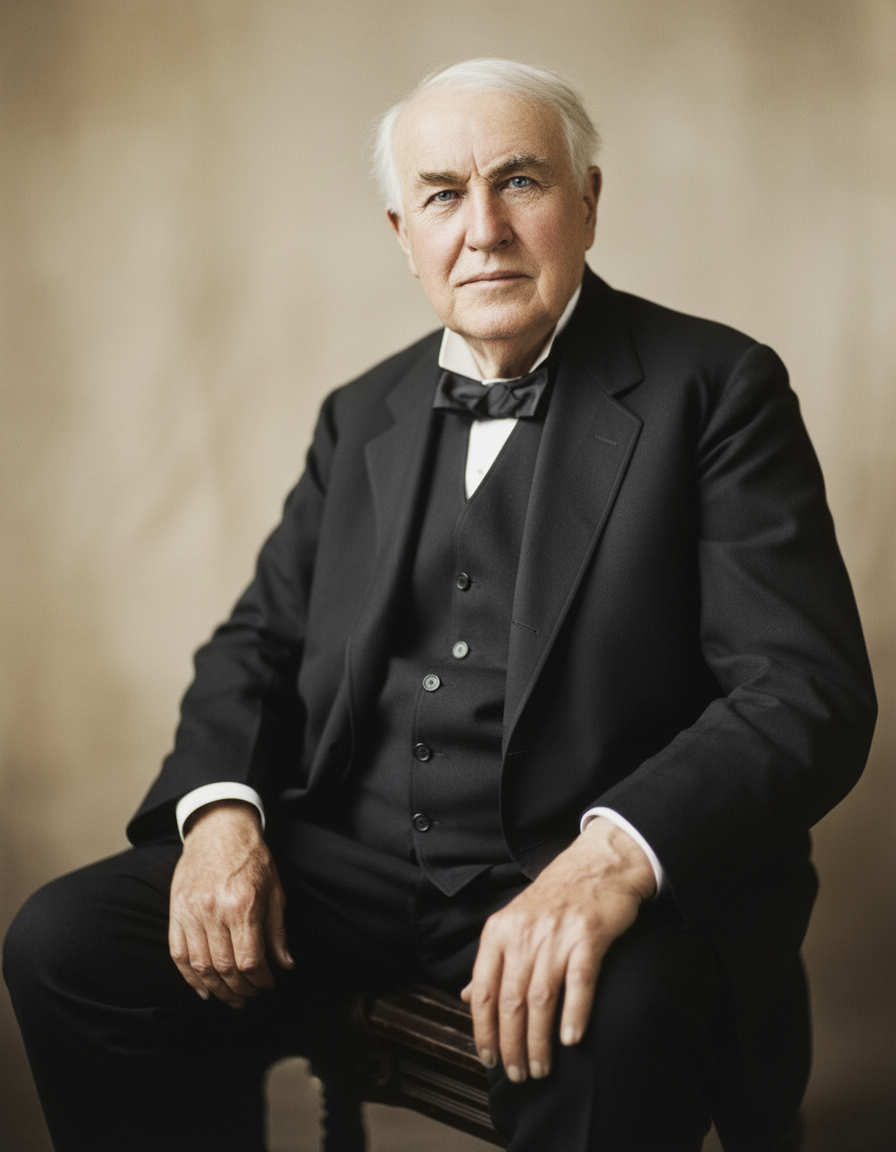
Thomas J. Watson
Architect of modern enterprise computing who transformed CTR into IBM through high-margin leasing, disciplined sales culture, and bold counter-cyclical capital allocation.
Thomas J. Watson was the executive titan who converted a disparate holding company of scales, time clocks, and punch-card machines into International Business Machines (IBM), the world's preeminent computing corporation. After rising through National Cash Register (NCR) under John Henry Patterson, Watson took the helm of the Computing-Tabulating-Recording Company (CTR) in 1914. Over a 42-year tenure, he created the template for modern B2B enterprise sales, institutionalized recurring-revenue machine leasing, and made the famous counter-cyclical bet during the Great Depression that secured IBM's role as the technological backer of the federal government and Fortune 500.
Biography
Accomplishments
- 01Transformed the Computing-Tabulating-Recording Company (CTR) from a $4.2 million holding company in 1914 into IBM, reaching $734 million in annual revenue by 1956.
- 02Engineered the enterprise hardware leasing model, tethering long-term machine rentals with recurring sales of high-margin Hollerith punch cards to generate recession-proof cash flows.
- 03Executed a historic counter-cyclical strategy during the Great Depression by expanding production and R&D between 1930 and 1934, enabling IBM to win the landmark 1935 Social Security Administration contract.
- 04Codified professional enterprise sales through the creation of the IBM Sales School in Endicott, New York, the '100% Club' quota incentive system, and customer-embedded systems engineers.
- 05Established a premier research culture that yielded the 80-column punched card (1928), the 405 Alphabetical Accounting Machine (1934), and early digital platforms like the SSEC (1948).
- 06Expanded operations into more than 80 countries, founding the IBM World Trade Corporation in 1949 to capitalize on post-war European and Asian modernization.
Lessons for Operators
Key Takeaways
Practical lessons distilled for operators, investors, C-levels, and capital allocators.
Hardware as a Service (HaaS) Monopolies
Watson avoided the feast-or-famine dynamics of capital equipment sales by insisting on leasing tabulators and standardizing punch card consumables, an architecture that created early lock-in and resilient gross margins.
Preparedness Meets Policy Winds
IBM's victory in modernizing the Social Security Administration in 1935 was not luck; it resulted from four years of deliberate inventory building when rivals were liquidating assets and laying off engineers.
The Solution-Selling Paradigm
Watson shifted sales incentives from transaction volume to business integration. IBM representatives were trained in the client's industry accounting processes, turning salespeople into operational consultants.
The 'THINK' Operational Philosophy
Watson elevated contemplation and intellectual rigor into daily work practices, providing employees with clear behavioral norms, corporate education, job security, and above-market welfare provisions to discourage unionization and breed fierce loyalty.
Frameworks & Principles
Named frameworks and strategic principles they popularized or embodied.
The Enterprise Annuity Engine
A strategic operating model where mission-critical hardware is leased at terms covering depreciation while essential operating consumables (punch cards) and maintenance agreements provide ultra-high-margin recurring revenue. Customer churn is minimized because switching costs require retraining clerical staff and restructuring established workflows.
When to useDeploy when selling expensive enterprise infrastructure that involves high adoption friction, heavy ongoing operational integration, and recurring programmatic input demands.
Counter-Cyclical Capacity Buffering
A capital allocation framework executed during economic downturns. While competitors slash R&D and reduce production runs to protect short-term earnings, the firm utilizes its cash reserves or debt capacity to maintain factory utilization, retain high-skill labor, and amass standardized finished inventory in anticipation of large-scale market or regulatory demand surges.
When to useUse when holding strong balance sheet reserves and predictable baseline cash flow during macro downturns, particularly in sectors where future demand is driven by inevitable state or industrial bureaucratization.
The Institutional Sales Academy Pipeline
A talent development model that selects candidates on character and discipline, puts them through a rigorous, company-run immersion program covering both technical mechanics and customer-specific accounting practices, and deploys them into strictly measured territories backed by tiered recognition clubs and high commissions.
When to useUse when scaling complex, high-ticket B2B solutions that require deep organizational trust and long consultative sales cycles rather than self-service or direct-to-consumer marketing.
Sources & Further Reading
Profiles, interviews, podcasts, and articles used to compile and verify this entry. Each link opens at the original publisher.
Explore Related Titans
Other figures in the archive who share Thomas J. Watson's domain, geography, or era.
More in Technology










From United States




Contemporaries — 19th century