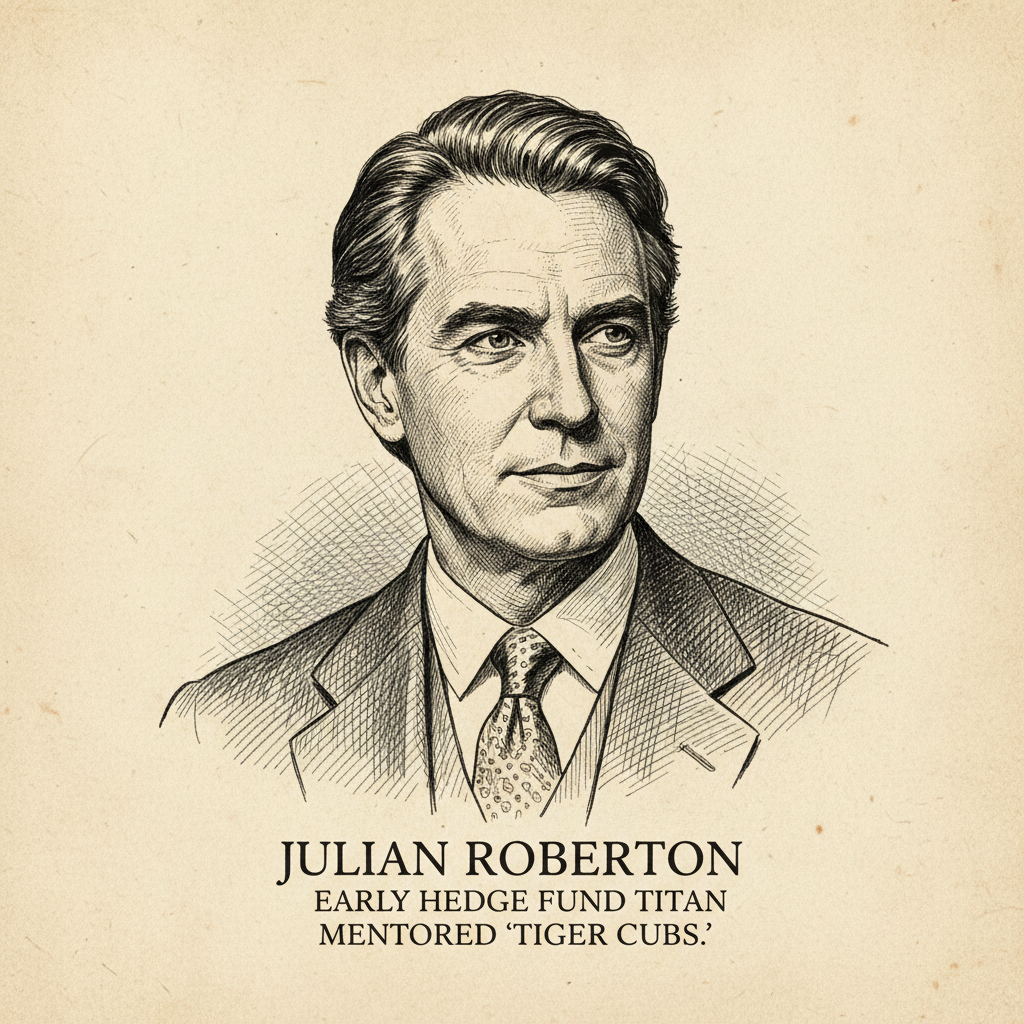
Julian Robertson
Julian Robertson: The 'Tiger' of Wall Street who pioneered the modern hedge fund industry and nurtured a generation of investment talent.
Julian Hart Robertson Jr. was an American investor, hedge fund manager, and philanthropist. He founded Tiger Management Corp. in 1980, which grew into one of the largest and most successful hedge funds globally, pioneering the 'Tiger Cub' phenomenon. Known for his fundamental, long/short equity strategy, Robertson was a pivotal figure in modern finance, influencing countless subsequent managers.
Biography
Accomplishments
- 01Founded Tiger Management Corp. in 1980, growing it into one of the largest and most influential hedge funds with over $22 billion in AUM by 1998.
- 02Pioneered the modern long/short equity hedge fund strategy, combining meticulous fundamental research with macroeconomic analysis.
- 03Achieved an annualized return of 31.7% from 1980 to 1998, significantly outperforming market benchmarks.
- 04Mentored and seeded over 40 'Tiger Cub' hedge funds, including Lone Pine Capital, Viking Global Investors, and Tiger Global Management, creating an enduring legacy in the investment community.
- 05Established the Robertson Foundation, committing hundreds of millions to philanthropy, particularly in education, medical research, and environmental conservation.
- 06Successfully navigated major market cycles, demonstrating adaptability and conviction in his investment theses for nearly two decades.
Lessons for Operators
Key Takeaways
Practical lessons distilled for operators, investors, C-levels, and capital allocators.
The Power of Conviction-Based Investing
Robertson's success stemmed from taking large, concentrated positions based on deep, proprietary research. He was willing to be a contrarian, holding onto positions even when they were unpopular, provided his fundamental analysis remained sound. For operators, this means having conviction in your business strategy, backed by thorough market and internal analysis, rather than chasing fads.
Build a Talent Incubator
Robertson's legacy extends beyond his fund's returns; it's also about the generation of 'Tiger Cubs' he mentored and seeded. This demonstrates the immense value of identifying, training, and empowering talented individuals, even if they eventually spin off. For C-levels and enterprise leaders, investing in talent development and fostering an entrepreneurial spirit within your organization can create long-term competitive advantages and a robust ecosystem of future leaders.
Adaptability in Strategy, Steadfast in Principles
While Tiger Management adhered to fundamental long/short equity, Robertson was also adept at incorporating global macro perspectives, understanding how currency, interest rates, and geopolitics impacted his core holdings. His downfall during the dot-com bubble also highlights the importance of recognizing when prevailing market dynamics fundamentally shift, and adapting strategy while staying true to core investment principles. This requires a balance between flexibility and discipline.
The Long Game of Philanthropic Capital
Robertson viewed his wealth as a tool for significant societal impact, directing substantial resources towards education, environmentalism, and medical research. This highlights that financial success can and should be leveraged for broader good. Fund managers and capital allocators should consider integrating philanthropic strategies as an extension of their wealth management, aiming for durable, impactful legacies.
The Crucial Role of Risk Management
Tiger Management's closure in 2000 served as a stark reminder that even the most successful strategies can falter if risk management doesn't adapt to changing market environments. Over-concentration or a misjudgment of market sentiment, particularly in speculative bubbles, can lead to rapid capital erosion. Leaders must continuously evaluate and stress-test their risk parameters, ensuring they are aligned with current market realities and potential Black Swan events.
The Value of a Strong Network
Robertson's vast network, both among his proteges and within the broader financial community, provided him with valuable insights and collaboration opportunities. For investors and operators, cultivating a strong professional network is crucial for intelligence gathering, deal flow, partnership opportunities, and even succession planning. It's about building enduring relationships, not just transactional contacts.
Frameworks & Principles
Named frameworks and strategic principles they popularized or embodied.
Fundamental Long/Short Equity
An investment strategy involving rigorous bottom-up research to identify undervalued companies for 'long' positions and overvalued companies for 'short' positions. The goal is to profit from both rising and falling stock prices, seeking an 'absolute return' independent of market direction.
When to useApplicable when seeking to generate alpha through stock-specific insights rather than broad market bets. Effective in diversified markets where mispricing opportunities are prevalent. Requires deep industry knowledge and robust financial analysis capabilities.
Tiger Cub Incubation Model
A talent development and capital allocation strategy where a successful fund manager mentors and provides seed capital to former employees (or promising external talent) to launch their own funds. The original manager often retains an economic interest in the new funds.
When to useUseful for established fund managers or business leaders looking to diversify their capital deployment, leverage their expertise, and perpetuate their investment philosophy through a new generation of leaders. It's also a powerful retention tool for top talent and creates an enduring professional network.
Global Macro Overlay
Integrating macroeconomic analysis (e.g., interest rates, currency movements, geopolitical events, commodity prices) into stock-specific or sector-specific investment decisions. It provides a top-down perspective to inform bottom-up choices or can be a standalone trading strategy.
When to useEssential when operating in interconnected global markets where external factors significantly impact company performance. Operators should use this to anticipate broad economic shifts, and investors to adjust portfolio allocations or hedge against systemic risks. It helps contextualize micro-level decisions within a broader financial and political landscape.
Conviction-Weighted Portfolio Construction
Building a portfolio where position sizes are directly proportional to the investor's conviction in the underlying investment thesis, typically leading to a more concentrated portfolio. This contrasts with diversified portfolios that spread risk broadly.
When to useSuitable for investors or business units with high confidence in their specific research and analytical capabilities. It aims to maximize returns from the highest-conviction ideas but also concentrates risk. Requires robust due diligence and a high tolerance for volatility associated with fewer, larger bets. Not suitable for those prioritizing broad market diversification or passive strategies.
Recent Appearances
Latest interviews, keynotes, and press from the past half year.
 youtube.com
 youtube.com
 m.youtube.com
 youtube.com
 youtube.com
 youtube.com
 youtube.com
 youtube.com
 youtube.com
 youtube.com
 youtube.comyoutube.com
 youtube.com
 youtube.com
 youtube.com
 youtube.com
 youtube.com
 youtube.com
 youtube.com
 youtube.com
 youtube.com
 youtube.comyoutube.com
Sources & Further Reading
Profiles, interviews, podcasts, and articles used to compile and verify this entry. Each link opens at the original publisher.
Explore Related Titans
Other figures in the archive who share Julian Robertson's domain, geography, or era.
More in Finance & Investing










From United States








Contemporaries — born 1930s