Judy Marks
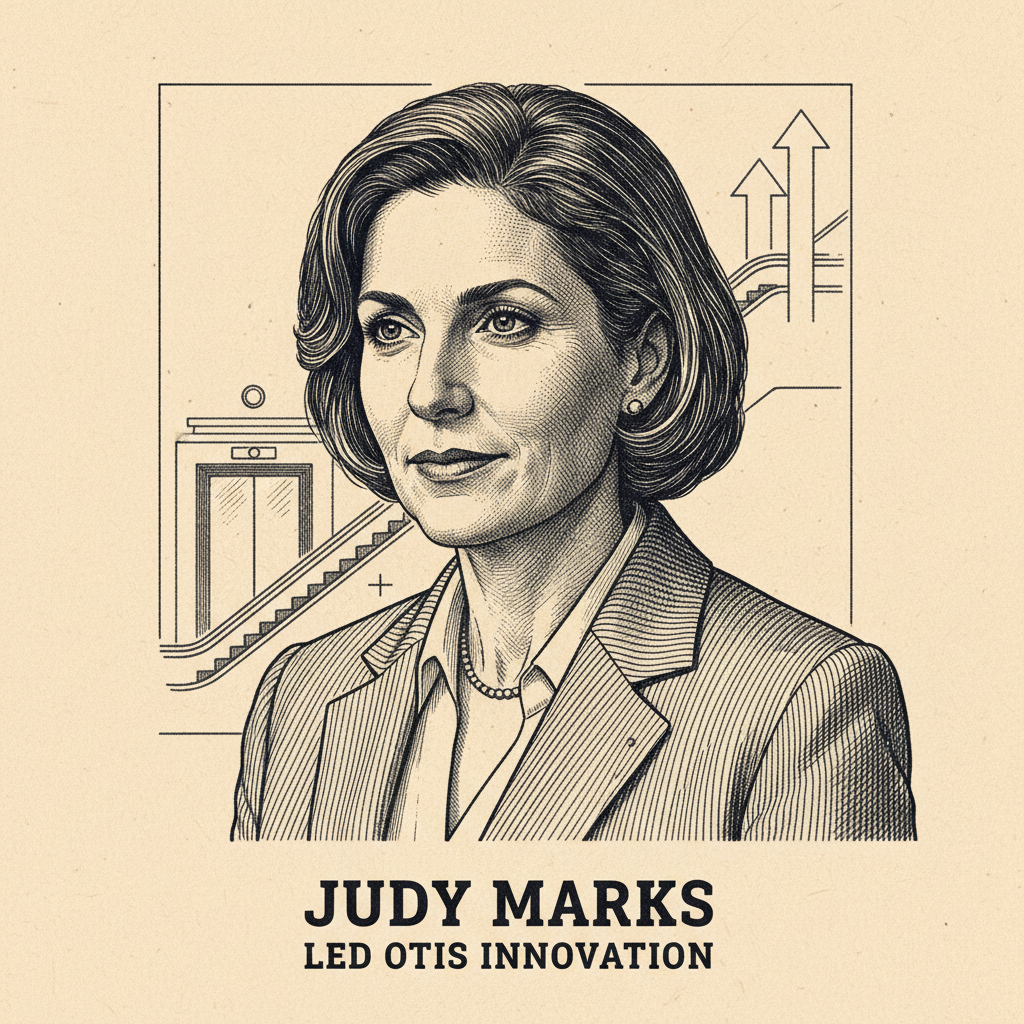
A leading force in industrial technology, known for driving digital transformation and operational excellence in complex, global enterprises.
Judy Marks is an American business executive currently serving as the Chair, CEO, and President of Otis Worldwide Corporation. Her career spans leadership roles at prominent technology and industrial companies, including IBM, Lockheed Martin, Siemens, and Raytheon. She is recognized for her strategic vision in integrating digital technologies, optimizing operational performance, and divesting/spinning off significant business units.
Biography
Accomplishments
- 01Led the successful spin-off of Otis Worldwide Corporation from United Technologies Corporation (UTC) in April 2020, creating an independent, publicly traded entity with a market capitalization exceeding $25 billion.
- 02Oversaw the digital transformation at Otis, accelerating the adoption of IoT technologies for predictive maintenance and enhanced service capabilities across its global footprint, servicing over 2 million elevators and escalators worldwide.
- 03Spearheaded margin expansion initiatives at Otis, achieving improved operational efficiency and profitability through strategic cost management and service portfolio optimization.
- 04Served as CEO of Siemens USA, managing a $22 billion enterprise with 50,000 employees, and driving significant growth and operational excellence across diverse business units from 2011-2015.
- 05Held CEO of Industrial segment role at Raytheon (2015-2018), overseeing a portfolio that included critical cybersecurity, intelligence, and space solutions, contributing to over $6 billion in annual revenue.
- 06Successfully navigated Otis through the initial challenges of the COVID-19 pandemic, maintaining operational continuity and safeguarding employee welfare while sustaining business performance.
Lessons for Operators
Key Takeaways
Practical lessons distilled for operators, investors, C-levels, and capital allocators.
Strategic Divestiture for Value Creation
The successful spin-off of Otis from UTC demonstrates that strategically separating complex conglomerates can unlock trapped value by allowing each entity to pursue distinct growth strategies and allocate capital more efficiently. Investors should assess opportunities for similar strategic portfolio realignments in their portfolios.
Digital Enablement in Industrial Services
Marks's push for IoT and predictive maintenance at Otis showcases how integrating digital technologies into traditional industrial service models can significantly improve asset uptime, customer satisfaction, and recurring revenue streams. Operators must prioritize digital investments that directly enhance service delivery and operational efficiency.
Embrace the Service Economy
Otis's continued growth under Marks's leadership has been significantly driven by its robust and expanding service contracts. For industrial manufacturers, transitioning from purely product-centric models to comprehensive service offerings provides more stable, higher-margin revenue streams and deepens customer relationships. This strategy de-risks capital expenditure cycles.
Leadership Through Transformation
Her tenure at multiple large-scale companies, particularly during significant organizational changes like spin-offs or market shifts, highlights the need for adaptable and clear leadership. C-levels and enterprise leaders should cultivate resilient organizational structures and leadership teams capable of navigating uncertainty with strategic clarity.
Focus on Core Competencies Post-Separation
The success of Otis as an independent entity underscores the importance of focusing relentlessly on core competencies post-spin-off. Rather than diversifying immediately, newly independent companies often thrive by deepening their expertise and market share in established areas, then leveraging that strength for adjacent growth.
Frameworks & Principles
Named frameworks and strategic principles they popularized or embodied.
Spin-off Strategy
A corporate restructuring strategy where a segment or subsidiary of a company is separated to become an independent entity, often distributed as shares to existing shareholders of the parent company. This allows both the parent and the spun-off company to focus on their respective core businesses, potentially unlocking greater shareholder value.
When to useWhen a large, diversified conglomerate has distinct business units with different growth profiles, capital requirements, or strategic imperatives that are not optimally served under a single corporate umbrella. As demonstrated with Otis's separation from UTC.
Digital Service Transformation (DST)
The strategic adoption and integration of digital technologies (e.g., IoT, AI, cloud computing) to enhance service delivery, improve operational efficiency, and create new value propositions in service-oriented businesses. This often involves shifting from reactive to predictive service models.
When to useApplicable for businesses, especially in industrial or asset-intensive sectors, looking to improve customer experience, reduce downtime, optimize maintenance costs, and generate recurring revenue. Marks's implementation of IoT for predictive maintenance at Otis is a prime example.
Global Operating Model Optimization
The process of designing and implementing the most effective organizational structure, processes, and technologies across a company's international operations to achieve strategic objectives, improve efficiency, and reduce costs. This involves standardizing best practices while allowing for regional adaptation.
When to useEssential for multinational corporations and global businesses like Otis to ensure consistency in service delivery, manufacturing, and supply chain management across diverse markets while maintaining local responsiveness and complying with regional regulations.
Recent Appearances
Latest interviews, keynotes, and press from the past half year.
 youtube.com
 youtube.com
 youtube.com
 youtube.com
 youtube.com
 youtube.com
 youtube.com
 youtube.com
 youtube.com
 youtube.com
Explore Related Titans
Other figures in the archive who share Judy Marks's domain, geography, or era.
More in Industrial & Manufacturing




From United States




Contemporaries — born 1960s