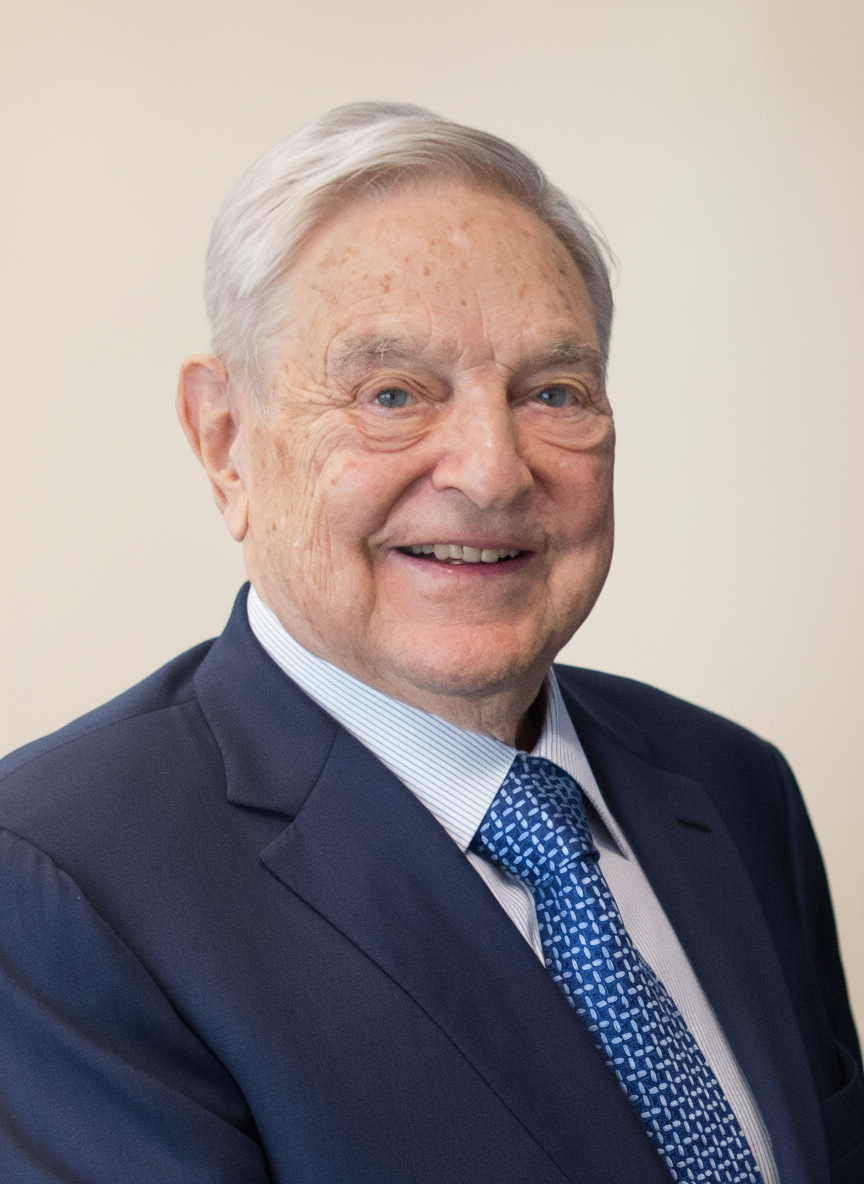
George Soros
The Man Who Broke the Bank of England: A Master of Reflexivity and Philanthropy
George Soros is a Hungarian-American investor, hedge fund manager, and philanthropist, renowned for his highly successful financial speculations and his extensive work with the Open Society Foundations. His investment philosophy is heavily influenced by his theory of reflexivity.
Biography
Accomplishments
- 01Co-founded Soros Fund Management in 1970, which managed the Quantum Fund, achieving an annualized return often cited as over 30% for several decades.
- 02Engineered the 'Black Wednesday' trade on September 16, 1992, short-selling 10 billion British pounds, resulting in a profit exceeding $1 billion and forcing the UK's withdrawal from the ERM.
- 03Established the Open Society Foundations (OSF) in 1993, expanding philanthropic activities globally to support democracy, human rights, and social justice.
- 04Donated over $32 billion to philanthropic causes, primarily through the Open Society Foundations, with $15 billion already distributed as of May 2025.
- 05Recognized by Forbes in 2020 as the 'most generous giver' in terms of the percentage of his net worth committed to philanthropy.
Lessons for Operators
Key Takeaways
Practical lessons distilled for operators, investors, C-levels, and capital allocators.
Reflexivity in Action
Investors should understand that market participants' biases and expectations can influence fundamental conditions, which in turn affect market expectations. This creates a reflexive feedback loop that can be exploited for profit. The 'Black Wednesday' trade exemplified this: market sentiment against the pound, amplified by Soros's actions, confirmed the weakness of the currency, leading to its devaluation.
The Power of Conviction and Scale
Soros operated with high conviction, making large, concentrated bets when his analysis indicated a strong probability of a major move. This approach, while high-risk, yielded enormous returns when successful. This is not for all funds or investors but demonstrates the power of conviction when coupled with strong analytical backing.
Philanthropy as a Strategic Investment
Soros demonstrates that substantial wealth accumulation can be coupled with significant philanthropic investment to drive societal change. His commitment of 64% of his original fortune to the Open Society Foundations illustrates a model where capital is deployed to address systemic issues, influencing global governance and human rights.
Adaptive Decision-Making
His investing career highlights the importance of adaptability and a willingness to change one's mind. Soros's philosophical grounding in fallibility means he is inherently skeptical of his own, and others', judgments, leading to a constant re-evaluation of positions based on new information and evolving market conditions.
Frameworks & Principles
Named frameworks and strategic principles they popularized or embodied.
Theory of Reflexivity
A framework positing that market prices do not passively reflect underlying fundamentals but can actively influence them, creating a two-way feedback loop. Market participants' expectations and biases affect prices, which then change the fundamentals, which in turn influences expectations, and so on. This often leads to boom-bust cycles.
When to useWhen analyzing markets where sentiment and expectations play a significant role in determining asset prices, particularly during periods of significant disequilibrium or bubbles/crashes. Useful for identifying situations where market action can reinforce underlying trends beyond what fundamentals alone suggest.
Fallibility Principle (Popperian Influence)
Derived from Karl Popper's philosophy, this principle emphasizes that all knowledge and understanding, including market predictions, are inherently uncertain and potentially flawed. It advocates for rigorous testing of hypotheses and a constant readiness to admit and correct mistakes.
When to useApplicable across all decision-making, particularly in volatile or complex environments like finance. Encourages a mindset of continuous learning, critical self-assessment, and rapid course correction, reducing biases like confirmation bias and overconfidence.
Sources & Further Reading
Profiles, interviews, podcasts, and articles used to compile and verify this entry. Each link opens at the original publisher.
Explore Related Titans
Other figures in the archive who share George Soros's domain, geography, or era.
More in Finance & Investing




From United States







Contemporaries — born 1930s