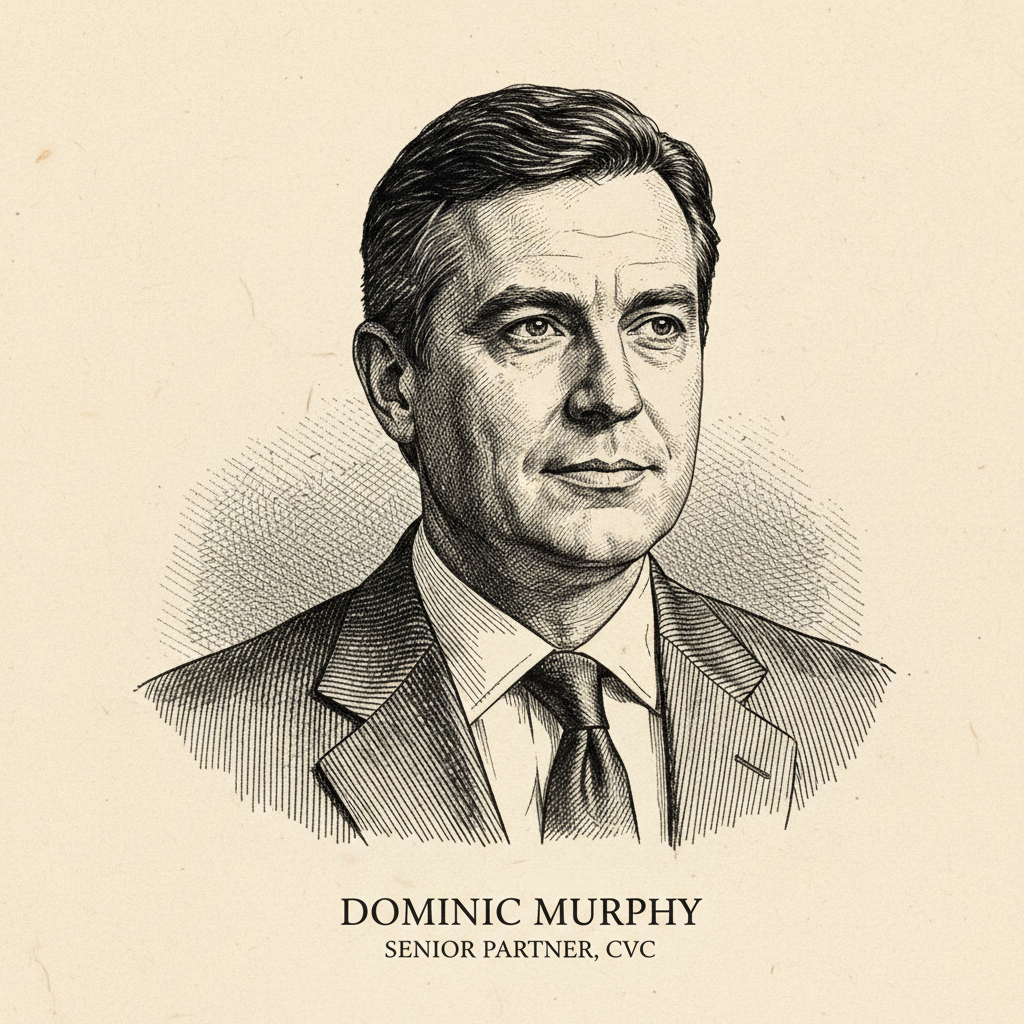
Dominic Murphy
Architect of pan-European private equity strategy and value creation at CVC Capital Partners.
Dominic Murphy is a Senior Partner at CVC Capital Partners, one of the world's largest private equity firms. Joining CVC in 1990, he played a pivotal role in the firm's expansion into pan-European and global markets, leading numerous high-profile transactions across diverse sectors, including consumer, retail, and industrials. He was instrumental in establishing CVC's reputation for complex carve-outs and operational improvements.
Biography
Accomplishments
- 01Led the acquisition of Cortefiel (Tendam) in 2005, a complex retail restructuring that evolved into a major Spanish fashion group.
- 02Instrumental in the 2014 acquisition and carve-out of Saga Group, a specialist provider of products and services for the over 50s, demonstrating expertise in regulated sectors.
- 03Oversaw the 2023 investment in Bosch Thermotechnology, a significant transaction in the energy efficiency sector, showcasing CVC's pivot towards sustainability-driven investments.
- 04Contributed significantly to CVC's ascent to become one of the largest global private equity firms, playing a key role in raising multiple flagship funds.
- 05Developed and executed pan-European investment strategies that consistently delivered strong returns for CVC's limited partners.
- 06Cultivated a reputation for successful operational enhancements and management team optimization within portfolio companies.
Lessons for Operators
Key Takeaways
Practical lessons distilled for operators, investors, C-levels, and capital allocators.
Beyond the Buyout: Operational Transformation
Dominic Murphy's career at CVC underscores that successful private equity is not just about financial engineering, but fundamentally about operational transformation. Investors and operators must focus heavily on post-acquisition value creation through improved management, strategic repositioning, and efficiency gains. A detailed 100-day plan and ongoing strategic reviews are essential.
Complexity as an Opportunity: The Carve-Out Advantage
Murphy has demonstrated a proficiency in complex carve-outs. These transactions, often overlooked by less experienced firms due to their intricacy, can yield significant value. Businesses should assess non-core assets for carve-out potential, and investors should develop specialized capabilities to execute them, recognizing the operational heavy lifting involved.
Sector Agnostic, Thematic Investor
While engaging in diverse sectors, CVC, under Murphy's influence, has often identified underlying themes (e.g., consumer trends, demographic shifts, sustainability). This suggests that businesses should identify megatrends relevant to their industry for long-term growth, and investors should approach deal sourcing with a thematic lens, rather than purely sectoral restrictions.
Global Capital, Local Expertise
CVC's success, partially steered by Murphy, is built on combining a massive global capital base with deep local market knowledge and relationship networks. For operators, this means seeking capital partners who not only provide funds but also strategic insights and access to a global ecosystem. For investors, it highlights the importance of hybrid models blending global reach with regional specialization.
Enduring Partnership Culture
CVC's long-standing success, and Murphy's extensive tenure, reflect a robust partnership culture. This fosters expertise retention, institutional knowledge, and consistent strategy. Entrepreneurs should seek long-term partners aligned on vision, and investors should cultivate internal cultures that reward collaboration and stability over short-term gains.
Frameworks & Principles
Named frameworks and strategic principles they popularized or embodied.
CVC's Value Creation Playbook
A proprietary, comprehensive framework for identifying, acquiring, operating, and exiting investments. It emphasizes detailed due diligence, strategic planning (often 100-day plans), strengthening management teams, operational improvements, international expansion, and M&A within portfolio companies.
When to useWhen evaluating potential acquisitions (for due diligence and post-acquisition planning), or for existing businesses seeking to optimize performance and prepare for future exits. Applicable to both private equity firms and corporate development teams.
Pan-European Investment Strategy
An approach that leverages CVC's extensive network and market insight across Europe to identify undervalued assets or synergistic opportunities across national borders. Focuses on companies with strong regional positions ripe for broader European growth or consolidation.
When to useFor businesses looking to expand across European markets, or for investors seeking to build diversified portfolios with cross-border growth potential. Requires understanding of diverse regulatory, cultural, and economic landscapes.
Complex Carve-Out Execution Model
A specialized methodology for acquiring and separating non-core divisions from larger corporations. This involves meticulous planning for operational independence, establishing new IT systems, supply chains, and management structures, while managing stakeholder expectations.
When to useApplicable for corporate strategists considering divesting non-core assets, or private equity firms and corporate buyers looking to acquire business units that require significant stand-alone operational build-out. Requires in-depth legal, financial, and operational expertise.
Recent Appearances
Latest interviews, keynotes, and press from the past half year.
 youtube.com
 youtube.com
 youtube.com
 youtube.com
 youtube.com
 youtube.com
 youtube.com
 youtube.com
 youtube.com
 youtube.com
 youtube.com
 youtube.com
Explore Related Titans
Other figures in the archive who share Dominic Murphy's domain, geography, or era.
More in Finance & Investing







From United Kingdom