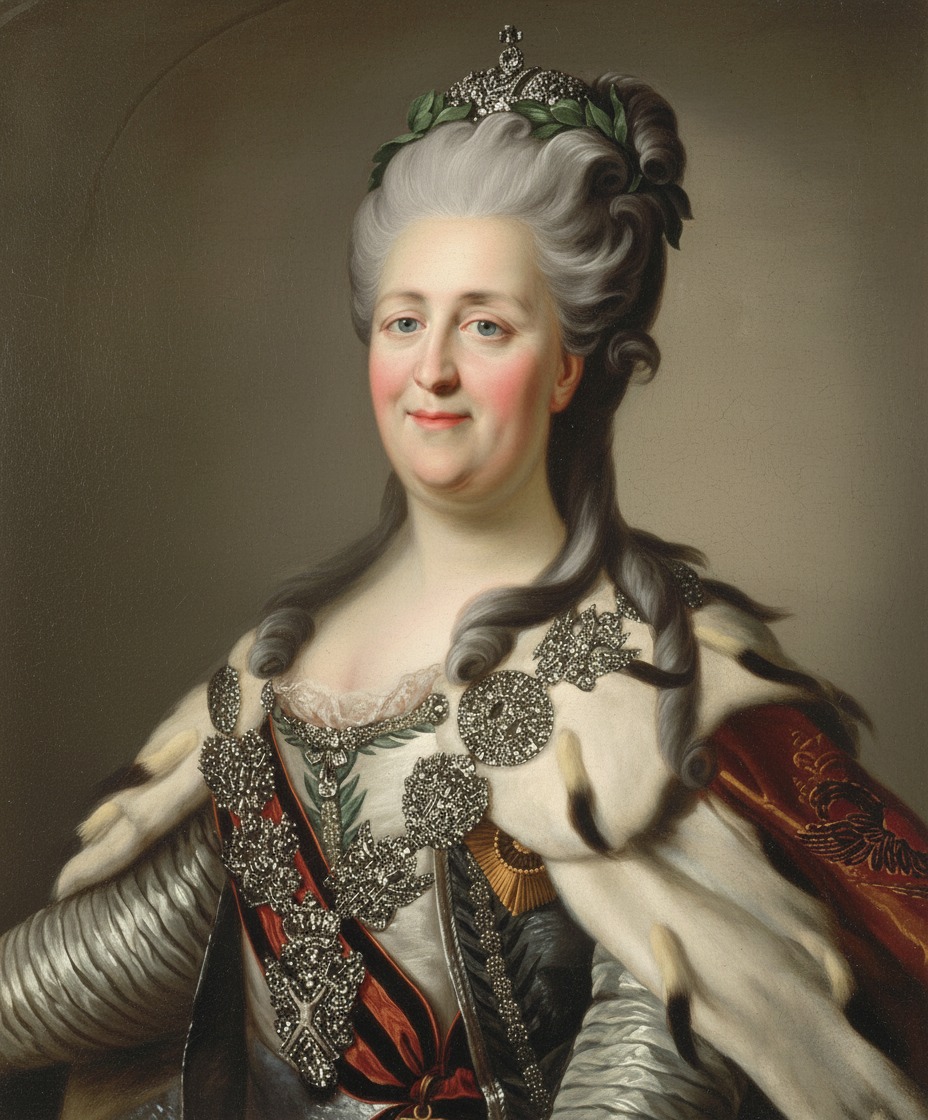
Catherine the Great
Architect of Modern Russia: A study in geopolitical expansion, economic reform, and centralized state-building.
Catherine II, known as Catherine the Great, reigned as Empress of Russia from 1762 to 1796. Her era marked a significant expansion of Russian territory through strategic diplomacy and military conquests, notably against the Ottoman Empire and in the partitions of Poland. Domestically, she pursued ambitious administrative and economic reforms, fostering trade, establishing new cities, and promoting education and the arts, consolidating Russia's position as a major European power.
Biography
Accomplishments
- 01Territorial Expansion: Acquired Crimea, New Russia, and significant parts of Poland through two successful wars against the Ottoman Empire and three partitions of Poland, adding approximately 200,000 square miles to the Russian Empire.
- 02Economic Development: Founded over 140 new cities and towns, including Odessa, and promoted industrial growth and foreign trade by expanding access to warm-water ports and encouraging foreign investment.
- 03Administrative Reform: Implemented the 'Statute for the Administration of the Provinces of the Russian Empire' (1775), establishing a more uniform and centralized provincial governance system, improving tax collection and public order.
- 04Cultural and Educational Patronage: Founded the Hermitage Museum, the Imperial Public Library, and numerous educational institutions, including the Smolny Institute for Noble Girls, fostering an 'enlightened' image and advancing Russian culture.
- 05Military Modernization: Significantly strengthened the Russian Army and Navy, allowing for successful territorial expansion and securing Russia's status as a dominant European military power.
- 06Legal Codification: Initiated the compilation of a new legal code (the 'Nakaz'), though ultimately incomplete, which aimed to introduce Enlightenment principles into Russian law, reflecting her reformist intentions.
Lessons for Operators
Key Takeaways
Practical lessons distilled for operators, investors, C-levels, and capital allocators.
Geopolitical Strategy as Economic Engine
Catherine demonstrated how strategic territorial expansion, particularly access to vital trade routes and resources (like Black Sea ports for grain exports), directly translates into economic growth and national power. Her wars were not just about land but about markets and strategic advantage.
The Power of Centralized Administration
Her administrative reforms centralized control, making the vast Russian Empire more governable, more efficient at tax collection, and better able to implement policies across diverse regions. This is analogous to a holding company optimizing its operational oversight across subsidiaries.
Brand Building for Statecraft
Catherine meticulously crafted her image as an enlightened ruler, engaging with prominent European thinkers. This 'soft power' helped attract foreign talent, secure diplomatic alliances, and project an image of progress, despite internal contradictions.
Incentivizing Development Through New Foundations
By founding new cities and offering incentives for settlement and industry, Catherine stimulated economic activity in underdeveloped regions, turning newly acquired territories into productive assets. This mirrors launching new ventures or regional hubs.
Balancing Ideals with Pragmatism
While espousing Enlightenment ideals, Catherine maintained and even strengthened serfdom, prioritizing the stability and economic output of her agrarian empire. Leaders must assess where ideological purity can yield to practical imperatives for stability and growth.
Long-Term Vision in Resource Allocation
Her investments in military strength, infrastructure (ports, cities), and cultural institutions were not just for immediate gains but were part of a long-term strategy to establish Russia as a formidable and modern European power, securing future prosperity and influence.
Frameworks & Principles
Named frameworks and strategic principles they popularized or embodied.
Enlightened Absolutism (Statecraft Model)
A political philosophy where monarchs embraced the principles of the Enlightenment, such as reason, progress, and individual rights, but retained absolute power. They often implemented reforms 'from above' for the good of the state.
When to useApplicable in environments where centralized authority is paramount, and leaders seek to drive significant reforms or modernization efforts while maintaining strict control. Useful for understanding top-down organizational transformations or national development strategies.
Geopolitical Resource Acquisition (Expansion Strategy)
A strategy focused on securing critical natural resources, strategic geographic locations (e.g., warm-water ports), or access to markets through diplomatic, military, or economic means to enhance national or corporate power and wealth.
When to useWhen evaluating long-term competitive advantages derived from control over essential resources, supply chain choke points, or market access. Useful for M&A strategies focused on vertical integration or market dominance through asset acquisition.
Urbanization as an Economic Accelerator (Development Model)
The strategic establishment and development of new cities and infrastructure to stimulate economic activity, integrate territories, and facilitate trade and administration. New urban centers act as growth poles.
When to useFor leaders planning to open new markets, develop remote regions, or create new industrial clusters. Applicable in real estate development, regional economic planning, or establishing new operational hubs for a growing enterprise.
Soft Power Projection (Influence Strategy)
The use of cultural and ideological appeal, rather than military or economic coercion, to influence the behavior of other states or entities. Catherine's patronage of arts and letters contributed to Russia's international standing.
When to useWhen building brand equity, fostering international goodwill, or influencing stakeholder perceptions without direct financial incentives or overt power displays. Relevant for corporate social responsibility, public relations, and cultural diplomacy.
Sources & Further Reading
Profiles, interviews, podcasts, and articles used to compile and verify this entry. Each link opens at the original publisher.
Explore Related Titans
Other figures in the archive who share Catherine the Great's domain, geography, or era.
More in Other

Contemporaries — 18th century