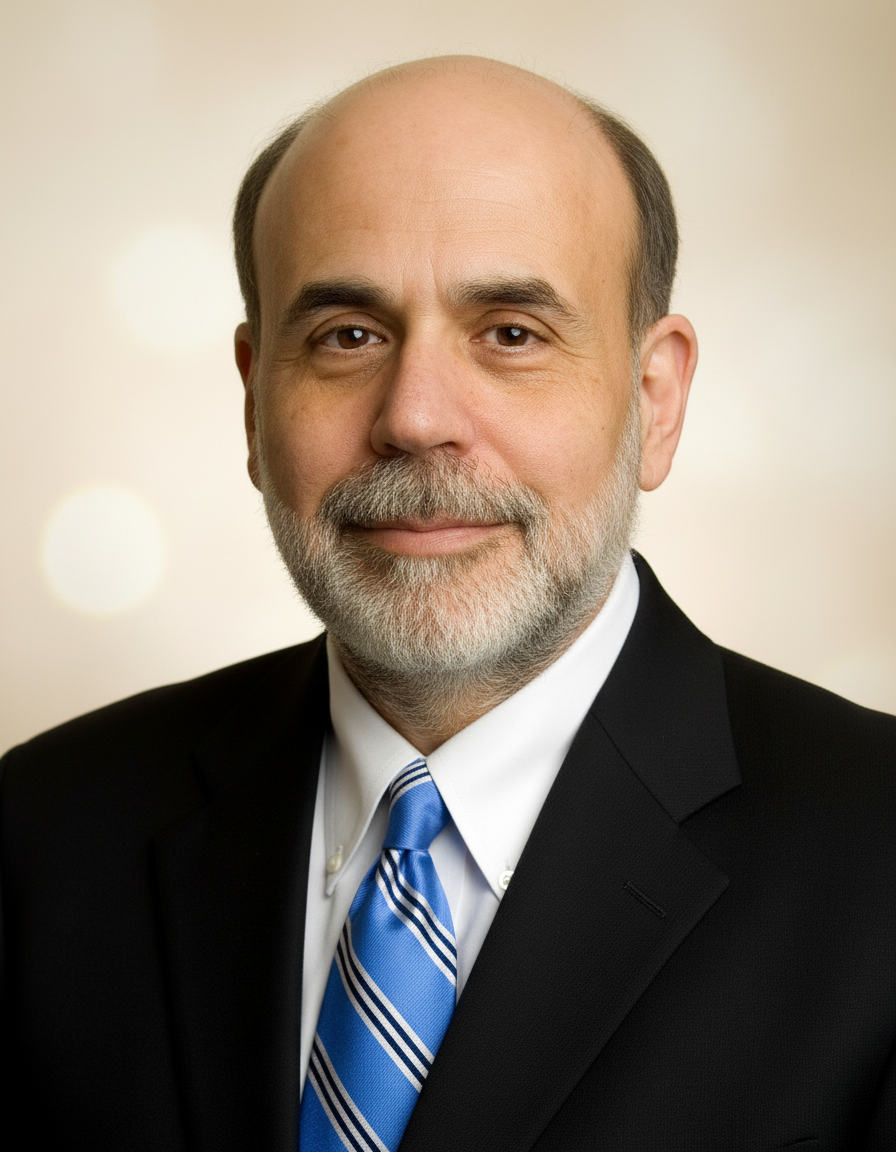
Ben Bernanke
Architect of the modern monetary response to financial crises, pioneering quantitative easing.
Ben S. Bernanke is an American economist who served as the 14th Chair of the Federal Reserve from 2006 to 2014. His tenure was notably defined by his leadership in navigating the global financial crisis of 2008 and the subsequent Great Recession. Bernanke implemented unconventional monetary policies, including quantitative easing (QE), to stabilize financial markets and stimulate economic recovery.
Biography
Accomplishments
- 01Led the Federal Reserve's response to the 2008 global financial crisis and the subsequent Great Recession, preventing a systemic collapse of the financial system.
- 02Pioneered and implemented Quantitative Easing (QE) programs (QE1 starting December 2008, QE2 in November 2010, QE3 in September 2012), which involved large-scale asset purchases to lower long-term interest rates and stimulate economic activity.
- 03Oversaw the reduction of the federal funds rate to a target range of 0 to 0.25 percent in December 2008, a historically low level to provide maximum monetary stimulus.
- 04Authored significant academic research on the Great Depression, which informed his approach to central banking during crises, emphasizing aggressive liquidity provision and avoiding passive policy responses.
- 05Played a crucial role in international coordination among central banks and finance ministries during the crisis, enhancing the global response.
Lessons for Operators
Key Takeaways
Practical lessons distilled for operators, investors, C-levels, and capital allocators.
Unconventional Wisdom
During 'black swan' events, orthodox methods may be insufficient. Leaders must be prepared to innovate and implement unconventional solutions, even if they lack historical precedent, to preserve organizational or systemic integrity.
Preparation through Study
Deep understanding of past failures and successes, whether from historical economic crises or industry-specific downturns, provides a robust framework for anticipating and responding to future challenges. Invest in understanding systemic risks.
Decisive Action over Hesitation
In a crisis, delayed or insufficient response can exacerbate problems. Bernanke's swift, aggressive actions (e.g., cutting rates to zero, QE) demonstrated that bold, early intervention can stabilize rapidly deteriorating situations. In business, this translates to quick execution on critical pivots.
Communication as a Stabilizer
Clear, consistent, and forward-looking communication from leadership can mitigate panic, manage expectations, and effectively guide stakeholders through uncertainty. Transparency builds trust and reduces speculative volatility.
Systemic Perspective
Recognize that individual failures can trigger widespread contagion. Leaders must analyze interdependencies within their industry or ecosystem and be prepared to act with a broader systemic view, rather than solely self-interest, to prevent collapse benefiting all.
Frameworks & Principles
Named frameworks and strategic principles they popularized or embodied.
Quantitative Easing (QE)
A monetary policy where a central bank purchases government securities or other securities from the market in order to lower interest rates and increase the money supply. This increases liquidity and stimulates economic activity when conventional interest rate cuts are no longer effective.
When to useWhen conventional monetary policy (e.g., lowering short-term interest rates) is exhausted or ineffective, typically during severe economic downturns or deflationary pressures, and there is a need to provide additional stimulus to financial markets and the broader economy.
Forward Guidance
A communication strategy used by central banks to signal the likely future path of monetary policy, providing clarity to financial markets and the public. This aims to influence long-term interest rates and economic expectations, even when short-term rates are at their lower bound.
When to useTo manage market expectations and enhance the effectiveness of monetary policy, especially when interest rates are near zero. It provides clarity on the central bank's commitment to maintaining accommodative policy for a defined period or until specific economic conditions are met.
Lender of Last Resort
The principle that a central bank stands ready to provide liquidity to solvent financial institutions that are experiencing short-term funding difficulties, thereby preventing bank runs and systemic financial collapse.
When to useDuring periods of financial crisis or liquidity crunches, when private credit markets seize up and financial institutions cannot obtain funding from traditional sources. This prevents healthy institutions from failing due to temporary liquidity issues.
Recent Appearances
Latest interviews, keynotes, and press from the past half year.
 youtube.com
 youtube.com
 youtube.com
 youtube.com
 youtube.com
 youtube.com
 youtube.com
 youtube.com
 youtube.com
 youtube.com
 youtube.com
 youtube.com
 youtube.com
![[Review] 21st Century Monetary Policy (Ben Bernanke) Summarized ...](https://i.ytimg.com/vi/qvkIex8JAOA/hqdefault.jpg) youtube.com
youtube.com![[Members Only] Yoichi Takahashi's Social Diary Vol. 20 Ben Bernanke](https://i.ytimg.com/vi/SX_Mh-5iYsE/hqdefault.jpg) youtube.com
youtube.com youtube.com
 youtube.com
 youtube.com
 youtube.com
 youtube.com
 youtube.com
 youtube.com
 youtube.com
 youtube.com
 youtube.com
 youtube.com
 youtube.com
 youtube.com
 youtube.com
 youtube.com
 youtube.com
 youtube.com
 youtube.com
 youtube.com
 youtube.com
 youtube.com
 youtube.com
 youtube.com
 youtube.com
 youtube.com
 youtube.com
 youtube.com
 youtube.com
 youtube.com
 youtube.com
 youtube.com
 youtube.com
 youtube.com
 youtube.com
 youtube.com
 youtube.com
 m.youtube.com
 youtube.com
 youtube.com
 youtube.com
 youtube.com
 youtube.com
 youtube.com
 youtube.com
 youtube.com
 youtube.com
 youtube.com
 youtube.com
 youtube.com
 youtube.com
![[7/9 18:00] OpenAI ChatGPT Work agent unveiled alongside ...](https://i.ytimg.com/vi/i5rnjw6a1ts/hqdefault.jpg) youtube.com
youtube.com youtube.com
 youtube.com
 youtube.com
 youtube.com
 youtube.com
 youtube.com
 youtube.com
 youtube.com
 youtube.com
 youtube.com
 youtube.com
 youtube.com
 youtube.comm.youtube.com
 youtube.com
 youtube.com
 youtube.com
 youtube.com
 youtube.com
 youtube.com
 youtube.com
 youtube.com
 youtube.com
 youtube.comyoutube.com
 youtube.com
 youtube.com
 youtube.com
 youtube.com
 youtube.com
 youtube.com
 youtube.com
 youtube.com
 youtube.com
 youtube.com
 youtube.com
 youtube.com
 youtube.com
![Warsh: the Fed owns 65 months of high inflation | Jackson Hole [FULL]](https://i.ytimg.com/vi/sJ1q9daiOpI/hqdefault.jpg) youtube.com
youtube.com youtube.com
 youtube.com
 youtube.com
 youtube.com
 youtube.com
 youtube.comm.youtube.com
 youtube.com
 youtube.com
 youtube.com
 youtube.com
 youtube.com
 youtube.com
 youtube.com
 youtube.com
 youtube.com
 youtube.comm.youtube.com
 youtube.com
 youtube.com
 youtube.com
 youtube.com
 youtube.com
 youtube.com
 m.youtube.com
 youtube.com
 youtube.com
 youtube.com
 youtube.com
 youtube.com
 youtube.com
 youtube.com
 youtube.com
 youtube.com
 youtube.com
 youtube.com
 m.youtube.com
 youtube.com
 youtube.com
 youtube.com
 youtube.com
 youtube.com
 m.youtube.com
 youtube.com
 youtube.com
 youtube.com
 youtube.com
 youtube.com
 youtube.comyoutube.com
 youtube.com
 youtube.com
 youtube.com
 youtube.com
 youtube.com
 youtube.com
 youtube.com
 youtube.com
 youtube.com
 m.youtube.com
 youtube.com
 youtube.com
 youtube.com
 youtube.com
Sources & Further Reading
Profiles, interviews, podcasts, and articles used to compile and verify this entry. Each link opens at the original publisher.
Explore Related Titans
Other figures in the archive who share Ben Bernanke's domain, geography, or era.
More in Finance & Investing





From United States





Contemporaries — born 1950s