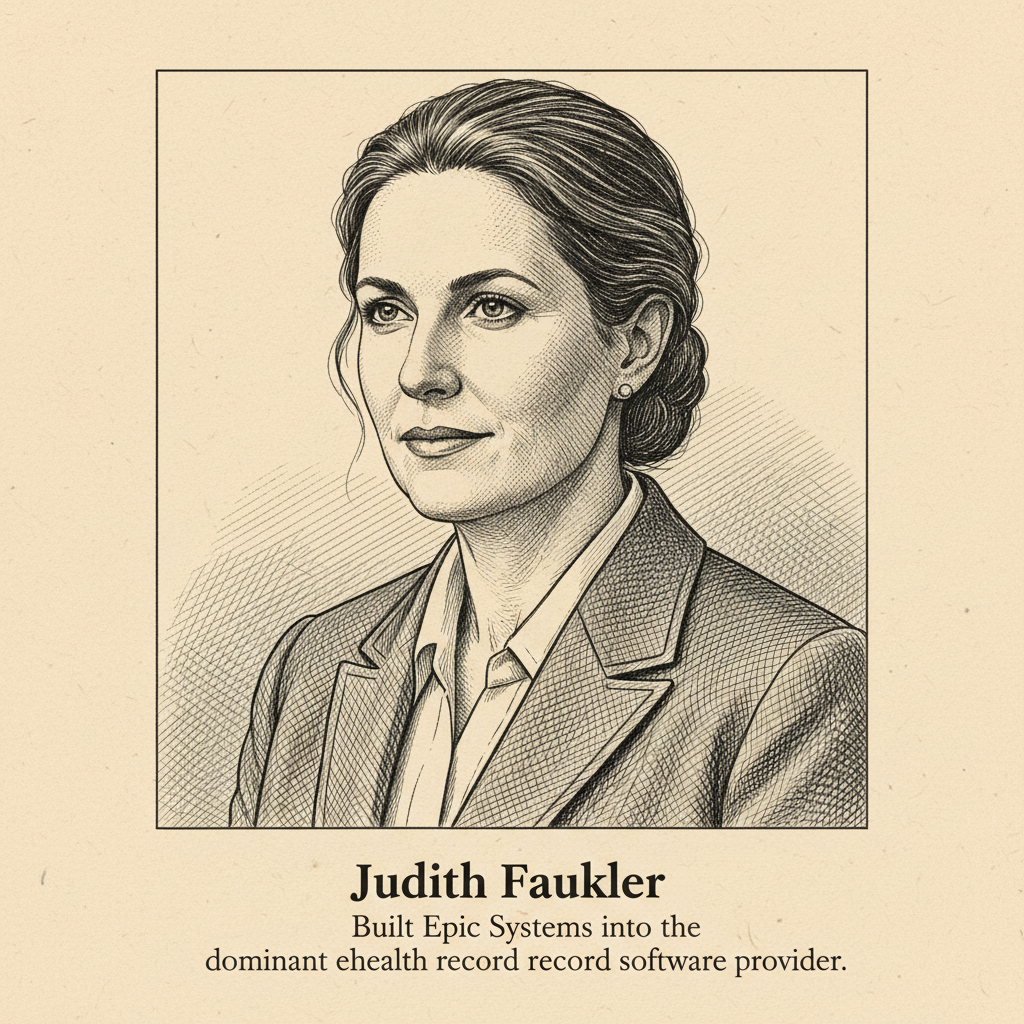
Judith Faulkner
Founder and CEO of Epic Systems, a dominant force in electronic health record software.
Judith Faulkner is the founder and CEO of Epic Systems Corporation, a privately held healthcare software company established in 1979. Under her leadership, Epic has grown into the leading provider of electronic health record (EHR) systems for large hospital systems and integrated healthcare organizations globally, achieving substantial market share without external capital.
Biography
Accomplishments
- 01Founded Epic Systems in 1979, growing it into the largest healthcare software vendor without external capital.
- 02Achieved dominant market share in the U.S. electronic health record (EHR) system for large hospitals and integrated delivery networks.
- 03Maintained private ownership and organic growth for over four decades, enabling long-term strategic focus and consistent product development.
- 04Led Epic to annual revenues exceeding $3.8 billion (2022 figures), with continuous profitability and reinvestment into R&D.
- 05Spearheaded the development and deployment of comprehensive, integrated EHR systems adopted by major healthcare institutions globally.
- 06Cultivated a distinct company culture focused on customer service and product excellence, evidenced by high customer retention rates.
Lessons for Operators
Key Takeaways
Practical lessons distilled for operators, investors, C-levels, and capital allocators.
Strategic Independence Through Private Ownership
Faulkner's refusal of external capital and public listing enabled Epic to pursue long-term R&D, cultivate a unique culture, and resist market pressures for short-term profits. This strategy is critical for industries requiring lengthy development cycles or facing intense regulatory scrutiny.
Product-Centric Dominance
Epic’s market leadership is a testament to consistent product quality and comprehensive functionality. Investors and operators should evaluate companies based on their enduring commitment to product excellence as a primary growth driver.
Customer-Centric Ecosystem Building
Epic does not just sell software; it builds deeply integrated partnerships with large health systems, often becoming central to their operations. This 'sticky' approach creates high switching costs and ensures recurring revenue, a valuable model for enterprise software companies.
The Power of Organic Growth
Epic’s growth, fueled by reinvested profits and a focus on product superiority, demonstrates that significant market share can be captured without aggressive M&A or venture-backed hyper-growth. This approach fosters stability and deep institutional knowledge.
Leadership Through Technical Understanding
Faulkner, a computer scientist, maintained a deep understanding of Epic's core technology and development process. For technical industries, leadership with direct domain expertise can be invaluable for strategic decision-making and product integrity.
Frameworks & Principles
Named frameworks and strategic principles they popularized or embodied.
The 'No Outside Capital' Growth Model
A strategic choice to fund growth exclusively through retained earnings and internal cash flow, forgoing venture capital, private equity, or public market offerings. This preserves founder control and allows for long-term strategic planning without short-term shareholder pressures.
When to useApplicable for businesses targeting sustained, quality-driven growth where market leadership is built on product depth and customer loyalty, rather than rapid user acquisition. Most effective in industries with high switching costs and significant R&D requirements (e.g., enterprise software, complex B2B services).
Integrated Platform Dominance Strategy
Focusing on building a single, comprehensive, and deeply integrated software platform that addresses a wide array of customer needs within a specific industry. This contrasts with 'best-of-breed' solutions that require extensive integration efforts by customers.
When to useIdeal for complex industries (like healthcare) where fragmentation leads to data silos and operational inefficiencies. Suitable when the value proposition of a unified system significantly outweighs the flexibility of modular components. Requires substantial, sustained investment in R&D.
Relentless R&D Reinvestment
A business strategy where a significant portion of company profits are consistently channeled back into research and development. This ensures continuous product innovation, feature enhancement, and technological leadership, keeping competitors at bay.
When to useCrucial for technology-driven sectors where innovation cycles are rapid and staying competitive requires constant evolution. Particularly effective when combined with a 'no outside capital' model, as it avoids external pressure to prioritize profit extraction over product development.
Sources & Further Reading
Profiles, interviews, podcasts, and articles used to compile and verify this entry. Each link opens at the original publisher.
Explore Related Titans
Other figures in the archive who share Judith Faulkner's domain, geography, or era.
More in Technology










From United States




Contemporaries — born 1940s