Badr Jafar
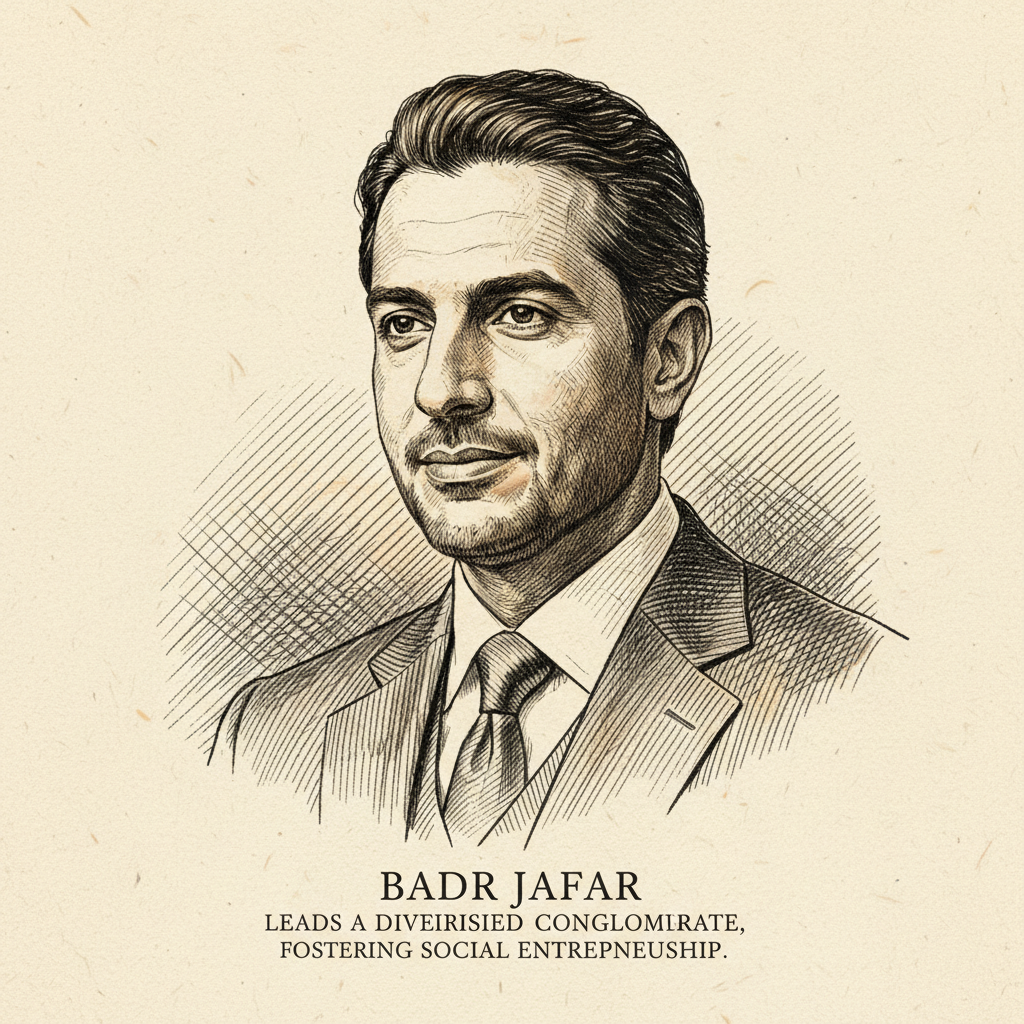
A leading Emirati entrepreneur and philanthropist, Badr Jafar is the CEO of Crescent Enterprises and President of Crescent Petroleum, championing sustainable business practices and responsible capitalism.
Badr Jafar is the CEO of Crescent Enterprises, a diversified business conglomerate headquartered in the UAE, and President of Crescent Petroleum, the Middle East's oldest private oil and gas company. A vocal advocate for sustainable development and responsible business, Jafar has founded and chairs numerous non-profit initiatives focusing on social entrepreneurship, humanitarian aid, and arts and culture. He is actively involved in global economic and philanthropic forums, serving as a Special Envoy for Business and Philanthropy, and shaping dialogues on capitalism's future.
Biography
Accomplishments
- 01Steered Crescent Enterprises through strategic diversification into logistics, power, healthcare, private equity, and venture capital, ensuring growth beyond traditional oil and gas.
- 02Led Crescent Petroleum in expanding its natural gas operations, positioning it as a key regional player in energy security and cleaner energy transition.
- 03Founded the Pearl Initiative in 2010, fostering corporate governance, transparency, and accountability across the Gulf region through private sector partnerships.
- 04Established and chairs the Middle East and North Africa Business Aviation Association (MEBAA), advocating for the growth and development of the regional aviation sector.
- 05Co-founded the Arab Children's Congress, promoting youth engagement and cultural exchange across the Arab world.
- 06Serves as a Special Envoy for Business and Philanthropy, representing the UAE's commitment to leveraging private sector resources for global development.
- 07Chaired the Global Council on SDG 9 (Industry, Innovation, and Infrastructure) for the UAE government, contributing to the nation's sustainable development agenda.
- 08Active participant and thought leader in global forums like the World Economic Forum, advocating for responsible capitalism and impact investing.
Lessons for Operators
Key Takeaways
Practical lessons distilled for operators, investors, C-levels, and capital allocators.
Integrated Value Creation
Badr Jafar exemplifies a business model where commercial success is intrinsically linked with social and environmental impact. His work with Crescent Enterprises and the Pearl Initiative demonstrates that long-term value for stakeholders extends beyond financial returns to include good governance, community engagement, and sustainable practices. Operators should integrate ESG principles not as compliance, but as core to their strategy for resilience and competitive advantage.
Strategic Diversification & Resilience
Jafar's leadership in diversifying Crescent Enterprises highlights the importance of not relying on a single industry, especially in volatile global markets. By building a portfolio across energy, logistics, healthcare, and venture capital, he has created a more resilient and adaptable enterprise. Investors and C-levels should actively assess portfolio concentration risk and explore strategic diversification, including into nascent or high-growth sectors, to ensure long-term stability.
Private Sector as a Catalyst for Stability
Jafar consistently articulates the critical role of the private sector in providing stability and driving positive change, particularly during times of economic uncertainty. His recent commentary on capital flows as 'risk recalibration' underscores a sophisticated understanding of investor behavior and the need for a stable, transparent business environment. Enterprise leaders should actively champion market transparency, uphold governance standards, and contribute to broader societal welfare to attract and retain capital.
Global Engagement and Thought Leadership
Jafar's extensive involvement in global forums (WEF, UN), advisory roles, and his appointment as a Special Envoy for Business and Philanthropy illustrate the power of proactive engagement in shaping global narratives and policies. This positions him and his enterprises at the forefront of critical discussions on the future of business and society. Fund managers and C-levels should encourage and support their leaders in contributing to global dialogues, enhancing their influence and identifying emerging opportunities and risks.
The Nuance of Capital Flows
His perspective on 'capital flight' versus 'risk recalibration' offers a crucial distinction for understanding investor decisions. It suggests that movements of capital are often strategic, informed choices rather than panic reactions, reflecting a re-evaluation of risk-reward profiles. Capital allocators must analyze market movements with a nuanced lens, distinguishing between temporary volatility and fundamental shifts in investment theses, and communicating these insights clearly to stakeholders.
Pioneering Responsible Energy
As President of Crescent Petroleum, Jafar has overseen the company's commitment to responsible energy production, particularly in natural gas, which is seen as a transition fuel. This demonstrates an understanding of both current energy needs and the imperative for sustainability. Operators in traditional industries should actively pursue strategies for decarbonization and sustainable practices, recognizing that responsible operations are increasingly a competitive differentiator and a requirement for long-term viability.
Frameworks & Principles
Named frameworks and strategic principles they popularized or embodied.
Triple Bottom Line (TBL)
A business framework that suggests companies should commit to focusing on social and environmental concerns just as they do on profits. The TBL measures a company's success in terms of profit, people, and planet. Badr Jafar's emphasis on sustainable business practices and philanthropy aligns directly with this framework.
When to useApplicable for any organization seeking to integrate sustainability and social responsibility into its core strategy, moving beyond mere financial reporting to include broader impact metrics. Useful for strategic planning, investor relations, and brand building in the ESG era.
Stakeholder Capitalism
A system in which corporations are oriented to serve the interests of all their stakeholders – not just shareholders. Stakeholders include employees, customers, suppliers, communities, and the environment. Jafar's initiatives like the Pearl Initiative and his advocacy for responsible business practices embody this principle.
When to useRelevant for C-suite executives and board members looking to redefine corporate purpose beyond shareholder primacy. It guides decisions on governance, employee welfare, community engagement, and supply chain management, particularly in complex geopolitical landscapes.
Scenario Planning for Capital Allocation
A strategic planning method used to make flexible long-term plans by identifying potential future scenarios and developing strategies for each. Jafar's view of 'risk recalibration' rather than 'capital flight' reflects an understanding of dynamic market scenarios and proactive capital management.
When to useEssential for investors, fund managers, and CFOs in volatile markets to anticipate various economic, political, and social futures. It helps in stress-testing portfolios, optimizing capital allocation, and developing contingency plans to navigate uncertainty.
Public-Private Partnership (PPP) for Development
A long-term contract between a private party and a government entity for providing a public asset or service, in which the private party bears significant risk and management responsibility. Jafar's work through the Pearl Initiative (in partnership with the UN) and his role as Special Envoy for Business and Philanthropy highlight the efficacy of PPPs in addressing societal challenges.
When to useApplicable for governments seeking to leverage private sector efficiency and capital for infrastructure, social services, or development projects, and for private enterprises looking to engage in impactful, large-scale projects with government support. Useful for ESG investing and impact fund strategies.
Diversification Matrix (Ansoff Matrix variant)
A strategic tool that helps businesses decide their product and market growth strategies. While the Ansoff Matrix typically focuses on existing vs. new products and markets, Jafar's career illustrates diversification across *industries* and *geographies* to build a resilient conglomerate. This extends the Ansoff concept to encompass wider business ecosystems.
When to useUseful for conglomerate leaders, private equity firms, and corporate strategists evaluating options for growth, risk mitigation, and capital deployment across different sectors and regions. Helps in identifying synergistic opportunities and reducing systemic risk.
Recent Appearances
Latest interviews, keynotes, and press from the past half year.
 youtube.com
 youtube.com
 youtube.com
 youtube.com
 youtube.com
 youtube.com
 youtube.com
 youtube.com
 youtube.com
 youtube.com
 m.youtube.com
 youtube.com
 youtube.com
 youtube.com
 youtube.com
 youtube.com
 youtube.com
 youtube.com
 youtube.com
 youtube.com
 youtube.com
 youtube.com
 youtube.com
 youtube.comyoutube.com
 youtube.com
 youtube.com
 youtube.com
 youtube.com
 youtube.com
 youtube.com
 youtube.com
 youtube.com
 youtube.com
 youtube.com
 youtube.com
 youtube.com
 youtube.com
 youtube.com
 youtube.com
 youtube.com
 youtube.com
 youtube.com
 youtube.com
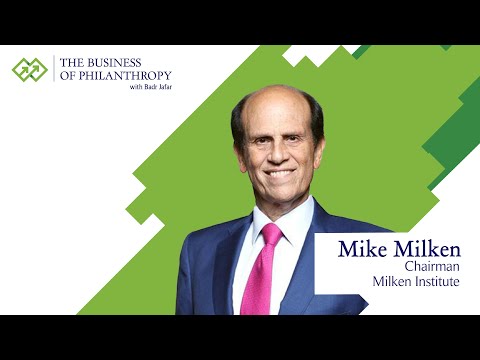 youtube.com
 youtube.com
 youtube.com
 youtube.com
 youtube.com
 youtube.com
 youtube.com
 youtube.com
 youtube.com
 youtube.com
 youtube.com
 youtube.com
 youtube.com
 youtube.com
 youtube.com
 youtube.com
 youtube.com
 youtube.com
 youtube.com
 youtube.com
 youtube.com
 youtube.com
 youtube.com
 youtube.com
 youtube.com
 youtube.com
 youtube.com
Sources & Further Reading
Profiles, interviews, podcasts, and articles used to compile and verify this entry. Each link opens at the original publisher.
- interviewNo capital flight from the UAE, only risk recalibration: Badr ...x.com→
- interviewSpecial Envoy for Business & Philanthropyinstagram.com→
- interviewInterview with Badr Jafar, Chief Executive Officer, Crescent ...badrjafar.com→
- interviewBadr Jafar: Private sector must shoulder stability in times of ...agbi.com→
- interviewUAE envoy Badr Jafar speaks to THE WEEK on future ...linkedin.com→
- interviewWhat comes next for the UAE? At The Briefing with Arabian ...facebook.com→
Explore Related Titans
Other figures in the archive who share Badr Jafar's domain, geography, or era.
More in Other

From United Arab Emirates
Contemporaries — born 1970s