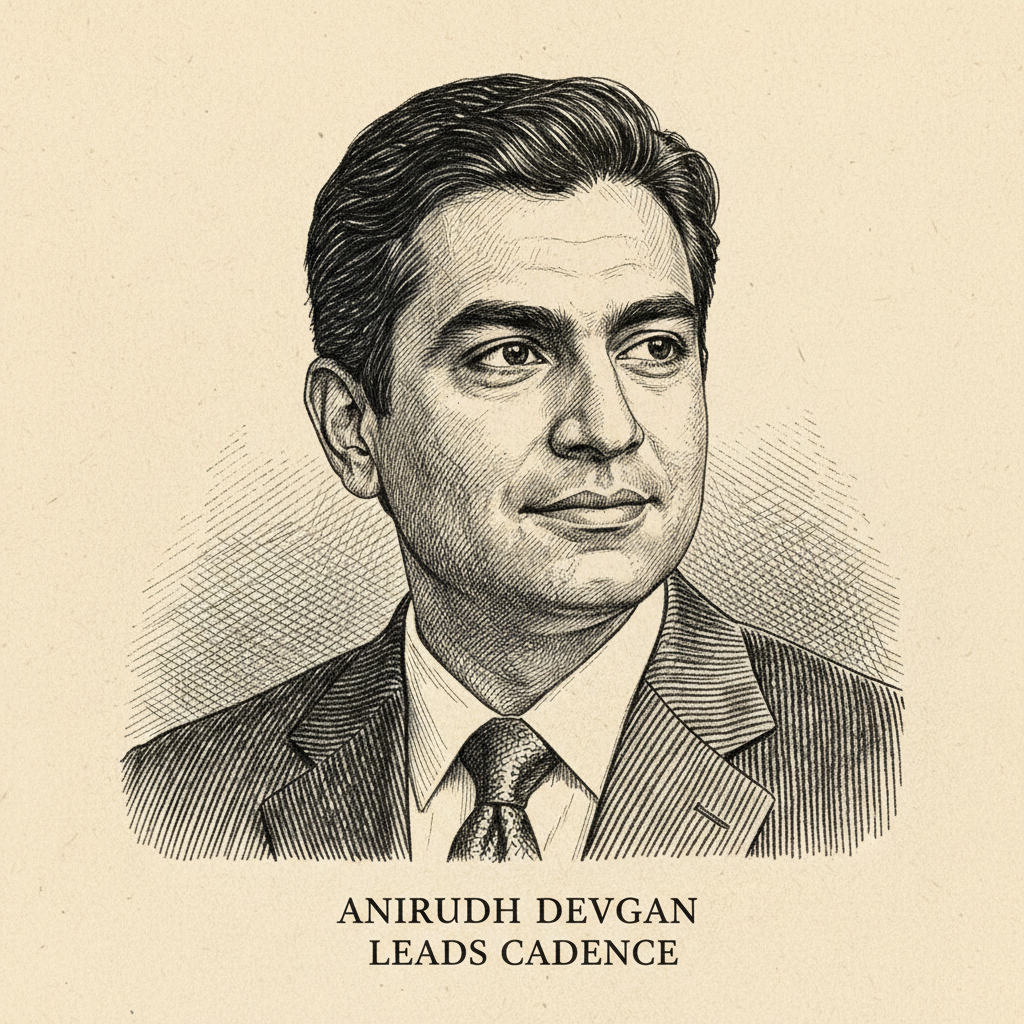
Anirudh Devgan
Anirudh Devgan, CEO of Cadence Design Systems, is a pivotal figure in Electronic Design Automation, recognized for advancing chip design technologies and driving commercial innovation.
Anirudh Devgan is an Indian-American computer scientist and business executive currently serving as the CEO of Cadence Design Systems. He is renowned for his significant contributions to electronic design automation, spanning circuit simulation, physical design, and verification. A fellow of the IEEE and a member of the National Academy of Engineering, Devgan transitioned from a distinguished scientific career to lead one of the semiconductor industry's foundational software companies.
Biography
Accomplishments
- 01Ascended to CEO of Cadence Design Systems (December 15, 2021), leading a multi-billion dollar EDA company critical to global semiconductor innovation.
- 02Instrumental in expanding Cadence's market reach beyond traditional EDA into system design and analysis, and computational software, significantly growing the company's total addressable market.
- 03Formulated key strategies that integrated computational software capabilities across Cadence's product portfolio, enhancing offerings in AI/ML, automotive, and hyperscale computing.
- 04Recognized as a Fellow of the Institute of Electrical and Electronics Engineers (IEEE), acknowledging profound technical contributions to electronic design automation.
- 05Elected as a member of the National Academy of Engineering, one of the highest professional honors accorded to an engineer, signifying exceptional original contributions to engineering research.
- 06Held leadership positions at Cadence, including President and General Manager of crucial divisions (Digital & Signoff and System & Verification), driving significant product development and revenue growth.
- 07Authored or co-authored numerous technical papers and patents in areas like circuit simulation, physical design, and verification, demonstrating foundational scientific impact.
Lessons for Operators
Key Takeaways
Practical lessons distilled for operators, investors, C-levels, and capital allocators.
Technical Depth as a Strategic Advantage
Devgan's foundational contributions to EDA, including circuit simulation and physical design, demonstrate that a deep understanding of core engineering principles can underpin successful commercial strategies in technology. Investors should seek leaders with authentic technical credentials in complex industries.
Expanding Total Addressable Market (TAM)
Cadence's expansion under Devgan into adjacent markets like system design and computational software showcases a successful strategy for growth beyond saturated core businesses. Operators should continuously evaluate untapped opportunities where existing capabilities can be reapplied.
The Scientist-to-CEO Transition
Devgan's journey from computer scientist to CEO of a major tech firm highlights the value of leaders who can bridge advanced research with business execution. Capital allocators should consider leaders with strong technical backgrounds who have also demonstrated strategic business acumen.
Integrated Product Strategy
Cadence's focus on integrated solutions, combining design, verification, and analysis, reflects a trend towards holistic offerings in complex engineering fields. Enterprise leaders should prioritize developing synergistic product portfolios that address customer challenges comprehensively rather than in silos.
Investing in Computational Software
Devgan's emphasis on computational software, including AI/ML applications, demonstrates foresight in a rapidly evolving technological landscape. Fund managers should identify companies investing early and strategically in next-generation computation to maintain competitive advantage.
Frameworks & Principles
Named frameworks and strategic principles they popularized or embodied.
Technical Acumen-Driven Market Expansion (TADME)
This framework emphasizes leveraging deep technical expertise as the primary engine for identifying and entering new market segments. It prioritizes R&D and intellectual property in strategic planning, ensuring that market growth is rooted in technological differentiation.
When to useApplicable for high-tech companies in rapidly evolving sectors (e.g., semiconductors, biotech, AI) where technological leadership dictates market position. Use when assessing opportunities to expand beyond core product lines by extending existing scientific capabilities.
Holistic Design-to-Realization (HDR)
Focuses on providing comprehensive solutions across the entire product lifecycle, from initial design and simulation through verification and manufacturing. This framework eliminates silos between design stages, enabling integrated toolchains and processes.
When to useIdeal for companies in complex engineering domains (e.g., EDA, aerospace, automotive) where product development involves multiple interdependent phases. Implement when aiming to improve efficiency, reduce errors, and accelerate time-to-market by offering end-to-end solutions.
Computational Intelligence Integration (CII)
A strategy for embedding advanced computational techniques, including AI and machine learning, throughout product offerings and operational processes. This framework aims to enhance performance, optimize decision-making, and create intelligent automation.
When to useRelevant for any industry seeking to gain a competitive edge through data-driven insights and automation. Apply when developing next-generation products or optimizing existing workflows, particularly in sectors generating vast amounts of complex data.
Recent Appearances
Latest interviews, keynotes, and press from the past half year.
 youtube.com
 youtube.com
 youtube.comyoutube.com
 youtube.com
 youtube.com
 youtube.com
 youtube.com
 youtube.com
 youtube.com
 youtube.com
 youtube.com
 youtube.com
 youtube.com
 youtube.com
 youtube.com
 youtube.com
 youtube.com
 youtube.com
 youtube.com
 youtube.com
 youtube.com
 youtube.com
 youtube.com
 youtube.com
 youtube.com
 youtube.com
 youtube.com
 youtube.com
 youtube.com
 youtube.com
 youtube.com
 youtube.com
 youtube.com
 youtube.com
 youtube.com
 youtube.com
 youtube.com
 youtube.com
 youtube.com
 youtube.com
 youtube.com
 youtube.com
 youtube.com
 youtube.com
 youtube.com
 youtube.com
 youtube.com
 youtube.com
 youtube.com
 youtube.com
 youtube.com
 youtube.com
 youtube.com
 youtube.com
 youtube.com
 youtube.com
 youtube.com
 youtube.com
 youtube.com
 youtube.com
 youtube.com
 youtube.com
 youtube.comyoutube.com
![SIEPR Economic Summit 2026 | Lip-Bu Tan of Intel [abridged]](https://i.ytimg.com/vi/fnIrYAO0DiU/hqdefault.jpg) youtube.com
youtube.com youtube.com
 youtube.com
 youtube.com
 youtube.com
Sources & Further Reading
Profiles, interviews, podcasts, and articles used to compile and verify this entry. Each link opens at the original publisher.
Explore Related Titans
Other figures in the archive who share Anirudh Devgan's domain, geography, or era.
More in Other










From United States