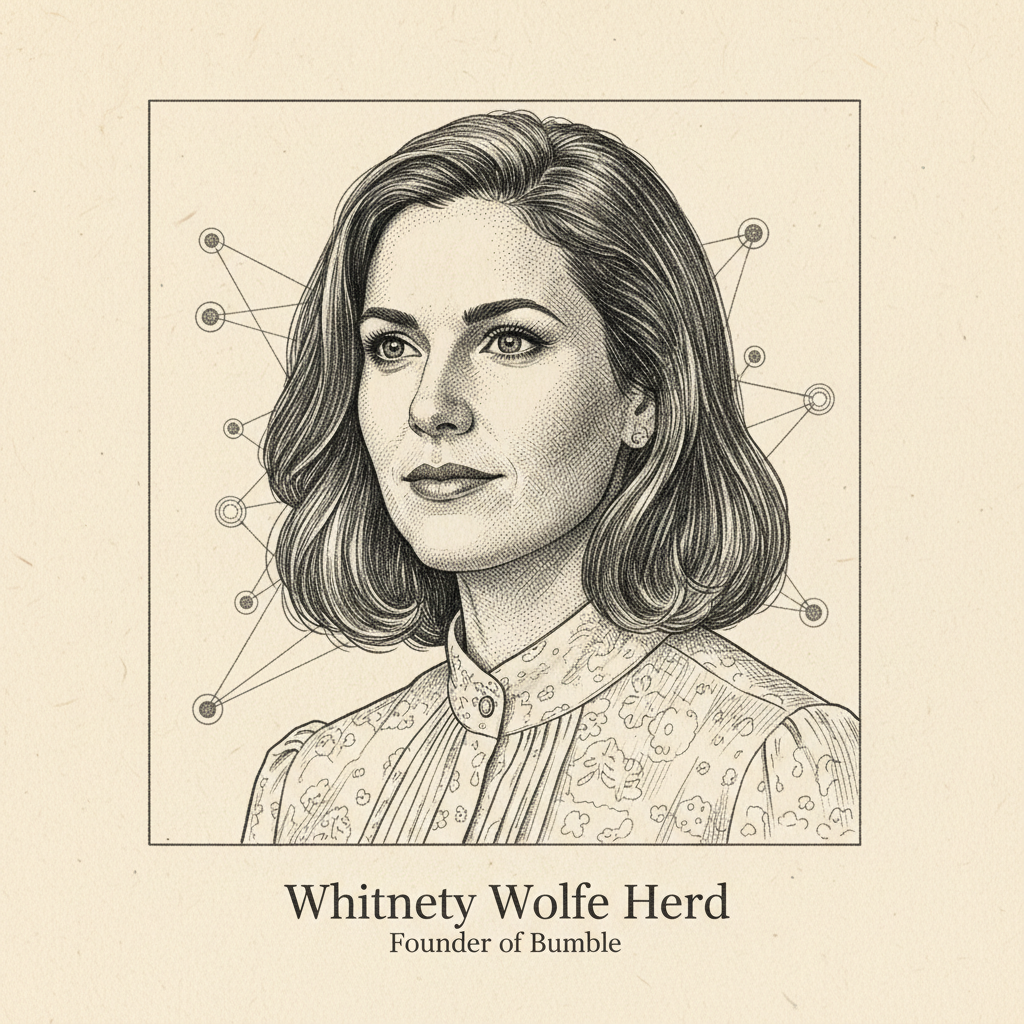
Whitney Wolfe Herd
Founder and former CEO of Bumble, Whitney Wolfe Herd revolutionized social networking by prioritizing women's safety and control.
Whitney Wolfe Herd is an American entrepreneur who founded Bumble, a dating and social networking app, in 2014. Previously, she was a co-founder of Tinder. She led Bumble to a successful IPO in 2021, becoming the youngest self-made female billionaire.
Biography
Accomplishments
- 01Co-founder and initial marketing lead for Tinder, launching the app in 2012 and popularizing its 'swipe' mechanic.
- 02Founded Bumble in 2014, securing early investment from Andrey Andreev, and rapidly scaling its user base by differentiating with a 'women-first' approach.
- 03Led Bumble Inc. to a successful IPO on NASDAQ (BMBL) in February 2021, achieving a market capitalization exceeding $13 billion.
- 04Expanded Bumble's offerings beyond dating to include Bumble BFF (friendship) and Bumble Bizz (professional networking).
- 05Transitioned from CEO to Executive Chair of Bumble Inc. in January 2024, maintaining strategic influence while bringing in new leadership.
- 06Became the youngest self-made female billionaire at the time of Bumble's IPO.
- 07Championed legislative efforts such as Texas House Bill 2779 (2019), making it a criminal offense to send unsolicited lewd images.
Lessons for Operators
Key Takeaways
Practical lessons distilled for operators, investors, C-levels, and capital allocators.
Problem-Oriented Innovation
Instead of merely iterating on existing solutions, identify deep-seated user problems (e.g., harassment, unsolicited messages) and build a product explicitly designed to mitigate them. This creates stronger value propositions and brand loyalty.
Mission-Driven Branding
A clear, compelling mission (e.g., 'creating a kinder internet') guides product development, marketing, and company culture. This attracts dedicated talent, loyal users, and differentiates in crowded markets.
Strategic Exit and Re-entry
Negative professional experiences can be reframed into opportunities for new ventures. Her departure from Tinder directly led to the creation of Bumble, leveraging lessons learned and a refined vision.
Empowerment as a Business Model
Building platforms that empower a specific demographic, often an underserved one, can unlock significant market potential and foster strong brand advocacy. Bumble's success proves empowerment can be a powerful economic driver.
Public Policy Advocacy as Ecosystem Building
Engaging in public policy (e.g., anti-dick-pic legislation) can extend a company's mission beyond its platform, enhance its brand reputation, and contribute to a safer environment for its users, indirectly boosting growth and trust.
Frameworks & Principles
Named frameworks and strategic principles they popularized or embodied.
The 'Women-First' Product Design
A product development philosophy where the user experience is intentionally designed to prioritize the safety, control, and empowerment of women, often by reversing traditional power dynamics.
When to useApplicable when building platforms or services in domains where women (or other historically disempowered groups) experience disproportionate friction, harassment, or lack of control (e.g., social media, e-commerce, ride-sharing).
Mission-Driven Value Proposition Canvas
A modification of the traditional Value Proposition Canvas, emphasizing how a company's core mission directly addresses customer pains and creates gains, beyond just functional features.
When to useUseful for startups and established companies seeking to differentiate in competitive markets by clearly articulating how their overarching purpose solves deeply felt customer needs and builds community, not just a product.
Ecosystem Expansion Strategy (Hub-and-Spoke Model)
Starting with a core product (the 'hub') and then extending into adjacent, complementary services (the 'spokes') that leverage the existing user base and brand trust to meet broader needs.
When to useEmploy when a core product has achieved significant market penetration and brand recognition, and there's an opportunity to diversify offerings by addressing related user needs or lifecycle stages (e.g., dating -> friendship -> professional networking).
Sources & Further Reading
Profiles, interviews, podcasts, and articles used to compile and verify this entry. Each link opens at the original publisher.
Explore Related Titans
Other figures in the archive who share Whitney Wolfe Herd's domain, geography, or era.
More in Technology










From United States


Contemporaries — born 1980s