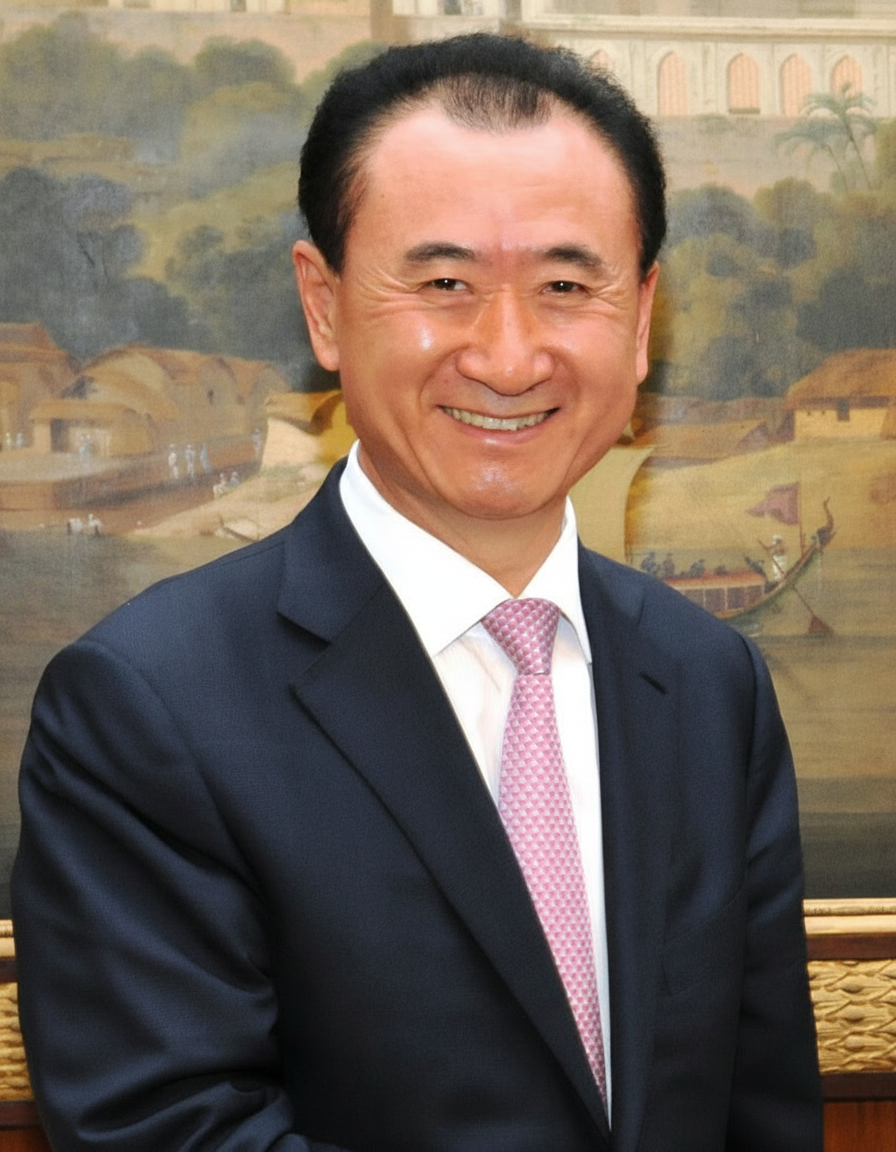
Wang Jianlin
The architect of Wanda Group's ascent and a pivotal figure in China's global commercial expansion.
Wang Jianlin, a former People's Liberation Army officer, founded Dalian Wanda Group in 1988, transforming it from a residential developer into a global diversified conglomerate with significant holdings in commercial real estate, entertainment, sports, and finance. His strategic acquisitions, particularly in Hollywood, aimed to extend China's cultural influence and diversify Wanda's revenue streams.
Biography
Accomplishments
- 01Pioneered the 'Wanda Plaza' integrated commercial property model, revolutionizing urban retail and leisure in China, establishing over 300 nationwide by the late 2010s.
- 02Acquired AMC Entertainment Holdings in 2012 for $2.6 billion, making Wanda the world's largest cinema operator.
- 03Led the acquisition of Legendary Entertainment in 2016 for $3.5 billion, representing a significant foray into Hollywood film production.
- 04Expanded Wanda's international presence with investments across diverse sectors including luxury yacht manufacturing (Sunseeker International), sports (Atlético Madrid stake), and tourism.
- 05Successfully navigated a government-mandated deleveraging period, divesting billions in overseas assets while preserving the core domestic commercial property business.
- 06Spearheaded Wanda's transition towards an 'asset-light' model, focusing on property management and intellectual property licensing rather than direct ownership of all assets.
Lessons for Operators
Key Takeaways
Practical lessons distilled for operators, investors, C-levels, and capital allocators.
Integrated Ecosystem Development
Wang's 'Wanda Plaza' model illustrates the power of creating self-contained, integrated ecosystems that address multiple consumer needs (retail, entertainment, residential). Operators should consider how to bundle services or products to increase stickiness and capture a larger share of customer spend.
Navigating Geopolitical & Regulatory Headwinds
Wanda's forced asset sales in 2017 serve as a stark reminder for investors and C-levels operating in sensitive markets: understand and rigorously model the impact of government policy shifts, especially concerning capital outflows and strategic industries. Diversify geographical and political risk exposure.
The 'Asset-Light' Transition
Wanda's shift towards property management and brand licensing demonstrates a move towards higher-margin, less capital-intensive business models. Enterprise leaders should evaluate opportunities to transition from asset ownership to service or IP licensing, particularly in mature or volatile sectors.
Resilience Through Divestment
Strategic divestment, even under duress, can be critical for corporate survival. Wang's ability to offload assets, albeit at reduced valuations, allowed Wanda to deleverage and refocus. Capital allocators should assess a company's agility in shedding non-performing or high-risk assets.
The Chinese Context of Big Business
The experiences of entrepreneurs in China, including those like Ye Xianyu (Forbes interview about family business resilience) and Huang Nubo (Forbes interview on real estate magnates), indicate that even successful private enterprises operate within tightly defined political and economic parameters. Understanding these nuances is paramount for investors and partners.
Frameworks & Principles
Named frameworks and strategic principles they popularized or embodied.
Ecosystem Business Model Canvas
Analyzes how different business units or offerings within a company create value for each other and the end-user, similar to Wanda Plaza's integrated approach. It maps customer segments, value propositions, channels, customer relationships, revenue streams, key resources, key activities, key partnerships, and cost structure within an interconnected ecosystem.
When to useWhen designing or evaluating multi-faceted business ventures that aim to capture a broader share of customer wallet by offering complementary services (e.g., real estate, retail, entertainment, and hospitality under one roof).
Political Economy Risk Assessment Matrix
A tool to systematically identify, assess, and prioritize political and economic risks (e.g., regulatory changes, capital controls, nationalization threats) in target markets. It involves evaluating risk likelihood and impact to develop mitigation strategies.
When to useEssential for C-levels and fund managers planning cross-border investments or operating in politically sensitive jurisdictions. Used to understand macro factors that could influence asset ownership, capital movement, and operational freedom.
Asset-Light Strategy Evaluation
Examines opportunities to reduce capital intensity and increase return on assets by moving from asset ownership to management, licensing, or franchise models. It considers the trade-offs between control, capital requirement, and scalability.
When to useFor enterprise leaders looking to optimize capital efficiency, divest non-core assets, or pivot business models in response to market changes or regulatory pressures, particularly in capital-intensive industries like real estate and manufacturing.
Recent Appearances
Latest interviews, keynotes, and press from the past half year.
 youtube.com
 youtube.com
 youtube.com
 youtube.com
 youtube.com
 youtube.com
 youtube.com
 youtube.com
Sources & Further Reading
Profiles, interviews, podcasts, and articles used to compile and verify this entry. Each link opens at the original publisher.
Explore Related Titans
Other figures in the archive who share Wang Jianlin's domain, geography, or era.
More in Technology








From China




Contemporaries — born 1950s