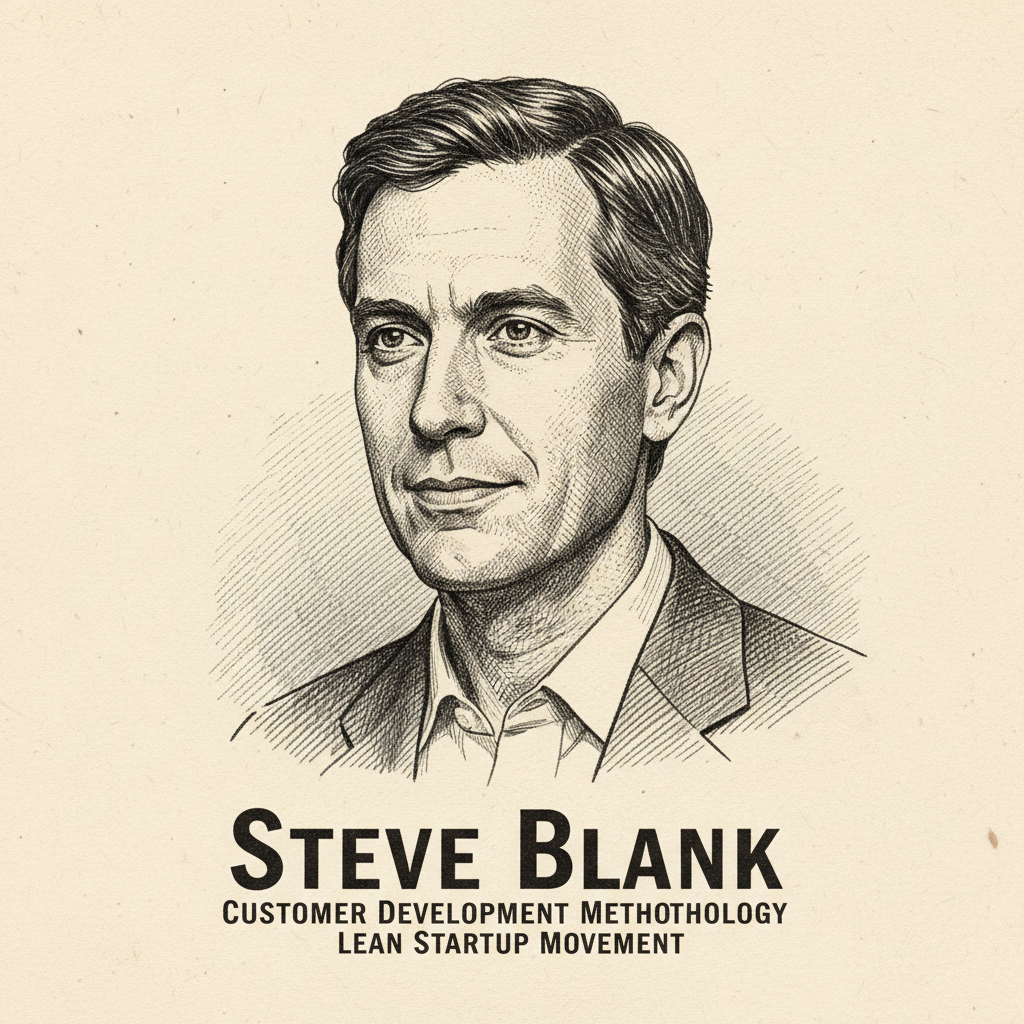
Steve Blank
The intellectual architect of the Lean Startup movement, reshaping entrepreneurship education and corporate innovation.
Steve Blank is a Silicon Valley serial entrepreneur, credited with developing the Customer Development methodology, which became the cornerstone of the Lean Startup movement. He has founded or worked in eight startups, including E.piphany, and is a distinguished academic at Stanford University, UC Berkeley, and Columbia University. His work has profoundly influenced modern entrepreneurship and corporate innovation practices globally.
Biography
Accomplishments
- 01Developed the Customer Development methodology, which underpins the Lean Startup movement, fundamentally altering how startups and large corporations approach product-market fit.
- 02Authored 'The Four Steps to the Epiphany' (2005), a foundational text in entrepreneurship that details the Customer Development process and emphasizes iterative product development and customer feedback.
- 03Co-founded or held senior roles in eight successful Silicon Valley startups, including E.piphany (co-founder, IPO 1999) and Zilog (early employee, IPO 1979), providing practical experience that informs his theoretical frameworks.
- 04Created and taught the 'Lean LaunchPad' course at Stanford, UC Berkeley, and Columbia, which was adopted by the National Science Foundation as the I-Corps program, training thousands of scientists and engineers in entrepreneurship.
- 05Influenced government and defense innovation through programs like Hacking for Defense and Hacking for Diplomacy, applying Lean Startup principles to national security challenges.
- 06Published 'The Startup Owner's Manual' (2012) with Bob Dorf, offering a comprehensive, step-by-step guide to building a successful startup using the Customer Development and Lean Startup methodologies.
Lessons for Operators
Key Takeaways
Practical lessons distilled for operators, investors, C-levels, and capital allocators.
Customer-Centricity is Paramount
Successful ventures don't start with a perfect product; they start with a deep understanding of customer problems. Investors and operators should demand evidence of rigorous customer discovery before significant capital allocation or product scaling.
Iterative Development Reduces Risk
The traditional linear 'plan and execute' model is ill-suited for uncertain environments. Adopting an iterative approach, characterized by Build-Measure-Learn cycles, dramatically de-risks product and market development by failing cheaply and learning quickly. This applies to both startups and internal corporate innovation.
Validation Over Intuition
Gut feelings are valuable, but concrete data from real customer interactions is indispensable. Enterprises and funds should establish metrics and processes for validating key business model assumptions through experiments, not just market research reports.
The Business Model Canvas as a Strategic Tool
Use frameworks like the Business Model Canvas (often taught alongside Blank's methods) to visually represent and test critical assumptions about customer segments, value propositions, channels, revenue streams, and cost structures. This facilitates strategic discussions and pivot decisions.
Innovation is a Manageable Process
Blank demonstrates that innovation, often perceived as chaotic, can be systematized. By applying his methodologies, organizations can create repeatable processes for discovering and validating new business opportunities, transforming innovation from an art into a discipline.
Frameworks & Principles
Named frameworks and strategic principles they popularized or embodied.
Customer Development Methodology
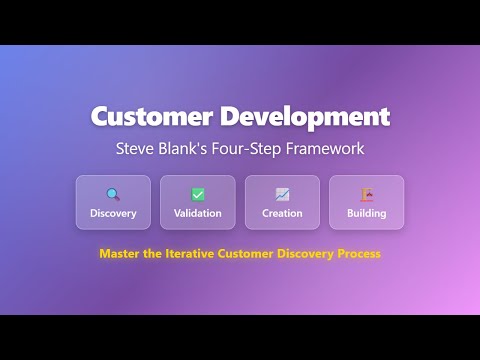
A four-step process (Customer Discovery, Customer Validation, Customer Creation, Company Building) designed to help entrepreneurs search for a repeatable and scalable business model by getting out of the office and talking to potential customers.
When to useEssential for any new venture (startup or corporate innovation project) in its earliest stages, before significant product development or scaling. Used to validate problem-solution fit and product-market fit.
Lean LaunchPad / I-Corps
An experiential learning course that teaches entrepreneurial teams (often scientists and engineers) to apply the Customer Development methodology. It emphasizes hands-on interviews with hundreds of customers and partners to validate or invalidate business hypotheses.
When to useIdeal for academics, researchers, or technical teams looking to commercialize novel technologies or ideas. Also applicable for corporate intrapreneurs launching new initiatives that require market validation.
Business Model Canvas (often used in conjunction with Blank's methods)
A visual chart with nine elements describing a firm's or product's value proposition, infrastructure, customers, and finances. It helps founders and executives visualize and test their business model hypotheses.
When to useUsed at the outset of any new business idea or innovation project to map out initial hypotheses about the business model. Continually refined as customer discovery and validation progresses.
Recent Appearances
Latest interviews, keynotes, and press from the past half year.
 youtube.com
 youtube.com
 youtube.com
 youtube.com
 youtube.com
 youtube.com
 youtube.com
 youtube.com
 youtube.com
 youtube.com
 youtube.com
 youtube.com
 youtube.com
 youtube.com
 youtube.com
 youtube.com
 youtube.com
 youtube.com
 youtube.com
 youtube.com
 youtube.com
 youtube.com
 youtube.com
 youtube.com
 youtube.com
 youtube.com
 youtube.com
Sources & Further Reading
Profiles, interviews, podcasts, and articles used to compile and verify this entry. Each link opens at the original publisher.
Explore Related Titans
Other figures in the archive who share Steve Blank's domain, geography, or era.
More in Technology










From United States




Contemporaries — born 1950s