Michael Corbat
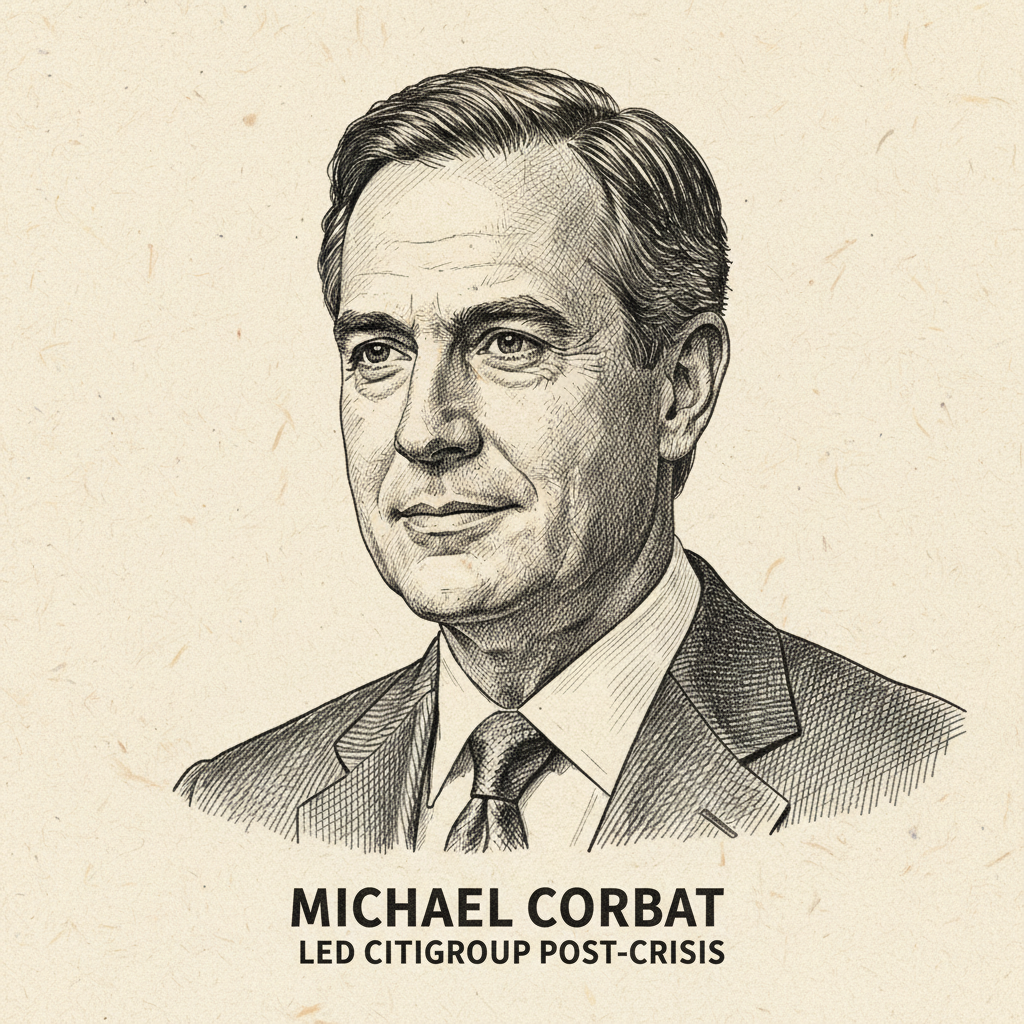
Michael Corbat: The Architect of Citi's Post-Crisis Simplification and Resilience
Michael Corbat served as CEO of Citigroup from 2012 to 2021, leading the bank through a critical post-financial crisis period focused on simplification, divestiture of non-core assets, and strengthening capital and regulatory compliance. His tenure was marked by a disciplined approach to risk management and a strategic pivot towards core banking services.
Biography
Accomplishments
- 01Successfully divested over 60 non-core businesses from Citi Holdings, reducing its assets from approximately $600 billion to under $50 billion and significantly simplifying the bank's structure (2012-2018).
- 02Improved Citigroup's Common Equity Tier 1 (CET1) capital ratio, exceeding regulatory requirements and enabling the return of over $80 billion in capital to shareholders through dividends and share repurchases between 2015 and 2019.
- 03Led Citigroup to successfully pass all Federal Reserve stress tests (CCAR) during his tenure, demonstrating robust capital adequacy and risk management capabilities (2013-2020).
- 04Streamlined operations and invested in technology, improving efficiency ratios and positioning Citi for long-term digital competitiveness, particularly in global payments and treasury services.
- 05Restored investor confidence and credit ratings by demonstrating consistent execution against strategic objectives and maintaining a clear focus on profitability and risk discipline.
- 06Established a culture of greater accountability and risk awareness, integrating regulatory compliance into the core operational framework of the global bank.
Lessons for Operators
Key Takeaways
Practical lessons distilled for operators, investors, C-levels, and capital allocators.
Divest to Thrive
Corbat's management of Citi Holdings illustrates that successful corporate restructuring often involves a decisive and methodical divestiture of non-core or sub-scale businesses, even if those assets were foundational in previous eras. This frees up capital and management attention for higher-return activities. Investors should analyze a company's willingness and ability to shed underperforming assets.
Capital as Foundation
His tenure underscored that in highly regulated industries, robust capital reserves are not merely compliance requirements but strategic assets that confer stability, enable shareholder returns, and provide flexibility during economic downturns. C-levels should treat capital planning as a core strategic function, not just a financial metric.
Discipline over Diversification
Corbat shifted Citi from a 'financial supermarket' model towards a more focused, disciplined global institutional and consumer bank with emphasis on its core competitive strengths. This approach prioritizes profitable, sustainable growth over expansive but diffuse operations. Fund managers should look for companies with clear strategic guardrails and a demonstrated ability to say 'no' to non-core opportunities.
Operational Resilience is Competitive Edge
The continuous investment in technology, risk management, and regulatory compliance under Corbat's leadership wasn't just about avoiding penalties; it built an operational resilience that became a distinct competitive advantage, particularly in times of market volatility. Enterprise leaders must view infrastructure and compliance investments as strategic enablers.
Long-Term Vision in Short-Term Markets
Corbat pursued a multi-year strategy of simplification and capital building during an era often fixated on quarterly results. This long-term commitment, despite initial investor impatience, ultimately delivered sustainable value. Capital allocators must evaluate leadership's capacity to execute multi-year strategic plans effectively.
Frameworks & Principles
Named frameworks and strategic principles they popularized or embodied.
Strategic Simplification via Divestiture
A methodical approach to identifying, isolating, and divesting non-core or underperforming assets to improve financial ratios, regulatory compliance, and strategic focus. Corbat effectively utilized this with Citi Holdings, transforming a collection of distressed and non-strategic assets into a significantly smaller, more manageable entity.
When to useApplicable when a conglomerate or diversified business has accumulated disparate assets, post-merger integration challenges, or when facing significant regulatory pressure to reduce complexity and risk. Useful for unlocking shareholder value from non-core operations.
Capital-Driven Strategic Planning
A framework where decisions regarding business lines, investment, and growth are primarily dictated by capital requirements, return on capital, and regulatory capital thresholds. Corbat's management was deeply informed by the imperative to strengthen Citi's CET1 ratio and pass stress tests, directly influencing which businesses received investment and which were de-emphasized.
When to useEssential for highly regulated industries (e.g., banking, insurance, utilities) or capital-intensive businesses. Useful for ensuring that growth initiatives align with financial stability and generate adequate risk-adjusted returns.
Client-Centric Core Business Reinforcement
Focusing resources and innovation on business segments where the company possesses a clear competitive advantage and a strong client base, rather than attempting to be excellent in all areas. Corbat emphasized Citi's competitive strengths in global payments, treasury services, and targeted consumer segments, leveraging its international network.
When to useEffective for established companies seeking to navigate competitive pressures or differentiate themselves. Useful for guiding resource allocation towards core competencies and moving away from marginal ventures. Promotes sustainable growth through specialized value creation.
Sources & Further Reading
Profiles, interviews, podcasts, and articles used to compile and verify this entry. Each link opens at the original publisher.
Explore Related Titans
Other figures in the archive who share Michael Corbat's domain, geography, or era.
More in Finance & Investing








From United States





Contemporaries — born 1960s