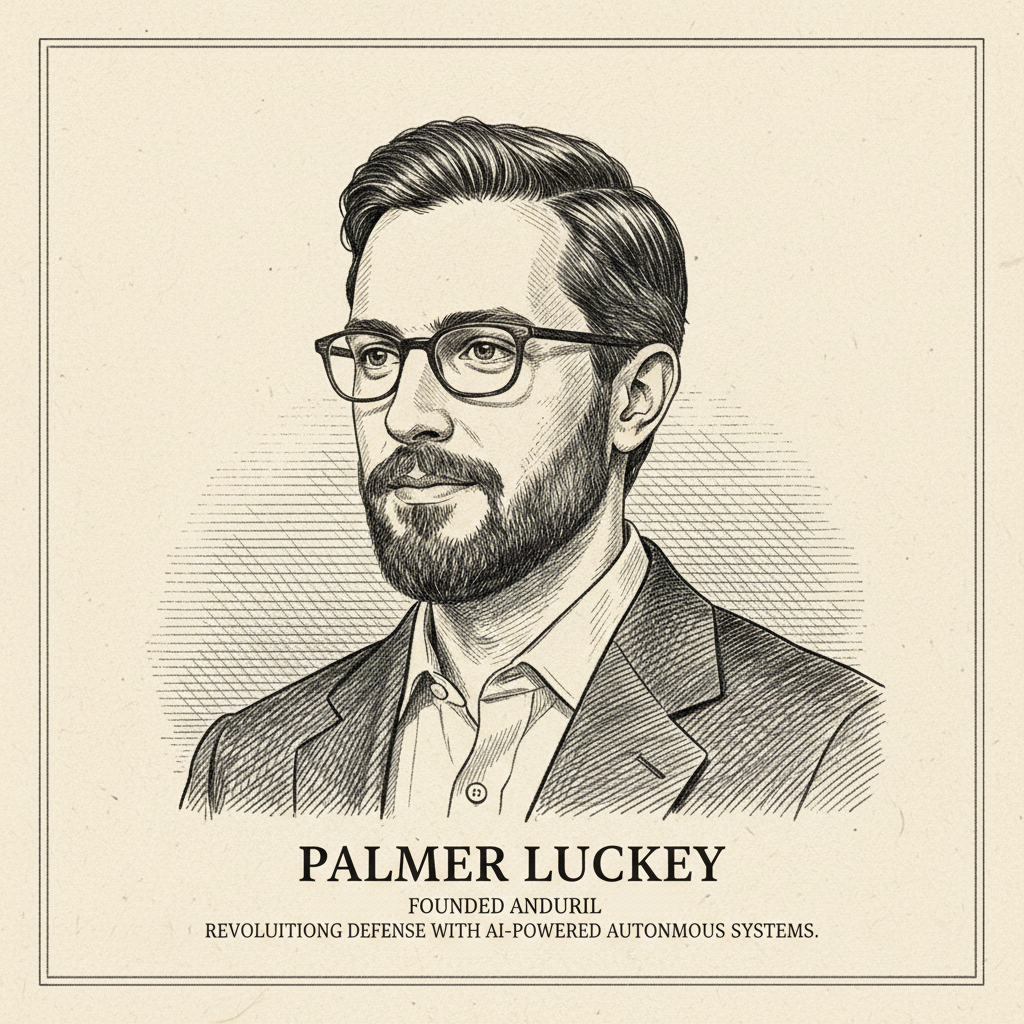
Palmer Luckey
Visionary founder who commercialized virtual reality (Oculus VR) and revolutionized defense technology (Anduril Industries), demonstrating a consistent ability to identify and scale disruptive hardware-software solutions.
Palmer Luckey is an American entrepreneur best known for founding Oculus VR, which developed the Oculus Rift virtual reality headset and was acquired by Facebook for $2 billion in 2014. Following his departure from Facebook, he founded Anduril Industries in 2017, a defense technology company focused on autonomous systems and AI-powered defense infrastructure.
Biography
Accomplishments
- 01Co-founded Oculus VR and developed the Oculus Rift, pioneering modern consumer virtual reality technology in 2012.
- 02Successfully raised over $2.4 million via Kickstarter for Oculus Rift, demonstrating early market validation for advanced VR.
- 03Negotiated and completed the acquisition of Oculus VR by Facebook for approximately $2 billion in March 2014.
- 04Founded Anduril Industries in 2017, rapidly scaling it into a multi-billion dollar valuation defense technology firm.
- 05Secured substantial defense contracts for Anduril Industries, including with the U.S. Department of Defense and U.S. Border Patrol, by integrating AI and autonomous systems.
- 06Successfully challenged incumbents in two established industries (consumer electronics and defense) by introducing disruptive hardware-software platforms.
Lessons for Operators
Key Takeaways
Practical lessons distilled for operators, investors, C-levels, and capital allocators.
Disrupt from First Principles
Luckey re-imagined VR from the ground up, focusing on critical performance metrics (low latency, wide FOV) that existing solutions failed to deliver at scale. His approach to defense with Anduril also bypassed traditional procurement cycles by offering ready-to-deploy, AI-driven solutions.
Strategic Exits to Accelerate Vision
The sale of Oculus to Facebook provided the capital and scale necessary to bring VR to the mass market, a feat difficult for a startup alone. This highlights a willingness to partner strategically, even if it means ceding some control, for broader impact.
Hardware as a Differentiator
In an increasingly software-focused world, both Oculus and Anduril underscore the power of integrating novel hardware with advanced software to create genuinely differentiated products and services. This creates higher barriers to entry for competitors.
Adaptability in Entrepreneurship
His transition from consumer VR to defense showcases the ability to pivot sectors, applying core entrepreneurial and technical competencies to new, high-impact markets. This adaptability is critical for sustained value creation.
Regulatory Acuity in High-Growth Sectors
Operating in defense, Anduril navigates complex government contracts and security requirements, a significant departure from consumer tech. This demonstrates careful consideration of industry-specific regulatory environments.
Frameworks & Principles
Named frameworks and strategic principles they popularized or embodied.
Full-Stack Vertical Integration
Develop and control every critical layer of your product, from core hardware components to software, AI, and even deployment/service. This ensures optimal performance and a seamless user experience.
When to useApplicable when hardware performance is paramount, intellectual property protection is crucial, or existing solutions lack integration quality. Ideal for complex systems where vertical control reduces dependencies and optimizes the entire ecosystem (e.g., aerospace, robotics, specialized computing).
Bottom-Up Market Validation
Instead of relying solely on market research, build a functional prototype and use grassroots efforts (e.g., crowdfunding, developer kits, early access programs) to gauge genuine customer interest and iterate based on direct user feedback.
When to useEffective for disruptive technologies, consumer hardware, or niche markets where traditional market analysis might underestimate demand. Useful for de-risking investor capital by demonstrating tangible user engagement and demand.
Dual-Use Technology Strategy
Develop technology with potential applications in both commercial and defense/government sectors. This can diversify revenue streams, leverage R&D investments across multiple markets, and increase total addressable market.
When to useSuitable for companies in AI, robotics, advanced materials, cybersecurity, and surveillance where underlying technologies have broad applicability. Requires careful navigation of ethical considerations and differing regulatory environments.
Sources & Further Reading
Profiles, interviews, podcasts, and articles used to compile and verify this entry. Each link opens at the original publisher.
Explore Related Titans
Other figures in the archive who share Palmer Luckey's domain, geography, or era.
More in Technology









From United States




Contemporaries — born 1990s