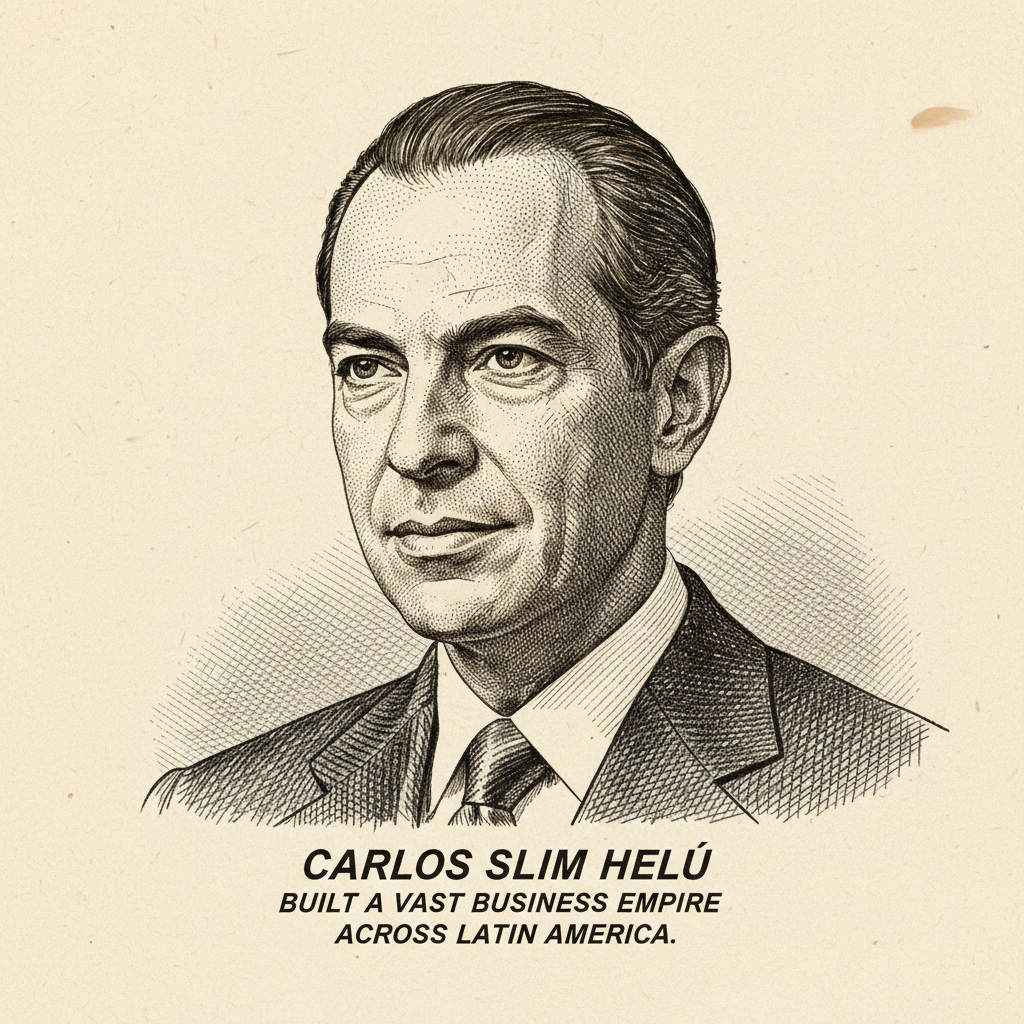
Carlos Slim Helú
The architect of Latin American telecommunications dominance and a master of diversified, counter-cyclical investment.
Carlos Slim Helú is a Mexican business magnate and philanthropist. He built his fortune through a diversified portfolio of companies, primarily Grupo Carso, S.A.B. de C.V., and América Móvil, S.A.B. de C.V. He is best known for his strategic acquisition and revitalization of Telmex, transforming it into a telecommunications powerhouse across Latin America.
Biography
Accomplishments
- 01Acquisition and revitalization of Telmex in 1990, transforming it from a state-owned monopoly into a highly profitable, privately-run telecommunications giant.
- 02Establishment and expansion of América Móvil, S.A.B. de C.V., which became one of the largest mobile network operators in the world by subscribers, dominating markets across Latin America.
- 03Strategic diversification of investments across multiple sectors including retail (e.g., Grupo Sanborns, Sears Mexico), finance (e.g., Grupo Financiero Inbursa), construction, and manufacturing through Grupo Carso.
- 04Successfully leveraged periods of economic instability in Mexico (e.g., 1980s debt crises, 1994 peso crisis) to acquire undervalued assets and build a diversified portfolio.
- 05Maintained and expanded a significant business presence in the United States through holdings in companies like The New York Times Company.
- 06Consistently ranked among the world's wealthiest individuals, often holding the top position, demonstrating sustained success in wealth creation and business leadership.
Lessons for Operators
Key Takeaways
Practical lessons distilled for operators, investors, C-levels, and capital allocators.
Opportunistic Acquisition in Distress
Slim's strategy involved acquiring companies during periods of economic downturn or distress, often at attractive valuations. This contrarian approach requires significant capital, risk tolerance, and a long-term perspective. For operators, this means preparing for downturns by building liquidity and identifying potential acquisition targets. For investors, it reinforces the value of patience and conviction during market corrections.
Mastery of Essential Utilities
His primary successes stem from dominating essential services like telecommunications. These industries often have high barriers to entry, predictable revenue streams, and can become natural monopolies or oligopolies. Enterprises should evaluate if their offering provides a fundamental, indispensable service that can capture sustained market share. Investors should favor businesses with strong competitive moats in essential sectors.
Operational Rigor and Cash Flow Focus
Slim's companies are characterized by meticulous cost control, efficient operations, and a strong emphasis on generating robust cash flow. This allows for self-funded growth and reduced reliance on external capital. C-levels should instill a culture of operational excellence and cash management. Fund managers should prioritize companies demonstrating consistent free cash flow generation and prudent capital allocation.
Strategic Diversification
While telecommunications is his core, Slim's broader empire in Grupo Carso spans retail, finance, construction, and mining. This diversification acts as a hedge against sector-specific risks and economic cycles. Operators should explore synergistic diversification when core business strengths allow. Capital allocators should seek out diversified conglomerates that demonstrate discipline and value creation across their various holdings.
Long-Term Value Creation
Slim's investment horizon is notably long-term, focusing on building sustainable businesses rather than short-term gains. This patient approach allows for strategic investments in infrastructure and market development that yield significant returns over decades. Leaders should resist pressures for quarterly performance if it compromises long-term strategic goals. Investors should align with management teams that prioritize long-term shareholder value.
Frameworks & Principles
Named frameworks and strategic principles they popularized or embodied.
Contrarian Investing
A strategy involving investing against prevailing market trends, often buying assets when they are out of favor or in distress, and selling when they become popular and overvalued. Slim applied this extensively during Mexico's economic crises.
When to useWhen markets are in panic or a specific sector/country faces temporary but addressable challenges. Requires deep fundamental analysis, strong balance sheet, and emotional discipline to go against the crowd.
Moat-Building (Economic Moats)
Focusing on businesses that possess sustainable competitive advantages (e.g., network effects, cost advantages, high switching costs, intangible assets like brand or patents) that protect long-term profits and market share. Telmex/América Móvil's network infrastructure and scale exemplify this.
When to useWhen evaluating potential investments or designing business strategy, prioritize industries and companies with strong, defensible moats to ensure long-term profitability and market leadership. Critical for capital-intensive industries.
Conglomerate Structure & Cross-Sector Synergy
Operating a diversified group of businesses across multiple, often unrelated, sectors under a single corporate umbrella. This can provide resilience and allow for cross-pollination of resources or expertise, although it can also introduce complexity.
When to useWhen seeking to deploy capital across different economic cycles, mitigate industry-specific risks, or leverage a strong centralized management team and financial resources across varied ventures. Requires disciplined capital allocation and decentralized operational expertise.
Recent Appearances
Latest interviews, keynotes, and press from the past half year.
 youtube.com
 youtube.com
 youtube.com
 youtube.com
 youtube.com
 youtube.com
 youtube.com
 youtube.com
 youtube.com
 youtube.com
 youtube.com
 youtube.com
 youtube.com
 youtube.com
 youtube.com
 youtube.com
 youtube.com
 youtube.com
 youtube.com
 youtube.com
 youtube.com
 youtube.com
 youtube.com
 youtube.com
 youtube.com
 youtube.com
 youtube.com
Sources & Further Reading
Profiles, interviews, podcasts, and articles used to compile and verify this entry. Each link opens at the original publisher.
Explore Related Titans
Other figures in the archive who share Carlos Slim Helú's domain, geography, or era.
More in Technology










From Mexico



Contemporaries — born 1940s