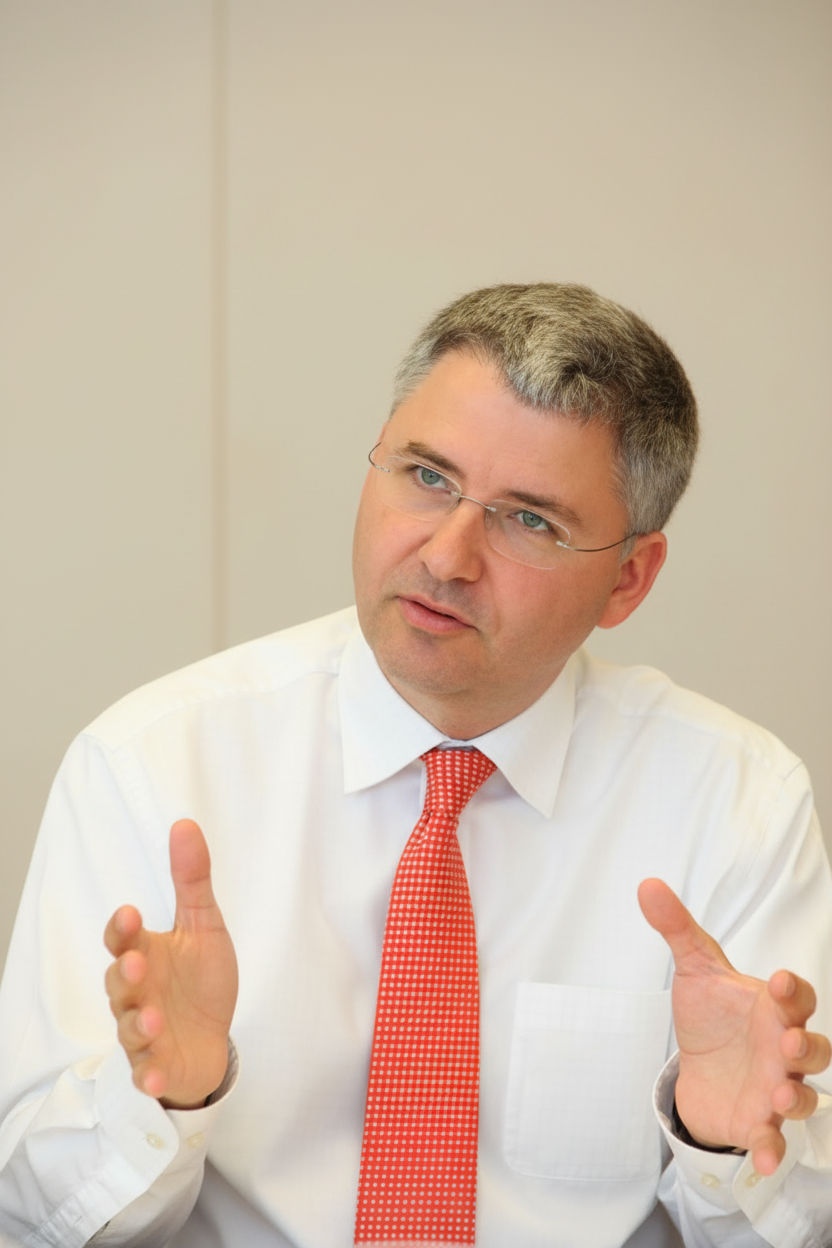
Thomas Caulfield
Architect of GlobalFoundries' resurgence, transforming a struggling foundry into a leading specialty semiconductor manufacturer and publicly traded entity.
Thomas Caulfield transformed GlobalFoundries from a financially challenged, general-purpose foundry into a focused, profitable, and publicly traded specialty semiconductor manufacturer. His leadership pivoted the company from competing directly with industry giants to carving out a niche in high-growth, differentiated technologies, culminating in a successful IPO.
Biography
Accomplishments
- 01Orchestrated the strategic pivot of GlobalFoundries in 2018, abandoning 7nm and smaller node development to focus on specialty process technologies, which proved crucial for financial viability and market differentiation.
- 02Led GlobalFoundries to a successful Initial Public Offering (IPO) on Nasdaq in October 2021 (NASDAQ: GFS), raising approximately $2.6 billion and demonstrating strong investor confidence in its renewed strategy.
- 03Improved GlobalFoundries' financial performance, turning it from a high-loss, capital-intensive operation into a profitable entity through strategic divestitures and a disciplined capital allocation strategy.
- 04Secured significant long-term supply agreements with major customers globally, providing revenue stability and justifying capacity expansions in key regions like the U.S. and Europe.
- 05Streamlined operations and product portfolio through strategic divestitures, including the ASIC business to Marvell Technology Group and its 300mm fab in Singapore to Vanguard International Semiconductor Corporation (VIS).
- 06Navigated the company through complex geopolitical and supply chain dynamics, solidifying its position as a critical player in semiconductor supply chain resilience.
Lessons for Operators
Key Takeaways
Practical lessons distilled for operators, investors, C-levels, and capital allocators.
Don't Be Afraid to Pivot Aggressively
GlobalFoundries' decision to stop leading-edge development (7nm and below) was a stark admission that competing with TSMC and Samsung on that front was unsustainable. This pivot to specialty processes for high-growth markets like automotive and IoT was instrumental in its turnaround. Leaders should be prepared to make bold, counter-intuitive strategic shifts when current paths are clearly unsustainable, regardless of internal or external pressure.
Identify and Dominate Your Niche
Instead of being a generalist struggling against giants, Caulfield focused GlobalFoundries on specialty process technologies where it had an advantage and where demand was strong and underserved. This created a defensible competitive position. Businesses should rigorously analyze their core competencies and market landscape to identify niches where they can be market leaders rather than fighting unwinnable wars.
Operational Rigor Drives Financial Health
Caulfield's deep operational background enabled him to optimize manufacturing, improve yields, and control CapEx. This focus on efficiency and execution directly contributed to the company's return to profitability and attractiveness to investors. C-levels and fund managers should prioritize leaders with strong operational experience, especially in capital-intensive industries, as effective execution translates directly to bottom-line results.
Strategic Divestitures Enhance Value
Selling off non-core or loss-making assets, such as the ASIC business and a 300mm fab, allowed GlobalFoundries to focus resources, improve profitability, and strengthen its balance sheet. Companies should regularly evaluate their portfolio for assets that no longer align with the core strategy or drag down overall performance, and be willing to shed them to create greater shareholder value.
Long-Term Partnerships Stabilize Growth
Securing long-term supply agreements with key customers has been a cornerstone of GlobalFoundries' strategy post-pivot. These agreements provide revenue predictability, de-risk large capital investments, and foster deeper customer relationships. For capital allocators and enterprise leaders, seeking stable, foundational customer relationships can significantly de-risk business models and provide a clear path for sustainable growth.
IPO as a Validation and Funding Mechanism
The successful IPO of GlobalFoundries in 2021 was a testament to the renewed investor confidence in Caulfield's strategic direction and execution. It provided capital for future growth and validated the turnaround efforts. For businesses and investors, an IPO can serve not just as an exit strategy, but as a critical mechanism to fuel expansion, gain market legitimacy, and unlock further value-creation opportunities, provided the underlying strategy is sound and executable.
Frameworks & Principles
Named frameworks and strategic principles they popularized or embodied.
Strategic Niche Identification (Porter's Generic Strategies Adaptation)
This framework, an adaptation of Porter's Generic Strategies, emphasizes finding a specific, underserved segment within a broader industry and tailoring capabilities to dominate it, rather than broad differentiation or cost leadership against entrenched giants. Caulfield applied this by exiting the leading-edge foundry race and focusing on specialty mature nodes.
When to useWhen operating in a highly competitive or commoditized industry where direct competition against market leaders is unsustainable. Useful for companies seeking to redefine their value proposition and secure a defensible market position.
Portfolio Rationalization & Capital Allocation
This involves a rigorous review of all business units and assets to identify those that align with the core strategic direction and those that do not. Non-strategic or underperforming assets are divested, and capital is reallocated to high-growth, high-return areas. Caulfield divested non-core assets (e.g., ASIC, Singapore fab) to focus capital on strategic mature node expansion.
When to useFor companies facing financial distress, needing to improve profitability, or seeking to sharpen their strategic focus. Also applicable for private equity or fund managers evaluating investment portfolios for optimal resource deployment.
Operational Turnaround Methodology
A methodical approach to identifying operational inefficiencies, streamlining processes, improving yield rates, and reducing costs. It often involves instilling a culture of continuous improvement and data-driven decision-making. Caulfield's strong operational background was critical in executing this at GlobalFoundries, dramatically improving their fab performance.
When to useApplicable to any business unit or company experiencing declining performance, high operational costs, or needing to enhance productivity and efficiency. Essential for manufacturing-intensive industries.
Explore Related Titans
Other figures in the archive who share Thomas Caulfield's domain, geography, or era.
More in Technology








From United States



Contemporaries — born 1960s